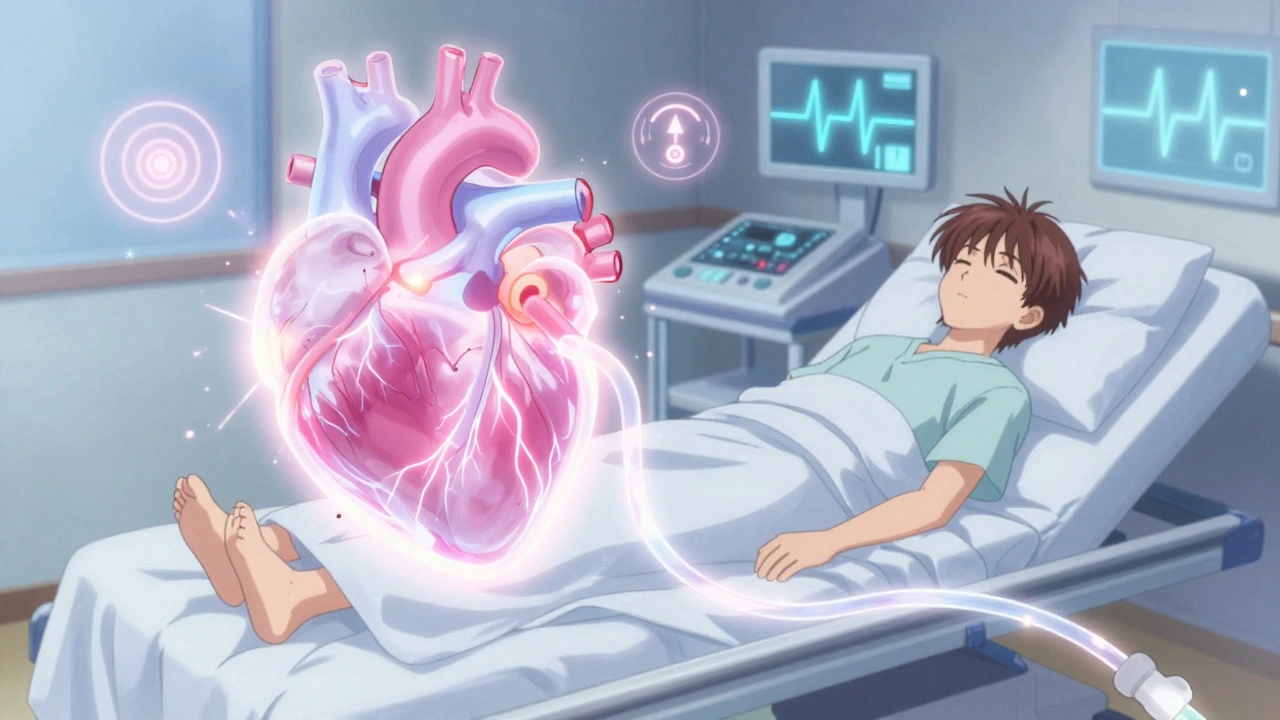
When your heart skips, races, or flutters out of rhythm, it’s not just annoying-it can be dangerous. Arrhythmias like atrial fibrillation (AF) affect over 33 million people worldwide, and for many, medications alone don’t cut it. That’s where catheter ablation and device therapy come in. These aren’t experimental treatments-they’re proven, widely used, and often life-changing.
What Is Catheter Ablation?
Catheter ablation is a minimally invasive procedure that fixes faulty electrical signals in the heart. A thin, flexible tube (a catheter) is threaded through a vein in your groin or neck up to your heart. Once in place, it delivers energy-either heat (radiofrequency) or extreme cold (cryoablation)-to destroy tiny areas of tissue causing the irregular rhythm. This isn’t open-heart surgery. You’re usually awake but sedated. Most people go home the same day or the next. The goal? To stop the abnormal signals before they start. For atrial fibrillation, the most common target is the pulmonary veins, where faulty signals often begin. The standard approach, called pulmonary vein isolation (PVI), creates a ring of scar tissue around these veins to block the erratic impulses.How Effective Is It?
Studies show catheter ablation beats medication for rhythm control. In one large analysis of nearly 1,800 patients, ablation reduced the chance of AF returning by 58% compared to drugs alone. For patients with heart failure and AF, the benefits are even clearer: ablation improved heart function, increased walking distance, and cut mortality risk by nearly half. One 2023 study found patients who had ablation had far less AF burden-0% to 3% compared to 15% to 46% in those on meds. That’s not just a number. It means fewer hospital visits, less anxiety, and the ability to return to activities like cycling, swimming, or even working long shifts without fear of a sudden episode.Types of Ablation Energy
Not all ablation is the same. The two main types are radiofrequency and cryoablation. Radiofrequency ablation uses heat to burn tissue. Newer catheters, like the THERMOCOOL SMARTTOOTH a contact-force sensing catheter that measures how well the tip touches heart tissue, include sensors that track pressure, power, and time. This combo, called the Ablation Index, helps doctors create deeper, more lasting scars. Studies show this reduces recurrence by 12-15% compared to older catheters. Cryoablation freezes tissue using a balloon inflated inside the pulmonary veins. It’s faster-often under two hours-and has a shorter learning curve for doctors. But it carries a small risk of injuring the phrenic nerve, which controls the diaphragm. That’s why specialists monitor nerve function during the procedure. There’s also a newer option: pulsed field ablation (PFA). Approved in late 2023, it uses electrical pulses instead of heat or cold. It’s precise, fast (about 76 minutes on average), and doesn’t damage nearby structures like the esophagus. Early results show 86% freedom from AF at one year.When Is Device Therapy Used?
Not all arrhythmias can be fixed with ablation. For some, especially those with slow heart rates or high risk of dangerous rhythms like ventricular tachycardia, doctors turn to implanted devices. Pacemakers are for slow rhythms. They send tiny electrical pulses to keep the heart beating regularly. Implantable cardioverter-defibrillators (ICDs) are for fast, life-threatening rhythms. If your heart goes into a dangerous rhythm, the ICD delivers a shock to reset it-like a built-in emergency response system. For patients with heart failure and irregular rhythms, a special device called a cardiac resynchronization therapy (CRT) device can help the heart pump more efficiently. It’s often combined with an ICD (called a CRT-D) and has been shown to reduce hospitalizations and improve survival.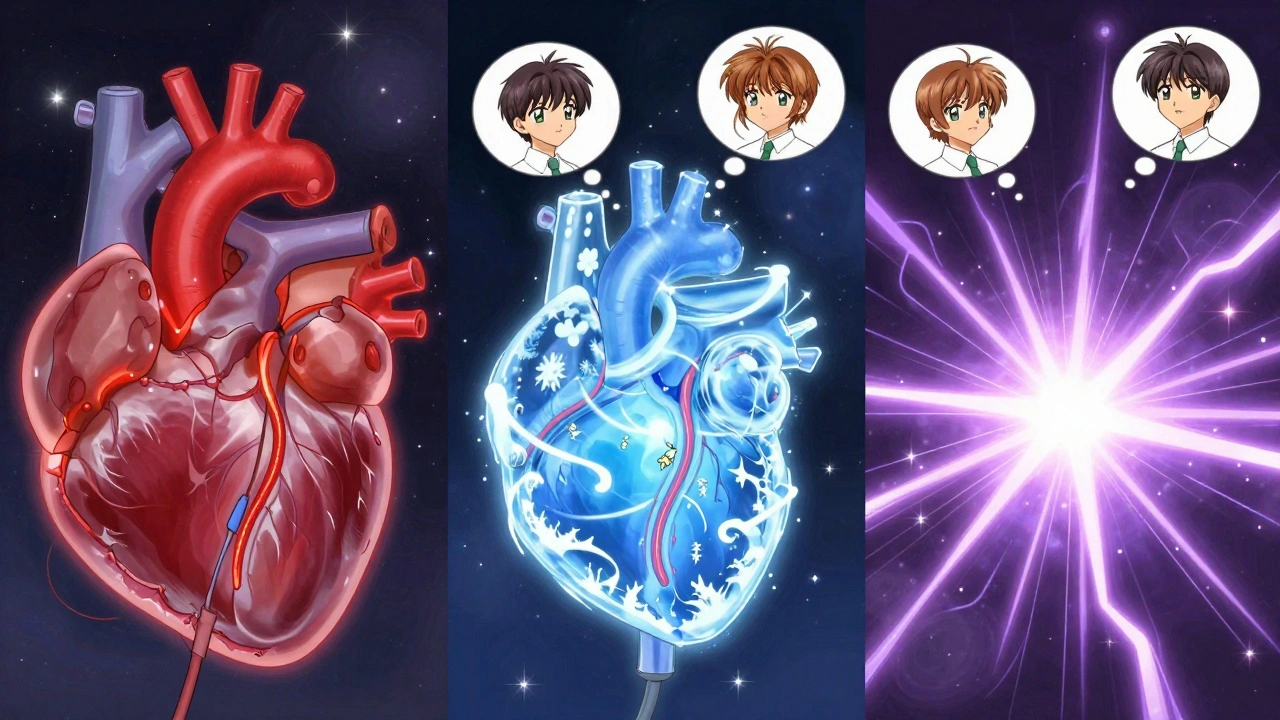
Comparing Ablation Technologies
| Technology | Average Procedure Time | 12-Month Success Rate | Key Advantages | Key Risks |
|---|---|---|---|---|
| Radiofrequency with Contact Force (THERMOCOOL SMARTTOUCH) | 150-180 minutes | 71% | Most effective for complex cases, precise lesion control | Cardiac tamponade (1.2%), esophageal injury (rare) |
| Cryoablation (Arctic Front Advance) | 90-120 minutes | 65% | Faster, easier for pulmonary vein isolation | Phrenic nerve injury (1.5-3%), slower lesion formation |
| Pulsed Field Ablation (Farapulse) | 76 minutes | 86% | Minimal collateral damage, no heat/cold, faster recovery | Long-term data still limited |
| First-gen Radiofrequency (no contact force) | 160-190 minutes | 58% | Widely available | Higher recurrence, longer procedure, more fluoroscopy |
Who Benefits Most?
Catheter ablation isn’t for everyone. Guidelines recommend it as a first-line option for people with paroxysmal AF who’ve tried at least one antiarrhythmic drug without success. For those with persistent AF and heart failure, the evidence is even stronger. Patients with severe symptoms-palpitations, fatigue, shortness of breath-often see the biggest quality-of-life improvements. One Reddit user, after two ablations with contact force technology, said: “I went from daily palpitations to zero episodes in nine months. The mental relief is as valuable as the physical.” But success depends on the center’s experience. Doctors need at least 50-75 procedures to become proficient with radiofrequency ablation. Cryoablation has a shorter learning curve-20-30 procedures. That’s why choosing a high-volume center matters.Cost and Accessibility
Ablation isn’t cheap. In the U.S., the average cost is $16,000-$21,000. But over time, it saves money. Patients on meds often end up in the hospital more frequently. After 3-8 years, ablation pays for itself through fewer ER visits and less medication. Reimbursement varies. Medicare covers about $18,500 per procedure. In Europe, it’s €12,000-€15,000. But access isn’t equal. Rural areas have 60% fewer ablation centers than cities. If you’re in a remote area, you might need to travel for care.What to Expect After the Procedure
Recovery is usually quick. Most people walk the same day. You’ll feel soreness at the catheter insertion site for a few days. Some report mild chest discomfort or skipped beats for a few weeks-that’s normal as the heart heals. You’ll likely stay on blood thinners for at least two months, even if your rhythm is back to normal. Antiarrhythmic drugs might be continued temporarily. Full healing takes about three months. Follow-up is key. You’ll have ECGs, Holter monitors, and sometimes remote device checks. Recurrence is highest in the first three months. If AF comes back, a second ablation often works well.
Real Stories, Real Results
John M., 58, had persistent AF for six years. Medications made him dizzy and tired. After cryoablation in March 2022, he was AF-free within weeks. He stopped all his heart meds and returned to competitive cycling within three months. Another patient, a nurse in her 60s, had been terrified to sleep on her left side because her heart would race. After radiofrequency ablation with contact force, she said: “I haven’t had a single episode in 14 months. I sleep like a baby now.” Not everyone has a perfect outcome. About 8% experience major complications-bleeding, infection, or damage to heart tissue. But the risk of stroke or death from untreated AF is far higher.What’s Next?
The future of arrhythmia treatment is moving fast. Pulsed field ablation is gaining traction. AI tools that analyze heart maps in real time are coming in 2025. Some centers are testing wearable sensors that predict arrhythmias before they happen. By 2030, experts predict catheter ablation will become the first-line treatment for all symptomatic AF patients-not just those who fail meds. That’s how strong the evidence has become.Frequently Asked Questions
Is catheter ablation a cure for atrial fibrillation?
It’s not always a permanent cure, but it’s the most effective way to control AF long-term. About 70% of patients with paroxysmal AF stay free of symptoms after one procedure. For persistent AF, success rates are lower, around 60-65%, but many still see big improvements. A second ablation often boosts success to 80% or higher.
Can I stop taking blood thinners after ablation?
Not right away. Even if your rhythm is normal, the risk of stroke remains elevated for at least two months. Your doctor will use a scoring system (like CHA₂DS₂-VASc) to decide if you need to keep taking them long-term. Some patients with low stroke risk can stop after 3-6 months if they stay in rhythm.
How do I know if I’m a good candidate for ablation?
If you have symptoms like palpitations, fatigue, or shortness of breath from AF-and medications haven’t helped or caused side effects-you’re likely a good candidate. If you also have heart failure, ablation may improve your survival. A cardiologist or electrophysiologist can review your ECG, echo, and medical history to decide.
What’s the difference between a pacemaker and an ICD?
A pacemaker treats slow heart rates by sending small pulses to keep your heart beating regularly. An ICD treats fast, dangerous rhythms by delivering a shock to reset the heart. Some devices do both-called CRT-Ds-and are used for heart failure patients with rhythm problems.
How long does recovery take after ablation?
Most people return to light activities in 2-3 days. Avoid heavy lifting or strenuous exercise for about a week. Full healing takes 3 months. You might feel extra heartbeats or fatigue during that time-it’s normal. Follow-up tests will show if the ablation worked.
Are there alternatives to ablation and devices?
Yes-medications like beta-blockers or antiarrhythmics. But they often have side effects and don’t stop AF from returning. For many, ablation offers better symptom control with fewer long-term risks. Lifestyle changes (weight loss, sleep apnea treatment, limiting alcohol) can help too, but they’re usually used alongside, not instead of, medical treatment.
Ashley Farmer
December 6, 2025 AT 22:11Just wanted to say how much this post helped me understand what’s actually going on with my heart. I’ve been scared to even ask my doctor about ablation, but now I feel like I can walk in with real questions. Thank you for breaking it down without the jargon overload.
Also, the part about sleeping on your left side? I’ve been avoiding it for years. Now I know it’s not just ‘in my head.’
Nicholas Heer
December 8, 2025 AT 16:23LOL they’re just trying to get you hooked on $20k procedures so Big Pharma can keep selling you meds. You know the FDA gets paid by the hospitals right? They approved PFA because the CEO’s son works at Farapulse. Cryoablation? That’s just a fancy ice pack with a $100K price tag. I’ve been researching this for 3 years and I’m 100% sure this is all a scam to drain your 401k.
Also, why do they never talk about how many people get nerve damage? They bury it in the fine print. #StopTheAblationScam
Louis Llaine
December 9, 2025 AT 04:46So let me get this straight - you’re telling me I can pay $20k to feel slightly less like a broken washing machine… and the ‘cure’ is still only 70%? Sounds like a really expensive gym membership for your heart.
Also, ‘pulsed field ablation’? Sounds like a Tesla feature. Next they’ll sell us ablation as a subscription service. ‘Your monthly AF fix: $199.’
Sangram Lavte
December 10, 2025 AT 23:09As someone from India, I’ve seen how expensive this is. Even in private hospitals here, ablation costs 12-15 lakhs INR. Most people just live with it because they can’t afford it. The tech is amazing, but access? Not even close to equal.
And yes, rural areas - forget it. My uncle had AF for 8 years. He never even saw an electrophysiologist. Just pills and prayers.
Olivia Hand
December 12, 2025 AT 11:17Interesting how they frame ablation as ‘life-changing’ but barely mention the psychological toll of waiting for it - the anxiety, the ‘will it work?’ dread, the guilt if it doesn’t. I had mine last year. The physical recovery was easy. The mental reset? Took six months.
Also, the phrase ‘you don’t have to live with a racing heart anymore’ - that’s the kind of language that makes people think it’s a magic bullet. It’s not. It’s a tool. And tools need context.
Jane Quitain
December 14, 2025 AT 05:04OMG I JUST HAD MY FIRST ABLATION AND I’M SO HAPPY 😭 I went from 3 panic attacks a day to zero! My cardiologist used the THERMOCOOL SMARTTOOTH and it felt like a miracle! I’m back hiking, dancing, even cooking without checking my pulse every 5 minutes! This post made me feel seen!! 🙌❤️
Ernie Blevins
December 15, 2025 AT 17:47So you’re telling me this $20k procedure has a 30% failure rate and you still call it ‘life-changing’? What’s next? Paying $10k to fix a leaky faucet and calling it ‘home improvement’? This is just corporate medicine selling hope as a product.
And the ‘success rates’? They count anyone who doesn’t have AF for 3 months as ‘cured.’ What about the 50% who get it back in 2 years? Nobody talks about that.
Sadie Nastor
December 17, 2025 AT 05:09Just wanted to say to everyone who’s scared - you’re not alone. I had two ablations. The first one didn’t stick. I cried for a week. But the second one? Life changed. I still get nervous before checkups, but now I can sleep through the night without my heart doing backflips. 🌙❤️
Also, if you’re thinking about it - find a center that does at least 100 a year. Don’t go to the hospital next door if they’ve only done 5. It matters. More than you think.
Nancy Carlsen
December 17, 2025 AT 07:47To the person who said ablation is a scam - I hear you. I used to think that too. But after my husband’s ICD saved his life during a VT storm, I realized: sometimes medicine isn’t about profit. It’s about survival.
To everyone on the fence - talk to someone who’s been through it. Not just the success stories. The messy ones too. That’s how you know if it’s right for you.