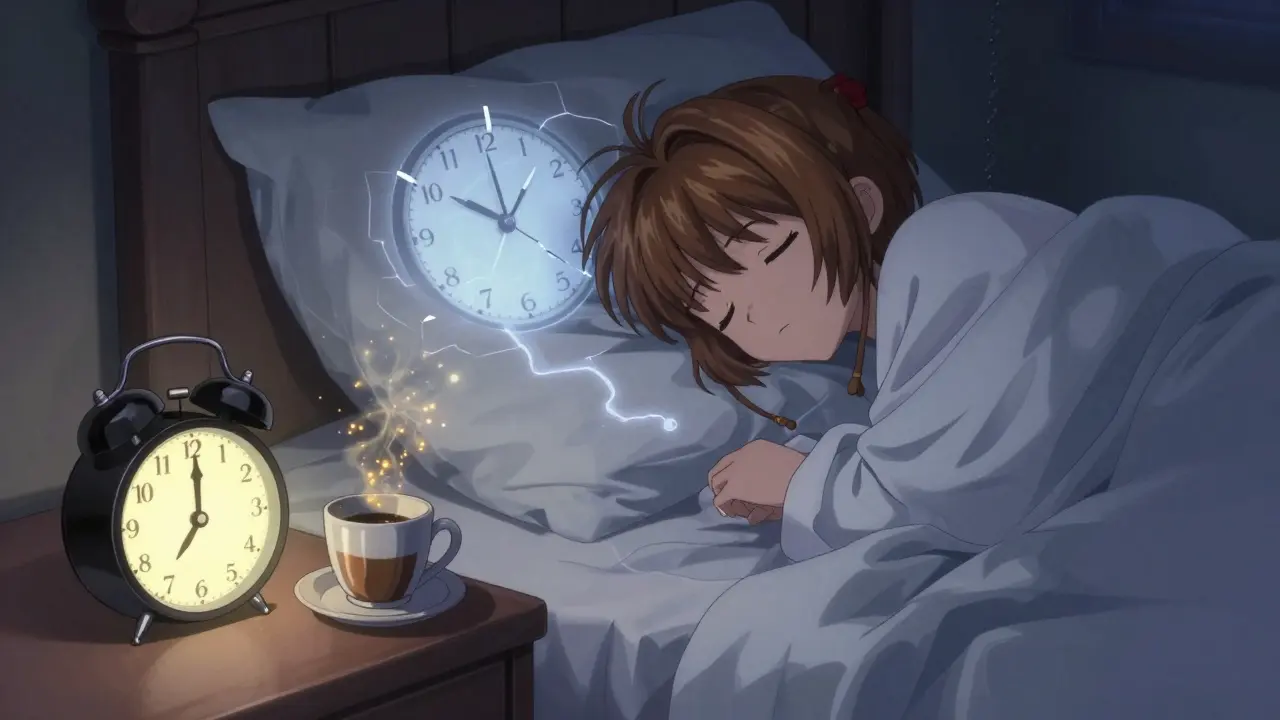
Most people think if they can fall asleep after a cup of coffee at 8 p.m., they’re fine. But falling asleep isn’t the same as sleeping well. You might drift off, but your brain never fully shuts down the caffeine buzz. That’s why so many people wake up tired, even after eight hours in bed.
Why Caffeine Messes With Your Sleep - Even If You Don’t Notice
Caffeine doesn’t just keep you awake. It changes the quality of your sleep. Research shows that having caffeine within 6 hours of bedtime cuts total sleep time by 45 minutes on average. It also lowers sleep efficiency - how much of your time in bed you’re actually asleep - by 7%. And it takes you 9 minutes longer to fall asleep than if you’d skipped the afternoon coffee.
The reason? Caffeine blocks adenosine, a chemical in your brain that builds up the longer you’re awake and tells you it’s time to sleep. Caffeine looks like adenosine, so it latches onto those receptors and tricks your brain into thinking you’re not tired. Even after the jittery feeling fades, caffeine is still sitting in your system, quietly disrupting deep sleep cycles.
A 2025 study in Nature Communications found caffeine doesn’t just delay sleep - it scrambles brain activity during non-REM sleep, the stage where your body repairs tissues and your brain consolidates memories. This disruption is stronger in people aged 41 to 58, meaning middle-aged adults are more sensitive to caffeine’s effects than younger people.
The 8-Hour Rule: Why 6 Hours Isn’t Enough
You’ve probably heard ‘stop caffeine by 2 p.m.’ But here’s the catch: that advice was based on a 400 mg dose - the amount in four espressos. Most people aren’t drinking that much. A standard 250 ml cup of coffee has about 107 mg. And that’s where things get precise.
A 2021 review of 24 studies concluded that for a typical coffee serving, you need an 8.8-hour cutoff before bed to avoid sleep disruption. That’s nearly 9 hours. If you go to sleep at 11 p.m., you should stop drinking coffee by 2:12 p.m. That’s earlier than most people think.
Why the big jump from the old 6-hour rule? Because earlier studies used high doses. Real-life caffeine intake is lower, but it’s more frequent. And even small amounts, if consumed too late, still chip away at sleep quality. The Sleep Foundation updated its guidelines in 2023 to recommend at least an 8-hour cutoff - aligning with the science, not the myth.
Not All Caffeine Is the Same
Black tea? You can probably drink it later. It has less caffeine - around 40 mg per cup - and studies haven’t found a clear cutoff time for it. But energy drinks? Don’t even think about it after noon.
A typical pre-workout supplement contains 217.5 mg of caffeine. That requires a 13.2-hour cutoff. So if you’re hitting the gym at 6 p.m. and downing a pre-workout, you’re setting yourself up for a night of broken sleep unless you go to bed before 7 a.m.
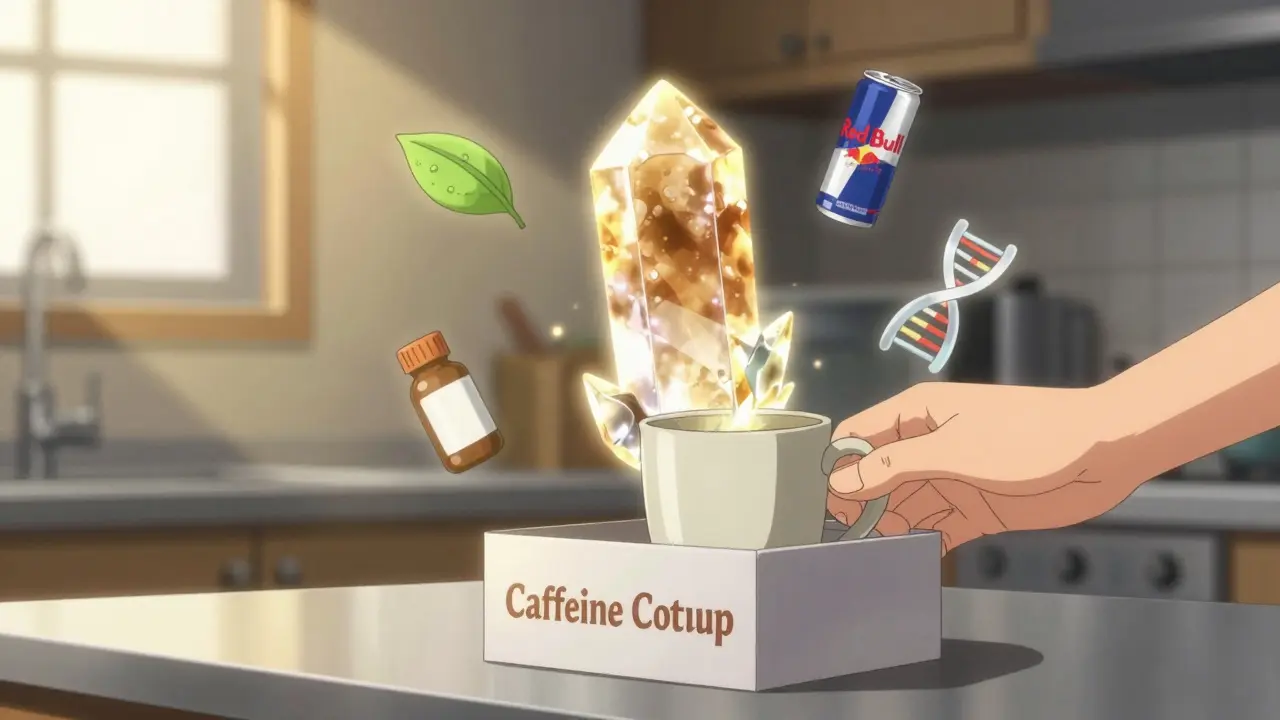
And don’t forget hidden sources. Excedrin has 65 mg per pill. A 250 ml can of Red Bull has 80 mg. That’s more than half a cup of coffee. Many people don’t realize they’re consuming caffeine in painkillers, diet pills, or even some chocolate-flavored protein bars.

Genetics Play a Bigger Role Than You Think
Some people can drink coffee at 8 p.m. and sleep like a log. Others feel wired after a single espresso at 3 p.m. Why? It’s not willpower. It’s genetics.
The CYP1A2 gene controls how fast your liver breaks down caffeine. Some people have a variant that makes them ‘slow metabolizers.’ For them, caffeine’s half-life stretches from the average 5 hours to 12 hours. That means a morning coffee could still be active in their system at midnight.
Companies like 23andMe now offer caffeine metabolism reports as part of their health kits. If you’ve struggled with sleep despite following all the rules, a genetic test might explain why. Slow metabolizers need to stop caffeine by 12 p.m. - or avoid it entirely after lunch.
Real People, Real Results
Reddit’s r/sleep community surveyed over 1,200 people who drank coffee within 6 hours of bedtime. 78% said they had trouble falling asleep. 63% said their sleep quality dropped - even when they did fall asleep.
One user, u/CaffeineStruggles, wrote in March 2023: ‘I switched from my last coffee at 4 p.m. to 2 p.m. and gained almost an hour of sleep quality. Eye-opening how dramatic the difference was.’
A 2022 survey of 2,150 Sleepopolis users found those who stopped caffeine by 2 p.m. (assuming a 10 p.m. bedtime) got 47 extra minutes of sleep and 8% higher sleep efficiency than those who drank until 4 p.m. That’s not a small gain - that’s a full extra hour of restful sleep over the week.
And the numbers back it up: users who followed the 8-hour cutoff reported 82% satisfaction with sleep quality. Those sticking to a 4-hour cutoff? Only 47%.
How to Actually Stick to a Cutoff Time
Knowing the rule is easy. Following it is hard. Especially when your afternoon slump hits at 3 p.m. and the coffee machine is right there.
Here’s what works:
- Switch to half-caf after noon. A 2022 review found this cuts sleep disruption by 32% compared to full-strength afternoon coffee.
- Track your intake. Apps like Caffeine Zone let you log every cup, soda, or pill. 73% of users in a 2022 review said it helped them stay on track.
- Replace coffee with herbal tea or sparkling water. The ritual of holding a warm cup still helps - just without the caffeine.
- Plan your day. If you need energy in the afternoon, try a 20-minute walk or a quick stretch. Movement boosts alertness better than caffeine for most people.
And if you’re really serious? Try a 3-day caffeine detox. Cut it out completely for 72 hours. You’ll reset your sensitivity. When you bring it back, you’ll notice how much more it affects you - and you’ll naturally choose to drink less, and earlier.
The Future: Personalized Sleep Advice Is Here
Generic cutoff times are being replaced by personalized ones. A 2024 study in Nature Communications used machine learning to predict optimal caffeine cutoffs based on your genes, age, and sleep history. It got it right 89% of the time - 22% more accurate than the old 8-hour rule.
Wearables like Oura Ring and Fitbit now give you personalized caffeine reminders based on your sleep data. If your sleep efficiency drops after afternoon coffee, your ring will nudge you: ‘Try cutting caffeine after 1 p.m. tomorrow.’
Even Starbucks noticed. In 2022, they launched ‘Evening Brew’ - a decaf blend specifically for after-4 p.m. drinkers. It captured 15% of the after-work coffee market in just six months.
The American Academy of Sleep Medicine is updating its guidelines in early 2026 to include beverage-specific cutoffs. No more vague ‘avoid caffeine late in the day.’ Instead: ‘Stop espresso by 4 p.m., black tea by 7 p.m., energy drinks by noon.’
What You Can Do Today
You don’t need a genetic test or a smart ring to start sleeping better. Just do this:
- Find out how much caffeine is in your usual drink. Use the FDA’s database or a simple app.
- Set a hard cutoff: 8.8 hours before bed. If you sleep at 11 p.m., stop by 2:12 p.m.
- Track your sleep for a week with a free app like Sleep Cycle or even your phone’s built-in tracker.
- Notice how you feel in the morning. Less groggy? More focused? That’s your body thanking you.
It’s not about giving up coffee. It’s about timing it right. Your brain needs rest. Caffeine might keep you awake, but it doesn’t make you more productive. Real productivity comes from deep, uninterrupted sleep - not from caffeine-fueled hustle.
Try the 8-hour rule for just one week. You might not feel it the first night. But by day four or five, you’ll notice the difference. You’ll wake up before your alarm. You won’t need that second cup. And you’ll finally understand why your sleep felt so ‘off’ - even when you thought you were getting enough.
Is it okay to drink coffee after 4 p.m.?
It depends. If you’re a fast metabolizer and go to bed after midnight, maybe. But for most people, drinking coffee after 4 p.m. means caffeine is still active in your system when you’re trying to sleep. The science recommends stopping at least 8.8 hours before bed. For a 10 p.m. bedtime, that’s 1:12 p.m. If you’re sensitive or over 40, aim for 2 p.m. or earlier.
Does decaf coffee have caffeine?
Yes. Decaf coffee still has 2-5 mg of caffeine per cup. That’s not much, but if you’re a slow metabolizer or drink multiple cups, it adds up. For strict sleep hygiene, treat decaf like a low-dose caffeine source - avoid it within 6 hours of bedtime if you’re sensitive.
How long does caffeine stay in your system?
The half-life of caffeine is 4-6 hours for most people - meaning half of it is gone in that time. But it can take up to 12 hours for your body to fully clear it, especially if you’re a slow metabolizer. That’s why a cup at 3 p.m. can still affect your sleep at midnight.
Can I drink tea instead of coffee in the afternoon?
Black tea has less caffeine than coffee - about 40 mg per cup versus 107 mg. Many people can drink it later without sleep issues. Green tea has even less. But if you’re sensitive, avoid all tea after 4 p.m. Herbal teas like chamomile or peppermint are caffeine-free and safe anytime.
Why do I still feel tired even after 8 hours of sleep?
Caffeine might be the culprit. Even if you fall asleep, caffeine reduces deep sleep and lowers sleep efficiency. You’re spending more time in light sleep, which doesn’t restore you. Try cutting caffeine after 2 p.m. for a week and track your sleep quality. Many people report feeling more refreshed without changing anything else.
Do energy drinks affect sleep more than coffee?
Yes. Energy drinks often contain 200 mg or more of caffeine - sometimes with added sugar and stimulants like taurine or guarana. A pre-workout drink with 217.5 mg needs a 13.2-hour cutoff. That means if you drink one at 7 a.m., you shouldn’t go to bed until 8:12 p.m. Most people can’t do that. Avoid energy drinks after noon if you care about sleep.
Akshaya Gandra _ Student - EastCaryMS
January 4, 2026 AT 13:03so i tried stoppin coffee after 2pm and honestly my sleep didnt change much lol maybe im just a caffeine monster
Peyton Feuer
January 4, 2026 AT 14:42you’re not alone. i used to think i was fine with late coffee until i tracked my sleep with my apple watch. turns out i was getting 47 minutes less deep sleep. weird how your brain lies to you like that.
melissa cucic
January 5, 2026 AT 22:00It is not merely a matter of caffeine's half-life, nor even of genetic predisposition; it is, rather, a profound testament to the delicate architecture of human neurochemistry-adenosine receptors, circadian rhythms, and the silent, insidious intrusion of stimulants into the sacred space of rest. We mistake the absence of wakefulness for the presence of recovery, and in doing so, we rob ourselves of the very restoration we claim to seek.
John Wilmerding
January 7, 2026 AT 17:05Great post. For those who want to implement this, I recommend using the FDA’s caffeine database to log your daily intake. Also, consider that decaf still contains 2–5 mg per cup-cumulative exposure matters. If you’re a slow metabolizer (CYP1A2 variant), even small amounts after 12 p.m. can disrupt sleep architecture. Sleep efficiency is more important than total hours.
Siobhan Goggin
January 9, 2026 AT 08:56I switched to matcha at 3 p.m. instead of coffee and noticed a huge difference in my morning clarity. No crash, no jittery anxiety, and I actually slept deeper. Herbal teas are underrated.
Cassie Tynan
January 10, 2026 AT 22:30Oh wow, so the reason I wake up like a zombie who lost a fight with a alarm clock is because I’m too lazy to stop drinking coffee at 4 p.m.? Groundbreaking.
Allen Ye
January 11, 2026 AT 04:44Let’s not ignore the cultural context here. In the U.S., coffee is ritual, identity, productivity porn. We glorify the 4 a.m. riser, the 12-hour workday, the ‘hustle.’ But sleep isn’t a luxury-it’s infrastructure. The fact that we need a 2,000-word guide to stop drinking coffee after 2 p.m. says more about our society than our biology. We’ve engineered ourselves into exhaustion, then monetized the cure: sleep trackers, decaf blends, $12 herbal tonics. The real fix? Stop glorifying burnout.
mark etang
January 11, 2026 AT 20:11Based on the peer-reviewed data presented, adherence to an 8.8-hour caffeine cutoff is statistically correlated with improved sleep efficiency, increased slow-wave sleep duration, and reduced sleep latency. It is therefore not merely advisable, but clinically optimal, to conform to this temporal boundary for individuals seeking to maximize restorative physiology.
Aaron Mercado
January 11, 2026 AT 23:12Anyone else notice how the ‘science’ here conveniently ignores that people have lives? I work a 9-to-5, have a kid, and get home at 6 p.m. You want me to stop coffee at 2:12 p.m.? That’s when I’m still at my desk, sweating through a Zoom call. Meanwhile, the people writing these articles are freelancers sipping oat milk lattes at 11 a.m. while their ‘sleep coach’ tells them to meditate. Wake up. Real life doesn’t run on sleep hygiene spreadsheets.
Jay Tejada
January 12, 2026 AT 18:06bro i tried the 3-day detox last month. felt like death for two days. then on day 4, i woke up at 6:30 a.m. without an alarm. i cried. not because i was sad. because i remembered what it felt like to be human again.
josh plum
January 14, 2026 AT 15:14EVERYTHING you just read? It’s all a Big Coffee conspiracy. The FDA, the Sleep Foundation, even your Oura Ring-they’re all paid off. Caffeine is a mind-control agent designed to keep you docile, productive, and dependent. The real reason you can’t sleep? They’re broadcasting subliminal signals through your coffee cup. Look at the logo on your cup. See the tiny ‘C’? That’s a tracking chip. They know when you drink it. They know when you sleep. Wake up.
Ashley Viñas
January 16, 2026 AT 13:20It’s amusing how casually people dismiss the science. If you’re still drinking espresso at 4 p.m. and wondering why you’re exhausted, perhaps your lifestyle choices simply don’t align with the biological realities of being a mammal. It’s not complicated. It’s not ‘unfair.’ It’s just biology. And if you can’t manage your caffeine intake, maybe you shouldn’t be trusted with a smartphone either.
Jason Stafford
January 17, 2026 AT 01:25They’re coming for your coffee. First they take your 4 p.m. latte, then your decaf, then your herbal tea, then your ‘warm lemon water.’ Next thing you know, they’ll ban caffeine entirely under ‘public sleep health.’ This is how they control the masses. They’ll tell you it’s for your own good. Don’t be fooled. Your coffee is your last act of rebellion.