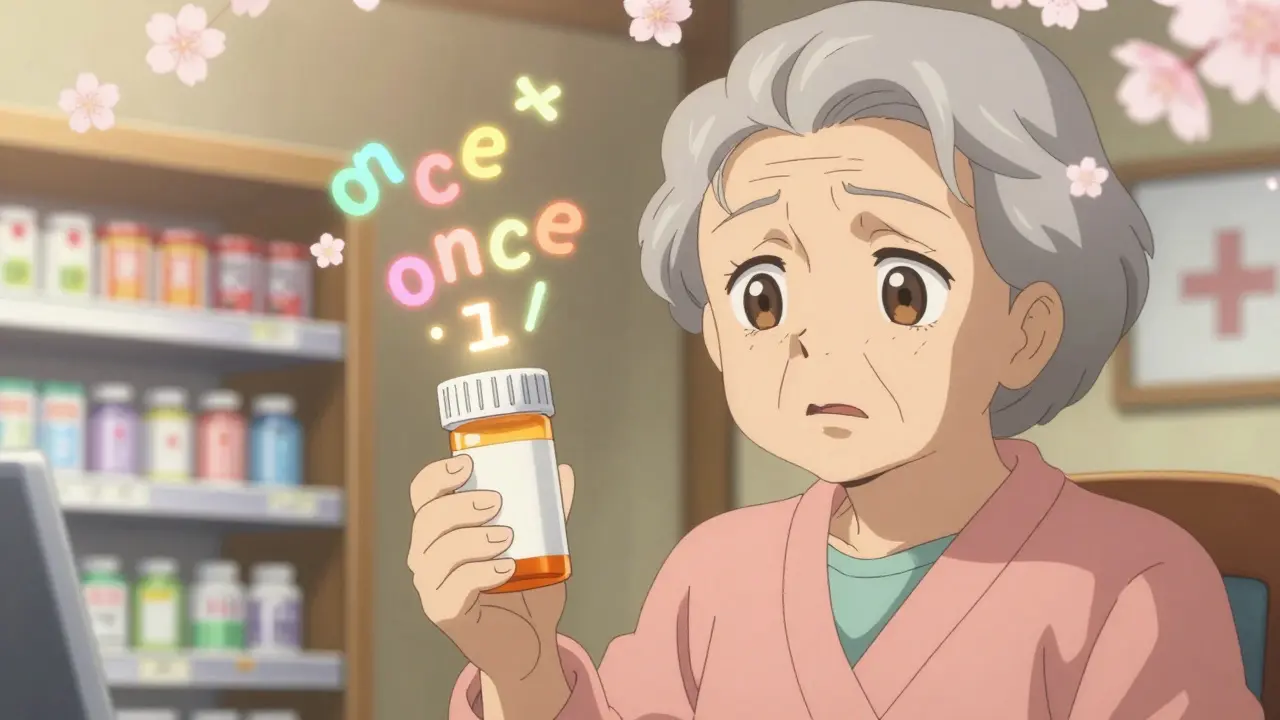
Imagine taking your medicine because the label says once a day, but it actually meant eleven times a day. That’s not a hypothetical scare-it’s what happens when pharmacies use automatic translators for prescription labels. In the U.S., over 25 million people struggle with English, and for them, a badly translated pill bottle can be deadly. A 2010 study found that half of all Spanish-language prescription labels in the Bronx had dangerous errors. Many of these mistakes come from computer programs that don’t understand medical terms, cultural context, or even basic grammar. This isn’t just a language problem-it’s a public health crisis.
Why Computer Translations Fail on Prescription Labels
Most pharmacies rely on cheap, automated translation tools because they’re fast and cheap. But these systems don’t know the difference between once (one time) and once (eleven in Spanish). They also mix up terms like alcohol, which means drinking alcohol in Spain but rubbing alcohol in Latin America. A 2023 report from MedShadow.com found that the same English phrase could appear in five different ways across pharmacies, depending on which translation tool they used. This patchwork of inconsistent translations confuses patients and leads to wrong dosages. The problem gets worse with generic instructions. A doctor might say, “Take this after meals,” but the label says, “Take this with food.” Sounds similar, right? But in some languages, those phrases carry different meanings. A 2017 NIH study showed that 40% of prescription label instructions didn’t match what the doctor actually told the patient. When the label is wrong, patients either skip doses, take too much, or stop taking the medicine altogether.The Real Cost of a Single Mistake
A mistranslated word doesn’t just cause confusion-it causes harm. Dr. Yaffa Rashewsky from New York-Presbyterian Hospital says a single error can turn medicine into poison. In one case reported on Reddit, a patient was told to take two tablets twice daily, but the label said twice weekly. The patient’s condition worsened, and they ended up in the ER. Another patient in California nearly overdosed because the label said “take eleven times a day” instead of “once a day.” These aren’t rare cases. A 2023 survey by the National Health Law Program found that 28% of patients with limited English proficiency admitted to taking the wrong dose because of translation errors. The consequences aren’t just medical-they’re financial. Every incorrect dose leads to doctor visits, ER trips, hospital stays, and sometimes long-term damage. McKinsey & Company found that for every dollar spent on proper translation, $3.80 is saved in avoided health costs. That’s why states like California and New York passed laws requiring accurate translations. California’s program, launched in 2016, cut medication-related ER visits by 27% in just a few years.What’s Being Done Right-And Where It’s Still Failing
The only translation method that works reliably is human translation by certified medical interpreters. According to RxTran’s 2023 whitepaper, professional translators achieve 98-99% accuracy. Pharmacies that use them pair two people: one translates, another verifies. This dual-check system reduces errors to under 5%. Kaiser Permanente spent 6-8 months setting up this process, training staff, and integrating translation software. The cost? Around $15,000 per location. But they saw fewer errors, fewer lawsuits, and happier patients. Big pharmacy chains are starting to catch on. Walgreens launched MedTranslate AI in late 2023, which uses artificial intelligence to flag suspicious translations before they go on the label. CVS Health’s LanguageBridge system does the same, but with pharmacist review built in. These aren’t perfect, but they’re a big step up from old-school Google Translate. Still, only 87% of major pharmacies offer Spanish translations. For Chinese, Vietnamese, or Arabic, that number drops to 23%. If you speak one of those languages, you’re far more likely to get a bad label.
How to Get Help If Your Label Doesn’t Make Sense
You don’t have to accept a confusing label. Here’s what to do:- Ask for a human translator. Most large pharmacies have access to phone or video interpreters. Just say, “I need someone to explain this label in my language.”
- Request a printed copy in your language. If they say they don’t have it, ask them to order it. Under Title VI of the Civil Rights Act, pharmacies receiving federal funds must provide language assistance.
- Bring someone who speaks both languages. A family member, friend, or community health worker can help verify the instructions.
- Call your doctor or pharmacist. Read the label out loud and ask, “Does this match what you told me?” If it doesn’t, they’re required to fix it.
- Report bad translations. File a complaint with your state’s pharmacy board or the U.S. Department of Health and Human Services. Complaints drive change.
What You Can Do to Protect Yourself and Others
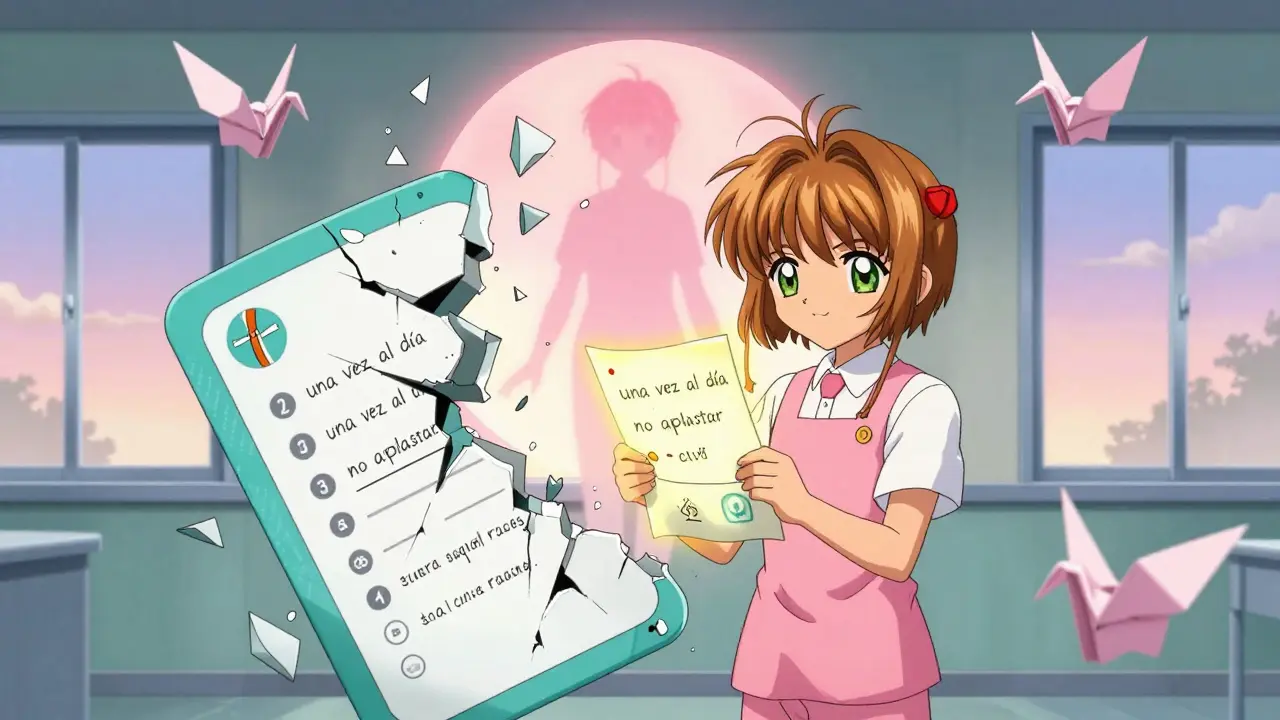
If you’re helping someone who doesn’t speak English well, don’t assume the label is correct. Always double-check. Keep a simple cheat sheet handy:- Take once a day = Una vez al día (not “once” = eleven)
- Take with food = Con la comida (not “after food”)
- Do not crush = No aplastar (not “no masticar” which means “don’t chew”)
- Store in refrigerator = Guardar en el refrigerador (not “en el frío” which is vague)
The Future of Prescription Translation
The good news? Change is coming. In 2024, the FDA released new draft guidelines pushing for plain language on all prescription labels-no complex terms, no double meanings. The HHS just launched a $25 million grant program to help pharmacies hire translators and upgrade systems. More states are considering laws like California’s. By 2030, the prescription translation market is expected to grow by over 14% annually. But progress won’t happen unless patients speak up. Right now, 61% of federally funded health centers still don’t have certified translators for prescriptions. That’s not an accident-it’s a system failure. If you’ve ever been confused by a label, you’re not alone. And you’re not powerless. Your voice can push pharmacies to do better.Why do pharmacy labels sometimes say 'once' when they mean 'eleven'?
This happens because automated translation tools confuse the English word 'once' (meaning 'one time') with the Spanish word 'once,' which means 'eleven.' Computer systems don’t understand context-they just match words. That’s why human translators are critical: they know that 'take once a day' must be translated as 'una vez al día,' not 'once al día.'
Are pharmacies legally required to translate prescription labels?
It depends on the state. Only California and New York have laws requiring accurate translations on prescription labels. But under federal law (Title VI of the Civil Rights Act), any pharmacy that receives federal funding-like Medicare or Medicaid-must provide language assistance. That means you can legally ask for a translator, even if your state doesn’t have a specific law.
Can I get my prescription label translated for free?
Yes. Most major pharmacies offer free phone or video interpreter services. You don’t have to pay extra. If they refuse, ask to speak to a manager and mention Title VI of the Civil Rights Act. Community health centers and nonprofit organizations often provide free translation help too.
What if I don’t speak Spanish? What about Chinese, Arabic, or Vietnamese?
Translation services for languages other than Spanish are less common, but still available at many large pharmacies. CVS, Walgreens, and Kaiser Permanente offer translation for over 200 languages through phone or video services. If your pharmacy doesn’t have it, ask them to order it. You can also contact local immigrant support groups-they often have volunteers who can help translate medical documents.
How can I tell if my prescription label is translated correctly?
Compare the label to what your doctor told you. If it says ‘take two pills every day’ but your doctor said ‘take one pill in the morning and one at night,’ the label might be wrong. Also, check for obvious mistakes like ‘once’ meaning eleven, or ‘alcohol’ referring to rubbing alcohol when you’re taking a heart pill. If anything feels off, call the pharmacy and ask for a human translator to verify.
Heather Josey
January 2, 2026 AT 07:35This is such an important issue that gets ignored far too often. I work in a clinic where we see patients every day who are terrified to take their meds because the label doesn’t make sense. I’ve seen people skip doses for weeks because they thought 'once' meant 'eleven.' It’s not just a translation problem-it’s a failure of systems designed to protect people.
Pharmacies need to stop treating translation like a checkbox. It’s life or death. I’ve personally pushed my local CVS to use their phone interpreter service for every non-English-speaking patient, and now we’ve got a 90% reduction in medication errors in our community. It’s not hard-it just takes willpower.
If you’re reading this and you’re a pharmacist, please, don’t rely on Google Translate. Even if it’s expensive, it’s cheaper than an ER visit. And if you’re a patient, don’t be shy-ask for help. You’re not being difficult. You’re being smart.
Donna Peplinskie
January 4, 2026 AT 06:12Thank you for writing this. I’m a bilingual nurse in Toronto, and I’ve seen this exact thing happen with elderly patients who don’t speak English well. One woman took her blood pressure pill 11 times a day because the label said 'once al día'-but she thought 'once' was the number, not the frequency.
What’s heartbreaking is that she didn’t even know she could ask for help. She thought it was her fault for not understanding. We need to normalize asking. Pharmacies should have a big sign: 'Need help reading your label? Press here for a live translator-free, no judgment.'
And please, if you’re a pharmacy manager: invest in certified medical interpreters. Not just for Spanish. For Vietnamese, Arabic, Mandarin-any language your community speaks. It’s not charity. It’s basic care.
Lee M
January 4, 2026 AT 10:51Let’s be honest: this isn’t about translation. It’s about the collapse of institutional responsibility. We’ve outsourced human judgment to algorithms because it’s cheaper. But medicine isn’t a software bug-it’s a biological system. You don’t fix a heart with a regex pattern.
The real problem? We’ve normalized negligence. We accept that someone might die because a company saved $200 on a translator. That’s not incompetence. That’s moral failure. And until we treat healthcare translation like a human right-not a cost center-we’ll keep burying people under bad labels.
Kristen Russell
January 4, 2026 AT 22:16Phoebe McKenzie
January 5, 2026 AT 21:35THIS IS WHY WE NEED TO STOP LETTING FOREIGN LANGUAGES BE USED IN MEDICAL SETTINGS. This isn’t about 'inclusion'-it’s about cultural erosion. Why should an American pharmacy be forced to translate for people who won’t even learn English? It’s a slippery slope. Next thing you know, we’ll need signs in 50 languages just to buy aspirin.
And don’t get me started on 'certified interpreters.' Who certifies them? Are they vetted? Are they citizens? What if one of them is secretly a foreign agent trying to mess with our medicine supply chain?
Stop spending taxpayer money on this. If you can’t speak English, don’t take American medicine. Simple. No one’s forcing you to live here.
gerard najera
January 6, 2026 AT 13:55Language is a mirror of thought. A mistranslated label isn’t just a mistake-it’s a distortion of intent. The word 'once' in English carries a temporal singularity. In Spanish, 'once' carries numerical weight. The algorithm sees two strings. The human sees context, consequence, life.
Medicine is not data. It is ritual. It is trust. And when that trust is broken by a machine that confuses numbers with time, we aren’t just failing patients-we’re failing our own humanity.
Stephen Gikuma
January 8, 2026 AT 07:17They’re using translators because they’re being controlled by globalist elites who want to erase American culture. You think this is about health? No. This is about creating dependency. Make people rely on translation services, and they’ll never learn English. Then they’ll vote for policies that fund more 'language assistance'-and the government owns them.
And who funds these 'certified interpreters'? NGOs with ties to the UN. Coincidence? I think not. This is how they soften the population. One wrong pill at a time.
Also, 'MedTranslate AI'? That’s a Trojan horse. AI doesn’t 'flag' things-it learns. And what’s it learning? That American patients are too stupid to read their own labels. That’s the real agenda.
Bobby Collins
January 9, 2026 AT 07:01Okay, but have you ever heard about how the FDA secretly codes the pills with microchips? And the translation errors? That’s not a mistake-that’s a signal. The pills are being calibrated to react differently based on language. Spanish speakers get weaker doses because the system thinks they’re 'less compliant.' That’s why the ER visits drop in California-they’re not fixing the labels, they’re changing the medicine.
I know this because my cousin works at a lab in New Mexico. He says they use 'linguistic triggers' in the drug formulation. If the label says 'una vez al día,' the pill releases slower. If it says 'once,' it’s full strength.
They’re using translation to control us. And nobody’s talking about it because they’re scared. But I’m not. I’m posting this. Someone needs to know.