
When your hip starts hurting, it’s easy to blame a bad workout or an awkward step. But if the pain sticks around, especially when you sit, stand up, or turn in bed, it might be something deeper-like a labral tear, early arthritis, or both. These aren’t rare. About 1 in 10 adults deal with hip pain linked to these issues, and many don’t realize they’re connected. The labrum, a rubbery ring of cartilage around your hip socket, isn’t just padding. It’s a seal. When it tears, the joint loses its grip on fluid, and that’s when the bones start grinding. Over time, that grinding wears down the cartilage, turning into arthritis. And once arthritis sets in, the labrum gets even more vulnerable. It’s not a one-way street. One problem makes the other worse.
What’s Really Happening in Your Hip?
The hip labrum is about 3 to 5 millimeters thick and wraps all the way around the socket. It’s made of tough fibrocartilage, built to handle pressure and keep the joint stable. When it tears, it’s usually because of repetitive stress or a structural flaw. The most common culprit is femoroacetabular impingement, or FAI. That’s when the ball of your hip isn’t shaped right-either too bumpy (cam-type) or the socket is too deep (pincer-type). Most cases are a mix. Cam-type FAI shows up in about 64% of people with labral tears, and it’s the one most likely to cause damage over time. These tears aren’t random. About 78% happen in the front of the hip, where the ball rubs against the socket during deep bends. Arthritis, on the other hand, is the slow erosion of the smooth cartilage that covers the bones. It’s graded from 0 to 4. Grade 0 means nothing’s wrong. Grade 4 means the bones are almost touching, with bone spurs sticking out and the joint space crushed to less than 2 millimeters. Here’s the key: 54% of people with hip arthritis also have a torn labrum. And 70-90% of people with FAI already have labral damage. They don’t just happen together-they feed each other. A torn labrum lets more pressure hit the cartilage. That speeds up wear. Once cartilage starts breaking down, the joint becomes unstable, and the labrum gets pulled and stretched until it tears again.Why Activity Modification Isn’t Just “Take It Easy”
Most people think “activity modification” means stopping everything that hurts. That’s wrong. It means changing how you move so you don’t trigger pain or damage. The goal isn’t to rest-it’s to protect the joint while staying active. The biggest triggers? Deep hip flexion (bending past 90 degrees) and twisting the hip inward while bent. That’s why sitting cross-legged, doing deep squats, or even getting out of a low chair can make things worse. Studies show that people who avoid these movements see real improvement. One yoga instructor in Cleveland cut out pigeon pose and kept her hip flexion under 90 degrees during all poses. Within three months, her pain dropped by 70%. She didn’t need surgery. On online forums, 92% of people with labral tears said eliminating deep squats and lunges helped. Eighty-seven percent stopped sitting cross-legged. Seventy-six percent started sleeping with a pillow between their knees to keep the hip aligned. But it’s not just about exercise. Daily habits matter too. Office workers who sit for hours report pain after 30 to 45 minutes. That’s because sitting with hips bent past 90 degrees puts constant pressure on the front of the joint. Solutions? Raise your chair so your knees are level with or slightly below your hips. Use a wedge cushion in your car seat to reduce hip flexion by 10 to 15 degrees. Install a raised toilet seat-it cuts the angle you need to bend by 15 to 20 degrees. These aren’t gimmicks. They’re biomechanical fixes backed by motion analysis.What Works-And What Doesn’t
Painkillers like ibuprofen can help with inflammation, but they don’t fix the root problem. Cortisone shots give relief for about 3.2 months on average, but if you get more than three a year, you risk damaging the cartilage even more. Viscosupplements-gel injections meant to lubricate the joint-help about 55% of people, but the benefit fades after six months. They’re not a long-term fix. Surgery is an option, but it’s not for everyone. Hip arthroscopy to repair a torn labrum has an 85-92% satisfaction rate at five years-if the patient has FAI and early-stage cartilage damage. But if you’re over 60 and already at Kellgren-Lawrence Grade 3 or 4 (severe arthritis), surgery won’t stop the decline. In fact, 45% of those patients end up needing a full hip replacement within five years, no matter what they do. That’s why experts warn against overtreating older patients. The pain might come from the labrum, but the real problem is the worn-out cartilage. For younger people with FAI and a labral tear, surgery can be life-changing. One study found that patients with cam-type FAI (alpha angle over 55 degrees on MRI) had 73% better outcomes with repair plus FAI correction than with physical therapy alone. But surgery isn’t magic. It only works if you follow up with the right rehab and keep modifying your movements.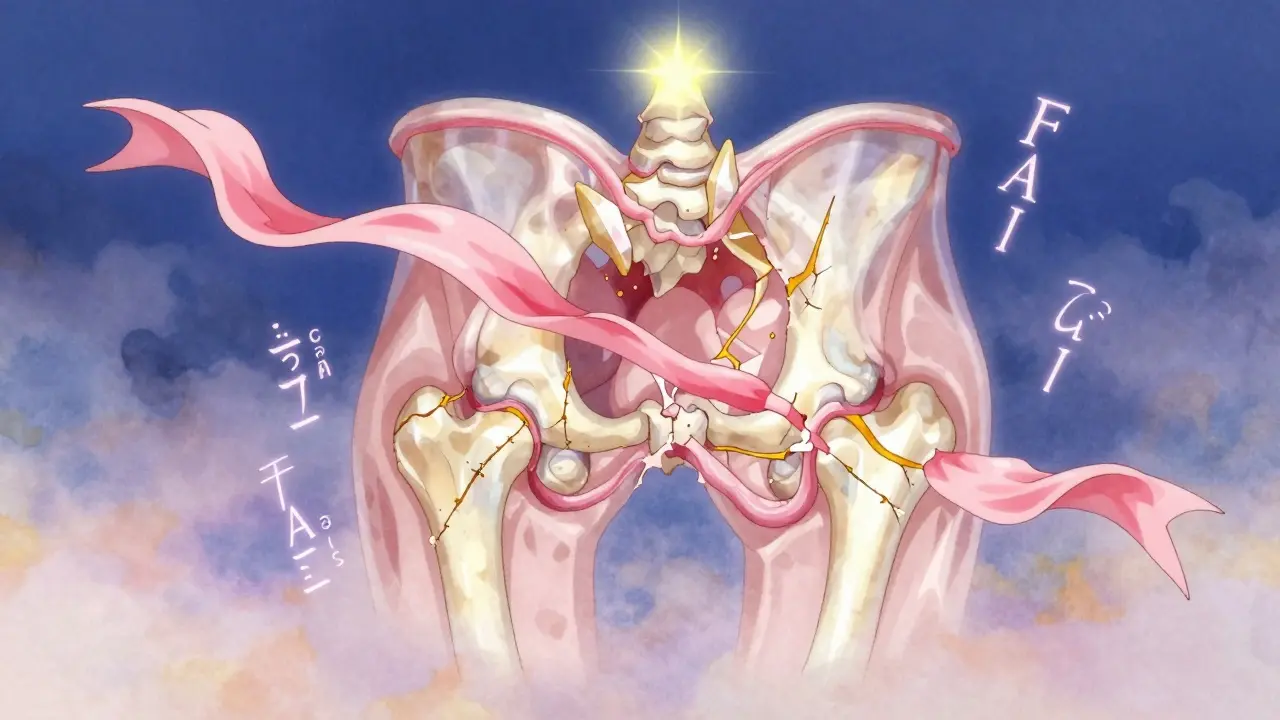
The Hidden Challenge: Being Believed
One of the hardest parts isn’t the pain-it’s the lack of understanding. People don’t see a limp or a brace. You look fine. But sitting in a car for 20 minutes can leave you stuck. Walking up stairs feels like climbing a cliff. A survey from the Hospital for Special Surgery found that 68% of patients felt dismissed because their pain wasn’t visible. “I’m not lazy,” one 42-year-old runner said on Reddit. “I just can’t do what I used to without hurting.” That’s why education matters. You’re not being dramatic. You’re managing a biomechanical problem.What to Do Next
Start with a simple 4- to 6-week activity modification plan:- Keep hip flexion under 90 degrees-no deep chairs, no floor sitting, no deep squats.
- Avoid twisting your hip inward while bent. That means no pigeon pose, no cross-legged sitting, no turning your foot inward when standing.
- Limit continuous weight-bearing to under 30 minutes at a time. Take breaks.
- Switch to low-impact cardio: swimming, elliptical, or stationary biking. Running and jumping? Skip them.
- Strengthen your glutes and hip abductors. Weak muscles make the joint unstable. Physical therapy usually takes 6 to 8 sessions to teach you how to move right.

What’s New in 2026
The field is moving fast. In 2023, the FDA approved a new viscosupplement called Durolane that lasts up to six months-double the old options. At Massachusetts General Hospital, they’re using advanced MRI to spot cartilage damage before it shows up on X-rays. That means earlier intervention. At Stanford, a pilot study used wearable sensors to give real-time feedback on hip position during daily activities. Patients who used them had 52% fewer pain episodes over 12 weeks. But the biggest shift is philosophical. The American Academy of Physical Medicine and Rehabilitation now says: “Focus on movement quality, not just quantity.” It’s not about doing less. It’s about doing it right. One study showed patients who learned proper movement patterns improved 40% more than those who just cut back on activity.When to See a Specialist
You don’t need surgery right away. But if you’ve tried activity modification for six weeks and still can’t walk without pain, or if you’re losing muscle or balance, it’s time to see a hip preservation specialist-not just any orthopedist. Look for someone who understands FAI, labral repair, and the difference between early and late-stage arthritis. Avoid providers who push surgery too fast or who say “it’s just aging.” You’re not too young to fix this. And you’re not too old to manage it.Can a labral tear heal on its own?
No, the labrum doesn’t heal on its own because it has poor blood supply. But symptoms can improve with activity modification and physical therapy. The goal isn’t to repair the tear-it’s to stop the joint from getting worse. Many people live without surgery by avoiding movements that stress the hip.
Is walking good for hip arthritis?
Yes, but only if you do it right. Walk on flat surfaces, wear supportive shoes, and keep your hips aligned. Avoid hills and stairs if they hurt. Short, frequent walks (15-20 minutes, 3-4 times a day) are better than one long walk. If walking causes pain that lasts more than two hours after you stop, you’re overdoing it.
Should I avoid all exercise if I have hip pain?
No. Inactivity makes things worse. Muscles weaken, joints stiffen, and pain increases. Focus on low-impact activities: swimming, cycling, elliptical, and strength training that avoids deep hip flexion. A physical therapist can design a safe program. The key is movement without pain provocation.
Does weight loss help hip pain?
Yes, especially if you have arthritis. Every pound of body weight adds 3-4 pounds of pressure on the hip during walking. Losing just 10 pounds can reduce pain by 30-40% in many cases. It doesn’t fix the tear or the cartilage loss, but it takes stress off the joint, making other treatments more effective.
How long does it take to see results from activity modification?
Most people notice less pain within 4 to 6 weeks if they stick to the plan. Full improvement can take 3 to 6 months, especially if you’re rebuilding strength and retraining movement patterns. Consistency matters more than intensity. Small, daily changes add up.
Can I still run with a labral tear or hip arthritis?
It’s possible for some, but not recommended. Running creates high-impact forces that accelerate cartilage wear. Studies show only 29% of people with hip labral tears can continue running without worsening pain. If you want to stay active, switch to swimming or the elliptical. They give you cardio without the pounding.
vishnu priyanka
January 14, 2026 AT 02:04Scottie Baker
January 14, 2026 AT 07:56Nelly Oruko
January 14, 2026 AT 19:54Anny Kaettano
January 15, 2026 AT 19:43Gregory Parschauer
January 16, 2026 AT 09:12Alan Lin
January 17, 2026 AT 17:20Robin Williams
January 18, 2026 AT 03:18Adam Vella
January 18, 2026 AT 19:06Angel Tiestos lopez
January 20, 2026 AT 03:25Pankaj Singh
January 20, 2026 AT 17:50