
Imagine walking into a crowded room where everyone is shouting different things at once. That is often what happens inside our healthcare system when doctors, specialists, and pharmacists don't have the same information. You are the one thing that connects them all, but without a clear medication list, you are essentially navigating blind. Studies show that inaccurate records contribute to roughly 7,000 preventable deaths each year in the United States alone. It sounds scary, but the good news is that a single sheet of paper or a smartphone app can bridge these gaps. Keeping this record up to date isn't just busy work; it is your first line of defense against dangerous interactions and hospital readmissions.
Why Your Medication List Is More Important Than You Think
Many people treat their pill bottle caps as their only record, but those labels get lost or outdated quickly. A comprehensive medication list goes beyond just names. It serves as the central source of truth during any medical emergency. When you land in the ER unconscious, paramedics need to know instantly if you are on blood thinners or insulin. If you cannot speak for yourself, they rely on this document. Furthermore, modern medicine faces a rising issue called polypharmacy, which is simply the term for taking five or more medications at once. As we age, this becomes more common, and the risk of one drug fighting another increases exponentially.
| Type of Risk | Potential Consequence |
|---|---|
| Duplicate Prescriptions | Taking two drugs that do the same thing, leading to overdose. |
| Drug Interactions | One prescription cancels out the effect of another or causes side effects. |
| Allergic Reactions | Being prescribed a substance you are allergic to due to missing allergy notes. |
| Hospital Readmission | Mistakes made after leaving the hospital cause return trips within 30 days. |
The Institute for Safe Medication Practices consistently ranks accurate reconciliation as their top safety goal. Without a verified list, providers often rely on memory or incomplete electronic records that might not have synced across different hospital systems yet. This gap leaves patients vulnerable to receiving doses that are too high or combinations that are toxic.
Exactly What Needs to Be on Your List
Simply writing down "Lipitor" isn't enough. To make the list truly useful, you need specific details that allow any provider to understand your treatment plan immediately. The Food and Drug Administration provides a standard template, and following its structure ensures you cover all bases. Every entry needs a unique identity so that confusion between similar-sounding drugs doesn't happen.
- Drug Name: Write both the brand name (what you buy) and the generic name (the active ingredient).
- Dosage: Note the strength, such as 10mg or 250mg.
- Frequency: How often do you take it? Is it morning, night, or before meals?
- Indication: Why are you taking it? Knowing the purpose helps if a doctor wants to stop it.
- Prescriber: Who ordered it? This helps resolve conflicts if two doctors give contradictory orders.
- Allergies: Document specific reactions, not just "Allergic." Specify if it was a rash, breathing trouble, or swelling.
Don't forget the non-prescription stuff. Many people hide their over-the-counter (OTC) vitamins and herbal remedies from doctors because they aren't "real medicine." They are wrong. St. John's Wort, ibuprofen, and even large doses of Vitamin C can interfere with prescription drugs. Your list is a complete inventory of everything going into your body.
Choosing the Right Format for Your Lifestyle
The best format is the one you will actually use and update consistently. There is no single winner here, so look at your daily habits to decide what fits best. Each method comes with trade-offs regarding convenience, durability, and ease of sharing.
| Method | Pros | Cons |
|---|---|---|
| Paper Wallet Card | Always accessible, no battery needed, easy for doctors to photocopy. | Can get wet/lost, hard to update quickly, takes manual effort. |
| Smartphone App | Sends reminders, tracks refill dates, cloud backups. | Requires charging, may lack senior-friendly design, privacy concerns. |
| EHR Portal Access | Directly linked to doctor's records, automatically syncs. | Limited to specific health systems, often lags behind real-time changes. |
For many adults over 65, physical copies remain king because they don't require technical literacy. However, apps like Medisafe have seen millions of downloads because they automate the heavy lifting of remembering. If you are tech-savvy, utilizing a dedicated app can reduce missed doses by nearly 30 percent. Just ensure the app allows you to export a printable version for your doctor, who might want a hard copy in your chart.
The Golden Rule of Updates
A static list is a dangerous list. The most critical mistake people make is creating the list once and never touching it again. Your medication profile changes constantly-doctors swap drugs, adjust dosages, or stop treatments that are no longer working. The golden rule is simple: update your list every time a prescription changes.
This means right after your pharmacy fills a new order, or immediately after a doctor gives you a verbal instruction. If you go to the hospital and get discharged, request a discharge summary and reconcile it with your home list before you leave the parking lot. Data shows that nearly 70 percent of lists become outdated within three months of creation if not actively maintained. Set a recurring reminder on your phone to review the whole list once a month. Treat it like checking your bank statement-a routine audit prevents surprises later.
Using the 'Brown Bag' Strategy
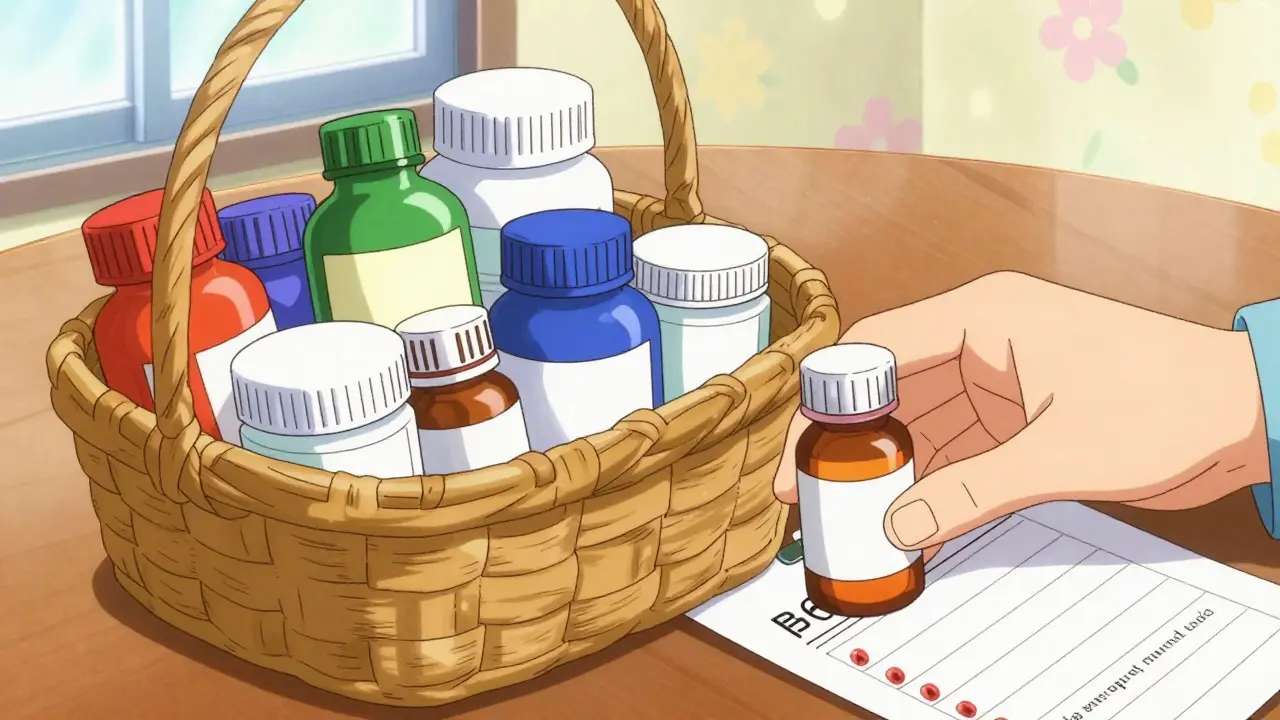
You don't have to trust your memory alone to keep this list accurate. Bring your actual bottles to your annual checkup. This technique, often called the "brown bag method," allows your pharmacist or nurse to verify what you are taking against what your records say. This catches discrepancies like old prescriptions you forgot were refilled or pills you stopped taking years ago that are still listed digitally.
- Gather all prescription bottles, vitamin containers, and supplement wrappers.
- Place them in a reusable bag along with your written list.
- Bring the bag to your appointment at least 15 minutes early so the staff has time to review it.
- Ask the provider to physically cross off anything that is discontinued and initial any new additions.
This hands-on approach significantly reduces the risk of accidental duplicate therapy. It forces a visual confirmation that matches the physical reality to the digital paperwork.

Sharing Your Information Effectively
Having the list is step one; using it is step two. Do not hesitate to hand a printed copy to your pharmacist, specialist, and primary care physician at every visit. Most providers appreciate the initiative because it saves them time digging through old charts that might be incomplete. If you visit a specialist, ask them to send an electronic note back to your primary care doctor confirming the new prescription. However, until your primary doctor acknowledges it electronically, always carry your own copy as the backup master record.
In emergencies, if you carry a wallet card version, make sure your family knows it exists. Emergency response teams move fast, and they might not see your home computer files. Keep a secondary copy in your car glove compartment and another in a known spot at home near your keys.
Overcoming Common Barriers
The main hurdle isn't knowing what to write; it's staying disciplined when life gets busy. Forgetting to update the list after a new doctor's visit is a universal struggle. One practical trick is to link the task to an existing habit. Perhaps you organize your weekly pill dispenser on Sunday mornings. Make updating your written list part of that ritual.
Another barrier is the intimidation of long lists. If you feel overwhelmed, start small. Get a professional pharmacist to help you organize the information once. Many community pharmacies offer medication therapy management services where they review your entire regimen and print a consolidated list for free or at low cost. Medicare Part D plans often cover these consultations, so check your benefits.
How often should I review my medication list?
Ideally, you should review your list at every doctor visit and at least once every three months. You must update it immediately whenever a new prescription is started or an old one is stopped.
Do vitamins and herbal supplements need to be included?
Yes, absolutely. Vitamins, herbs, and over-the-counter pain relievers can interact with prescription drugs. Including them prevents potential toxicity or reduced effectiveness of vital medications.
What is the best place to keep a backup copy?
Keep a printed copy in your wallet for immediate access. Also store a digital scan in a secure cloud folder shared with a trusted family member or caregiver, and keep a paper copy in your car.
Can I use my phone instead of a paper list?
Smartphones are excellent tools for tracking, but a paper version is safer for situations where power is lost or devices are not permitted in certain medical areas. Using both offers the best coverage.
Who is responsible for reconciling my medications?
While hospitals are required to reconcile meds during transitions, you are ultimately the constant in your care team. Sharing your personal master list ensures all providers have the most current information available.
Jonathan Alexander
March 31, 2026 AT 18:36The thought of doctors fighting over who knows my meds scares me more than the illness itself.
RONALD FOWLER
April 1, 2026 AT 21:56Just keep a paper copy in your wallet always.
Charles Rogers
April 2, 2026 AT 17:26It is astonishing how many people walk into clinics without any idea what they are actually taking. They rely on memory which is notoriously unreliable during times of stress and panic. A piece of paper is infinitely safer than the fragile human brain when discussing medical history. You see doctors working under pressure and they need that data immediately to prevent fatal errors. It is simply negligent to not maintain such a basic record of your own health. Most individuals prioritize organizing their digital photos over organizing their life-saving prescriptions. This prioritization is backwards and puts everyone in the waiting room at risk. We live in an era where information is power and hoarding it is dangerous behavior. If you do not know your medication regimen then nobody else can truly help you either. Ignorance is often cited as bliss but here it serves only to invite disaster upon the patient. The system is broken partly because patients fail to hold up their end of the bargain. Providers cannot guess what pills you swallowed yesterday and you should not expect them to try. A verified list bridges the gap between different specialists who never speak to each other. It forces accountability onto the person who is ultimately responsible for ingesting the substances. Taking control of your health starts with managing the inventory of chemicals entering your body daily. Nobody else cares about your specific biology quite as much as you care about surviving the day.
William Rhodes
April 4, 2026 AT 05:00We need to move past the fear and just do the work instead of waiting for permission to track our own lives. Energy is wasted worrying about things we can easily fix ourselves today. Get that notebook open and fill it before the next doctor visit comes around. The worst case scenario is having too much info and the best case is avoiding a trip to the hospital entirely. This is a small change that creates massive security for the family unit involved. Stop waiting for someone to hand you the tools and grab them yourself right now. Momentum builds quickly once the first entry gets made in that book. Every single day you delay this update puts you further behind on your own care plan. Take charge of the situation before the system takes control of you.
Vikash Ranjan
April 6, 2026 AT 03:18I find it ironic that we are told to share everything with strangers while our private data leaks everywhere online. Doctors often lose records anyway so why bother trusting this paper method blindly. It feels like an outdated solution forced onto modern patients who deserve better digital infrastructure. Carrying a bag full of pills is risky if someone finds them and uses them for themselves.
Michael Kinkoph
April 6, 2026 AT 03:51Your skepticism; is amusing; but woefully ignorant; of the stakes; involved!; While; electronic databases; crash; frequently; a physical copy; remains; foolproof.; One; does not; require; Wi-Fi; or; batteries; to function; effectively!; The; elite; among us; understand; redundancy; is key.; Do not; dismiss; proven; strategies; simply; because; they; lack; screens.;
You; clearly; lack; perspective; on; how; fast; paramedics; need; answers.;
Marwood Construction
April 7, 2026 AT 21:14Accurate record keeping represents a fundamental obligation for anyone living in a complex society. Neglecting this duty often results in systemic failures that impact the wider community. We observe significant improvements in outcomes when individuals adhere to strict documentation protocols. Verification processes become streamlined when source material exists physically and digitally.
Kendell Callaway Mooney
April 8, 2026 AT 11:55You can get free help at most local pharmacies to organize this for you. Just bring all your bottles and ask the staff member for a therapy management checkup. They print a nice clean sheet for you to put in your purse or wallet pocket. Update it whenever you add something new to your routine or stop taking something old. Keeping it fresh saves you trouble later when you go to the emergency room or specialist appointment.
Don't worry about making mistakes since you can always cross things out neatly. The main goal is having the right numbers and names written down clearly for the doctor to read.