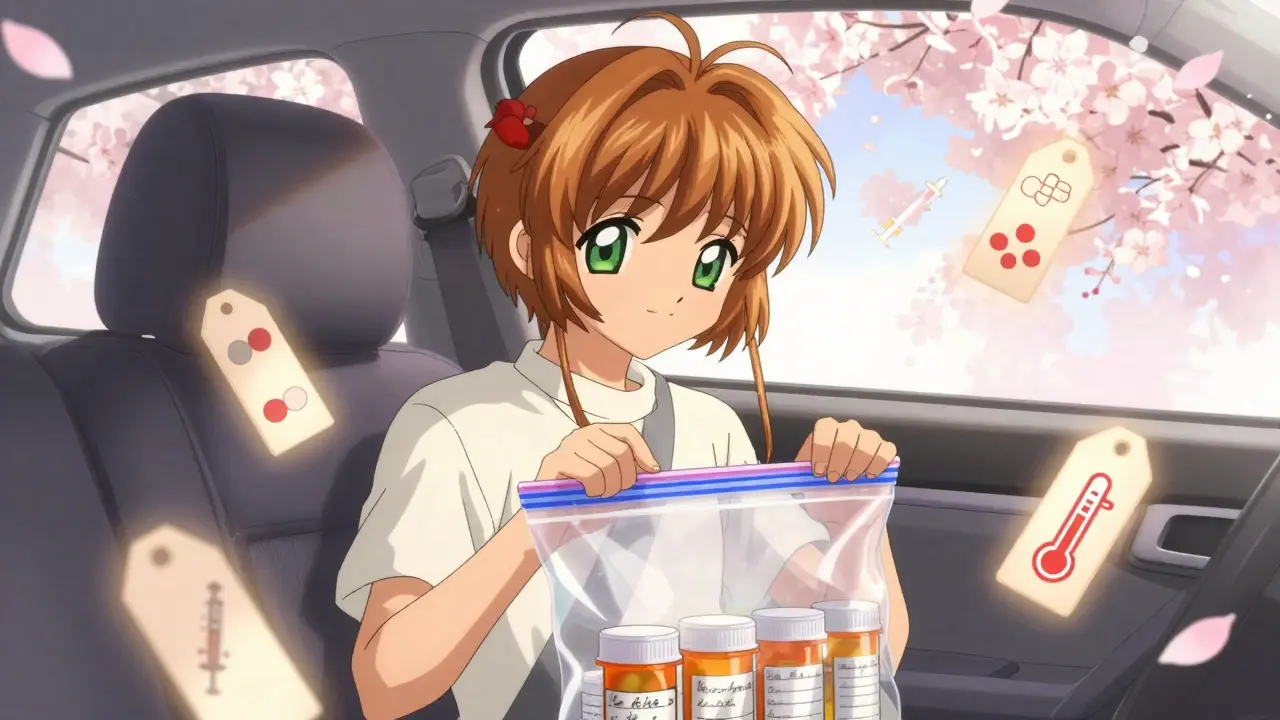
When you’re heading out on a long road trip or a cruise, the last thing you want is to run out of your meds-or worse, have them taken away at a border or port. I’ve seen people panic because they tossed their pills into a random pillbox without labels, only to get questioned by customs. Or worse, their insulin got lost in checked luggage. It’s not just inconvenient-it can be dangerous. Here’s how to do it right.
Start 30 Days Before You Leave
Don’t wait until the night before. Thirty days out, schedule a quick chat with your doctor. Ask them to confirm that every medication you’re taking is legal in every country you’ll visit. That’s not just a formality. In the Caribbean, for example, 42% of common medications-like certain painkillers or ADHD drugs-require special permits or are outright banned. Royal Caribbean’s 2024 policy update says passengers who didn’t check this ahead of time got denied boarding. Your doctor can also give you a signed letter listing your meds, dosages, and why you need them. Keep a printed copy and a digital version saved on your phone.Keep Everything in Original Containers
This isn’t optional. Every prescription you carry must stay in its original pharmacy bottle with the pharmacist’s label intact. That label has your name, the drug name, the doctor’s name, and the dosage. TSA and customs agents need to see that. Even if you hate how bulky those bottles are, don’t transfer pills to unlabeled containers. Reddit user u/TravelMedNurse, a travel nurse with 12 years of experience, says 90% of medication issues they’ve seen came from unlabeled pills. One woman in 2023 had her entire supply of anxiety meds confiscated in Mexico because they were in a plastic bag. No labels. No proof. No second chances.Bring Extra-A Lot More Than You Think
You’re going to need more than just enough for the trip. For road trips, bring at least one extra day’s supply. For cruises or flights? Bring two extra days. Why? Because delays happen. OAG’s 2023 report shows 23% of international flights are delayed by more than 3 hours. Cruises can change ports due to weather or mechanical issues. If your ship docks in a country where pharmacies don’t stock your exact brand, you’re stuck. The CDC and Royal Caribbean both recommend a minimum of three extra days’ supply. If you’re on insulin, thyroid meds, or anything life-sustaining, bring a full week extra. Better safe than stranded.Carry-On Only. No Exceptions.
Checked luggage gets lost. Not often-SITA reports only 0.02% of bags go missing annually-but when it does, it’s usually your meds. The FAA and TSA both require essential medications to be in your carry-on. Even if you’re driving, keep them with you in the car, not in the trunk or a suitcase you leave at a hotel. I’ve heard too many stories of people losing their blood pressure pills because they left them in a rental car. Keep your meds in a small, clear quart-sized Ziploc bag. That way, you can pull it out quickly at security. Don’t put it in your purse or coat pocket-keep it in your main carry-on bag where you can see it.
Organize Smart-No Guesswork
If you take multiple pills at different times of day, a pill minder can help. But here’s the catch: if you use one, you must label it clearly. Tape a sticker on the side with your name, the date, and what’s inside-like “8 AM: Metformin 500mg.” Cruise Critic recommends color-coding: blue for morning, red for evening, green for as-needed. Some people use pill envelopes-small, sealed bags labeled with the time and drug name. Special Journeys’ 2023 report found that 78% of medication errors on group trips happened because labels were missing or unclear. Don’t be that person.Know the Rules for Controlled Substances
If you take opioids, stimulants, or certain antidepressants, you’re in a different category. Norwegian Cruise Line requires you to declare controlled substances 30 days before sailing. Carnival requires a doctor’s note for any medication containing codeine or similar substances. Some countries treat even common ADHD meds like Adderall as illegal narcotics. The CDC’s 2024 Travelers’ Health Update lists over 65% of Caribbean destinations where stimulants require special permits. Your doctor’s letter must specify the medical necessity. Print two copies-one in your carry-on, one in your wallet. If you’re flying internationally, IATA now requires digital verification through their Travel Pass app. Download it. Enter your meds ahead of time. Saves time at check-in.Document Everything
Create a simple list: drug name, generic name, dosage, frequency, and reason. Example: “Lisinopril 10mg, once daily, for high blood pressure.” Keep this in your phone’s Notes app and print a copy. The CDC says 12% of travelers have trouble explaining their meds to foreign medical staff. If you end up in a clinic abroad, this list is your lifeline. Add a QR code that links to a Google Doc with your full medical history. Many U.S. travel clinics now offer these for free. It’s not overkill-it’s insurance.Cruise vs. Road Trip: Key Differences
On a cruise, you’re dealing with international laws. A pill that’s fine in the U.S. might be illegal in Jamaica or the Bahamas. Cruise lines have medical staff who can verify prescriptions, but they won’t refill them. On a road trip, you’re dealing with U.S. state laws. Medical marijuana is legal in 38 states but still illegal in 13. If you’re driving through those states with cannabis-based meds-even if they’re legal at home-you risk arrest. The AAA reports 67% of road-trippers have faced medication issues crossing state lines. Stick to FDA-approved meds. If you’re unsure, leave it behind.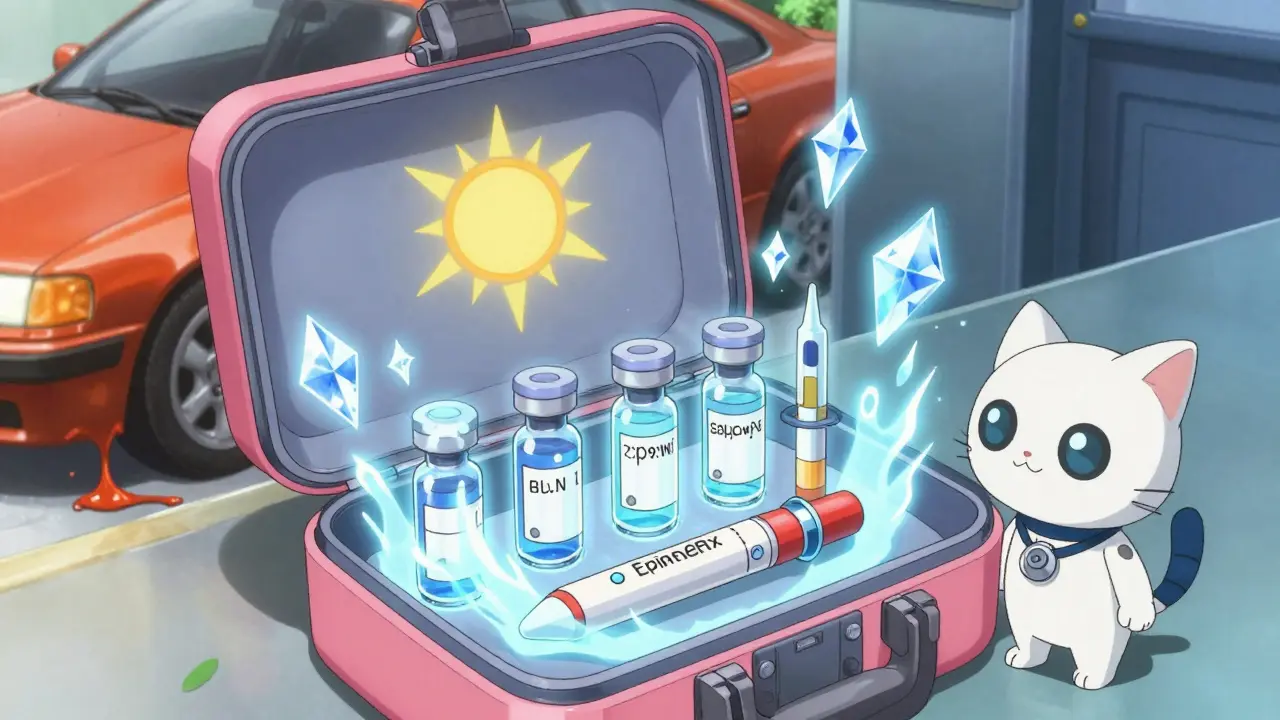
Protect Temperature-Sensitive Meds
Insulin, epinephrine pens, and some biologic drugs need to stay cool. The FDA says 41% of these meds degrade if exposed to heat for more than 72 hours. Don’t leave them in a hot car. Use a small insulated cooler with a cold pack. Some travel companies now sell UV-protective cases that keep meds at safe temps for up to 3 days. CVS and Walgreens offer free travel packs for these meds-if you ask. Bring your prescription and ask them to repack it into a temperature-controlled container. It’s a service, not a perk.What Not to Do
- Don’t mix pills from different prescriptions into one container.
- Don’t rely on your pharmacy to mail refills while you’re away.
- Don’t assume your travel insurance covers medication replacement.
- Don’t skip the doctor’s note-even if you think you don’t need it.
Final Checklist
- ☐ All meds in original bottles with labels
- ☐ 2 extra days’ supply (3+ for cruises)
- ☐ Doctor’s letter with generic names and dosages
- ☐ Digital and printed medication list
- ☐ QR code linked to full medical record
- ☐ Temperature-sensitive meds in insulated case
- ☐ Controlled substances declared to cruise line (if applicable)
- ☐ Travel Pass app updated (for international flights)
- ☐ Medications in carry-on, not checked bag
- ☐ Emergency contact info for your doctor on phone
Packing meds right isn’t about being overly cautious. It’s about knowing how the system works-and avoiding the mistakes that ruin trips. One woman told me she missed her cruise’s first port because her anxiety meds were confiscated. She spent the day in a foreign police station. She didn’t have a doctor’s note. She didn’t have the original bottles. She cried the whole time. Don’t let that be you.
Can I put my medications in a pill organizer?
Yes, but only if you label each compartment clearly with your name, the medication name, dosage, and time of day. Never use unlabeled organizers. Customs and TSA require original pharmacy labels as proof. Pill organizers are fine for convenience, but always keep the original bottles in your carry-on.
Do I need a doctor’s note for my regular prescriptions?
It’s not always required, but it’s strongly recommended-especially for controlled substances, insulin, or if you’re traveling internationally. A note from your doctor listing your meds, dosages, and medical reason helps avoid delays at customs or if you need emergency care abroad. Many cruise lines now require it for certain drugs.
What if I run out of meds on a cruise?
Cruise ships have medical centers, but they rarely carry the same brand or dosage you use. They might give you a substitute, but it could cause side effects or not work as well. That’s why bringing enough extra is critical. If you do run out, the ship’s medical team can contact your doctor for authorization, but that takes time. Don’t wait-pack extra.
Are over-the-counter meds treated the same as prescriptions?
Not always. Some OTC meds like pseudoephedrine (in cold pills) are controlled substances in other countries. Melatonin is banned in the UK and Australia. Always check the destination country’s rules-even for pills you buy without a prescription. Keep them in original packaging too.
Can I bring my medication in a travel case with compartments?
Yes, if the case is for organization only and you still carry the original bottles. Many travelers use cases like MedReady or PillPack for daily use, but TSA requires you to show the original pharmacy labels upon request. Never rely on the travel case alone as proof of prescription.
What should I do if my medication is confiscated?
Stay calm and ask for a written explanation. Contact your embassy immediately. If you have a doctor’s note and original packaging, you may be able to appeal. But prevention is better: always check destination rules before you go. Many countries have online lists of banned medications-use them.
Is it okay to carry liquid medications in my carry-on?
Yes. Prescription liquids are exempt from the 3-1-1 rule. You can bring more than 3.4 ounces, but you must declare them at security. Keep them in their original bottles with labels. TSA allows reasonable quantities for the duration of your trip. If it’s insulin or another life-saving liquid, bring extra vials and a cooler.
Next Steps
- If you’re flying: Download the IATA Travel Pass app and enter your meds now.
- If you’re cruising: Email your cruise line’s medical team with your list 72 hours before departure.
- If you’re driving: Check each state’s drug laws if crossing borders-especially for controlled substances.
- If you’re on insulin or biologics: Visit your pharmacy and ask for a temperature-controlled travel pack.
Medications aren’t just pills in a bottle. They’re your health on the move. Get it right, and your trip stays smooth. Get it wrong, and you could be stuck in a foreign hospital-or worse, without your meds at all.
Aishah Bango
January 27, 2026 AT 11:53People still don’t get it. Unlabeled pills? In 2024? I’ve seen customs officers laugh while confiscating a ziplock full of Xanax. You think they care about your anxiety? They care about paperwork. Original bottles. Every. Single. One. No excuses. Your ‘convenience’ isn’t worth a detention center visit.
And yes, I’ve been that person who cried in a foreign police station. Don’t be her.
Simran Kaur
January 28, 2026 AT 04:30As someone from India where even paracetamol requires a prescription in some states, this guide is a lifeline. I once got stopped at Dubai airport because my ‘vitamins’ were actually my thyroid meds in a pill organizer. No labels. No note. I spent three hours crying in a corner while they called my doctor in Bangalore.
Please, please, please-take the doctor’s letter. Even if you think it’s overkill. It’s not. It’s your safety net.
And yes, I’m sending this to my entire family before our trip to Bali. Thank you for writing this.
Jessica Knuteson
January 28, 2026 AT 08:4090% of medication issues come from unlabeled pills? That’s a made-up statistic. Where’s the source? You cited Reddit, a cruise line policy update, and OAG-but no peer-reviewed study. The CDC doesn’t track ‘medication confiscation rates by pill container type.’
Also, why is a ‘quart-sized Ziploc’ the gold standard? TSA says ‘reasonable quantity’ not ‘clear bag.’ You’re conflating convenience with regulation. This reads like fearmongering dressed as advice.
Also, why is the author so obsessed with cruise lines? Are we all going on cruises now?
rasna saha
January 29, 2026 AT 19:39Thank you for this. I’m a nurse and I’ve seen so many travelers panic when their meds vanish. I always tell my patients: your pills are not luggage. They’re your heartbeat.
And if you’re on insulin? Bring two coolers. One for the plane, one for the car. And label them like you’re sending a bomb to the White House. Because that’s how seriously they take it.
You’re not being paranoid. You’re being smart. And I’m proud of you for reading this far.
Skye Kooyman
January 30, 2026 AT 06:17So if I’m driving from California to Texas and I have a CBD tincture that’s legal in both states but the cop doesn’t know that… what do I do?
Also, do they check your phone notes at customs? Asking for a friend.
James Nicoll
January 30, 2026 AT 13:34Let me get this straight. You’re telling me I can’t just throw my Adderall in my gym bag like I’ve done for 12 years because some bureaucrat in Jamaica has a problem with dopamine?
Wow. The 21st century really is just a series of increasingly absurd compliance rituals.
I’ll take my doctor’s note, my QR code, my IATA app, and my three extra days of pills… and then I’ll go smoke a cigarette and pretend I’m still free.
But hey, at least I won’t get arrested. Progress?
Uche Okoro
January 31, 2026 AT 23:48The systemic fragility of pharmaceutical supply chains in transnational mobility contexts is a critical failure mode in global health logistics. The conflation of regulatory compliance with personal safety narratives constitutes a performative governance heuristic that obscures structural inequities in access to pharmacotherapy.
Furthermore, the implicit assumption that original pharmacy containers serve as ontological proof of legitimacy is epistemologically flawed-particularly in jurisdictions where pharmaceutical labeling norms diverge from U.S. FDA standards. The reliance on digital verification via IATA Travel Pass introduces a new vector of vulnerability: algorithmic gatekeeping.
Recommendation: Advocate for a blockchain-based, HIPAA-compliant, cross-border pharmacovigilance ledger. Until then, you’re just rearranging deck chairs on the Titanic.
Ashley Porter
February 2, 2026 AT 20:07Temperature-controlled travel packs from CVS? That’s a real service? I had no idea. I’ve been using a frozen water bottle wrapped in a towel for my insulin. Guess I’ve been doing it wrong.
Also, anyone know if the UV cases actually work? Or is that just marketing?
Peter Sharplin
February 4, 2026 AT 08:21Just got back from a 3-week road trip from Seattle to Miami. Here’s what I did: original bottles in a clear Ziploc, doctor’s letter in my wallet, extra week of insulin in a cooler in the front seat, QR code linked to my full EHR on my phone, and I declared everything in the IATA app before I even left home.
Had a flat tire in Tennessee. Got pulled over for speeding. The officer asked about the cooler. I showed him the label on the insulin vial and the letter. He said, ‘You’re the first person I’ve ever seen who actually knows what they’re doing.’
Don’t wait until you’re in trouble. Do it right now. Your future self will thank you.
John Wippler
February 5, 2026 AT 18:36This isn’t just about packing meds. It’s about reclaiming your autonomy in a world that treats your body like a liability.
You’re not a criminal for needing medication. You’re not a burden for wanting to travel. But the system? It’s designed to make you feel like one.
So you outsmart it. You label everything. You print the damn letter. You bring the extra week. You download the app. You don’t ask permission-you prepare like a warrior.
And when they try to take your pills? You don’t beg. You show them the paper. You show them the bottle. You show them the QR code.
And then you walk away with your dignity intact.
Because your health isn’t negotiable. And neither are you.
Geoff Miskinis
February 6, 2026 AT 16:40How quaint. You treat the U.S. pharmacy system as if it were a global standard. In the UK, we don’t carry original bottles-we carry NHS dispensing labels. In Germany, you need a ‘Rezept’ printed on special paper. The notion that American labeling norms are universally recognized is not just naive-it’s imperialistic.
And the idea that a QR code links to a Google Doc? That’s not ‘insurance.’ That’s a data privacy violation waiting to happen. Do you even know what GDPR says about medical data on public clouds?
Also, ‘travel packs’ from CVS? Please. That’s not a service. That’s a marketing gimmick for people who think ‘convenience’ replaces competence.
Mohammed Rizvi
February 7, 2026 AT 02:05Man, I just flew from Delhi to Orlando with my dad’s blood pressure meds. He’s 72. We had the bottles, the letter, the extra week, and I printed out the CDC’s list of banned drugs in the U.S. just in case.
At customs, the officer looked at the bottle, then at the letter, then at me, and said, ‘You’re the first Indian family who didn’t look like they were smuggling something.’
Turns out, the real secret isn’t the labels.
It’s the confidence.
Do it right. And carry yourself like you’ve got nothing to hide.