
When your life changes - a new job, a breakup, moving cities, or even just a rough patch at work - your medication routine often falls apart. Not because you’re lazy or forgetful. But because your brain is overwhelmed. Your body is stressed. Your old habits don’t fit the new rhythm anymore. And no one asks you how you’re holding up.
Here’s the hard truth: medication adherence drops by an average of 32% during major life transitions. That’s not a small slip. That’s a health risk. People with high blood pressure, diabetes, depression, or asthma are especially vulnerable. And the worst part? Most of these drops happen in the first two weeks. Before anyone even notices.
Why Your Routine Crashes When Life Changes
You think it’s about remembering pills. But it’s deeper than that. It’s about control.
When you’re moving houses, starting a new job, or going through a divorce, your sense of control shrinks. You’re dealing with unknowns - new addresses, unfamiliar schedules, emotional chaos. Your brain doesn’t have room for the extra mental load of managing meds. That’s not weakness. That’s biology.
Research from the Journal of Personality and Social Psychology shows that when people feel like they’ve lost control, their adherence to health routines plummets. And it’s not just about forgetting. It’s about giving up. "I can’t keep up with this right now," becomes "Why bother?"
And here’s what most doctors don’t tell you: standard pill organizers and phone reminders? They fail during transitions. A 2023 study in the Journal of Medical Internet Research found that while apps help during stable times, their effectiveness drops by more than half when life gets messy. Why? Because they assume your day is predictable. It’s not.
What Actually Works: The Three Lists Strategy
Instead of fighting chaos, work with it. Start with the Three Lists - a simple tool backed by psychology research from Supportive Care’s 2023 analysis.
- Things you can control directly: Where you keep your pills, when you take them, who you tell about your routine.
- Things you can influence: Talking to your doctor about adjusting your schedule, asking a friend to check in, choosing a pharmacy near your new home.
- Things outside your control: Your boss’s schedule, your ex’s actions, traffic delays, weather.
Most people waste energy on List 3. They stress over things they can’t change. That’s where adherence breaks. The fix? Shift your focus. Spend 80% of your mental energy on Lists 1 and 2.
Example: You’re moving to a new city. You can’t control the movers being late (List 3). But you can pack your meds in your carry-on with a note that says "DAILY MEDS - DO NOT PACK" (List 1). You can call your pharmacy ahead and ask them to hold your prescription at the new location (List 2). That’s how you stay on track.
Anchor Routines: Keep 3-5 Things the Same
Your brain thrives on predictability. Even when everything else changes, anchor a few daily habits.
Studies show that keeping just 3 to 5 consistent daily activities reduces psychological distress by 23% and boosts medication adherence by over 31%. These aren’t about timing - they’re about ritual.
Try this:
- Take your morning pill right after brushing your teeth.
- Set a 10-minute evening wind-down with your meds and a glass of water - no screens, just breathing.
- Always store your pillbox in the same spot - by your coffee maker, on your nightstand, in your purse.
These anchors become your emotional lifelines. They don’t need to be perfect. Just consistent. Even if you’re in a hotel room or sleeping on a friend’s couch, if you still take your pill after brushing your teeth, your brain says: "This is still me. I’m still in charge."
Flexible Scheduling Beats Rigid Timetables
Forget "Take at 8 a.m. and 8 p.m." That doesn’t work when your work hours shift or your kid wakes up at 5 a.m.
Instead, use time-blocking. It’s not about exact hours - it’s about windows. For example:
- "I’ll take my morning pill between 7 a.m. and 10 a.m."
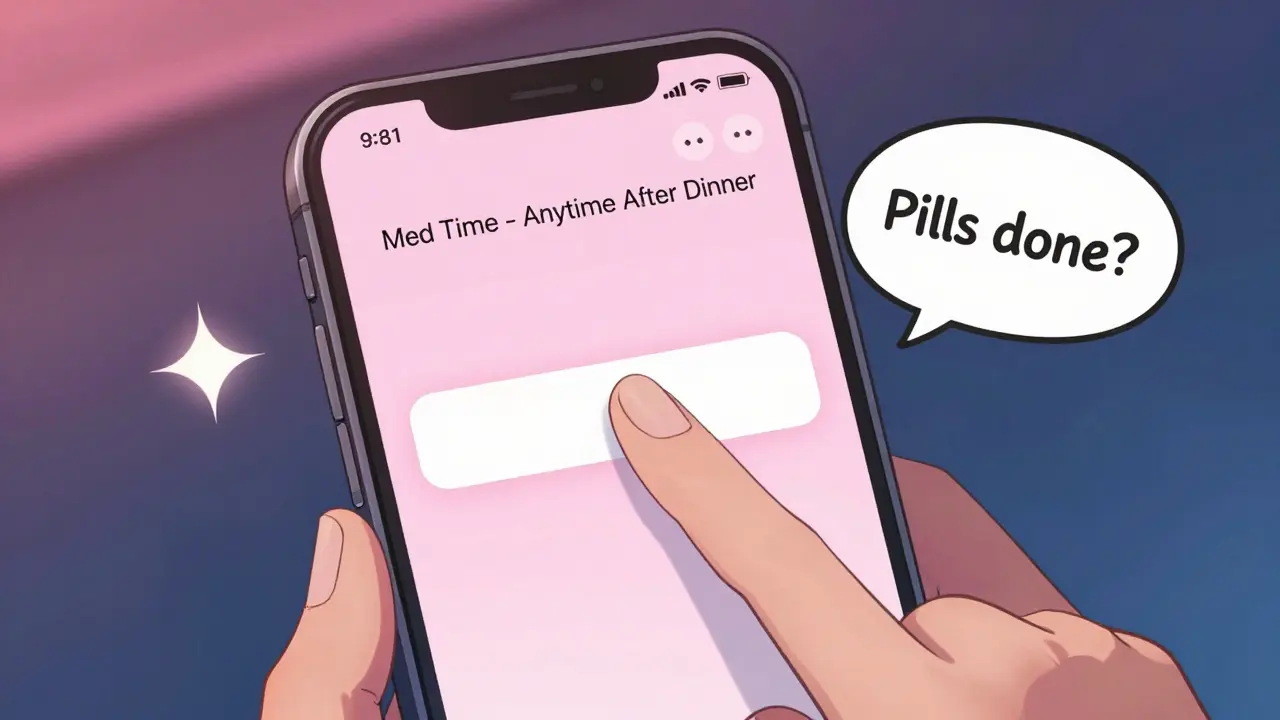
- "My evening dose goes in anytime after dinner, before bed."
This approach, tested by the Greater Boston Behavioral Health Institute, increases adherence by 28.6% during transitions. Why? Because it removes the guilt when things go off-schedule. You’re not failing - you’re adapting.
And here’s a pro tip: Use your phone’s calendar, but label events as "Med Time - Anytime in Window," not "8:00 a.m. Meds." That tiny change reduces stress and increases compliance.

Social Support Isn’t Optional - It’s Essential
One of the strongest predictors of adherence during stress? Having someone who checks in.
Health Psychology found that people with strong social support during transitions had 34.2% better adherence and 41.7% lower cortisol levels. That’s not coincidence. Connection reduces biological stress.
You don’t need a big network. Just one person. A friend. A sibling. A neighbor. Someone you trust.
Ask them: "Can you text me once a week just to ask if I’ve taken my meds? No judgment. Just a quick check-in." Most people say yes. And it works.
On Reddit’s r/ChronicIllness, users who had even one person checking in were 2.5 times more likely to stay on track during moves or job changes. One user wrote: "My sister texts me every Sunday: ‘Pills done?’ I hate it. But I take them because I don’t want to disappoint her."
Therapy Works - Especially Acceptance and Commitment Therapy
If you’re struggling emotionally during a transition, don’t wait until you’re in crisis. Talk to a therapist.
Acceptance and Commitment Therapy (ACT) is specifically designed for moments when life feels out of control. It doesn’t try to fix your stress. It teaches you to carry it - and still do what matters.
A 2022 JAMA Internal Medicine trial showed ACT improved medication adherence by 48.6% during transitions compared to standard care. That’s more than double the effect of reminders or apps.
ACT helps you answer questions like:
- "What’s one thing I still care about, even now?"
- "What would my healthiest self do today?"
- "How can I take this pill even if I feel broken?"
You don’t need to be "crazy" to benefit. You just need to be human.
Use Tools Designed for Transitions - Not Just General Apps
Most adherence apps are built for stable lives. They assume you’re home, on schedule, and not emotionally drained.
But a few apps are different. Tools like TransitionAdhere and LifeShiftRx are built for change. They ask: "What’s changing?" Then they help you adjust your plan - not just remind you.
Users rate these apps 4.2/5, compared to 3.5/5 for generic apps. Why? Because they include features like:
- "Transition Scenario Planner" - select your change (moving, job, breakup) and get a custom checklist.
- "Flexible Window Mode" - lets you set time ranges instead of fixed times.
- "Support Contact Sync" - lets you invite one person to get a gentle notification if you miss a dose.
These aren’t magic. But they’re designed for real life. And they work.
Ask Your Doctor - Before the Transition Starts
The American College of Physicians now recommends that doctors screen for upcoming life changes during every visit. But most don’t. So you have to ask.
Next time you’re in, say: "I’m going through a big change soon - moving, starting a new job, or going through a breakup. I’m worried I’ll stop taking my meds. Can we make a plan?"
Doctors can help with:
- Switching to once-daily pills if possible.
- Getting a 90-day supply to avoid refill stress.
- Writing a simple written plan: "When [change], do [action]."
And if they say no - ask for a referral to a care coordinator or pharmacist who specializes in adherence. Many hospitals now have them.
What Not to Do
Don’t wait until you’ve missed doses to act. Don’t blame yourself. Don’t assume your doctor knows what’s going on in your life.
And don’t rely on memory. Even if you’ve been perfect for years, transitions change everything.
One user on Reddit shared: "After my divorce, I stopped my antidepressants for three months. I didn’t think it was a big deal. I just felt like I didn’t need them anymore. I didn’t realize I was spiraling until I ended up in the ER."
That’s the cost of silence.
Start Small. Start Now.
You don’t need to overhaul your life. Just pick one thing.
- Today, pick your one anchor habit.
- Tomorrow, make your Three Lists.
- Next week, text someone and ask them to check in.
That’s it. No apps. No fancy tools. Just you, your health, and a plan that bends with your life - instead of breaking under it.
Medication adherence during transitions isn’t about willpower. It’s about design. And you’re smarter than your stress. You just need the right structure.
Why do I keep forgetting my meds during big life changes?
It’s not laziness - it’s cognitive overload. When your brain is busy adjusting to new routines, locations, or emotions, it drops non-essential tasks like medication. Your body’s stress response literally reduces your ability to manage complex habits. The solution isn’t better reminders - it’s simpler, more flexible systems that fit your changing life.
Are phone reminders useless during transitions?
Not useless - but limited. Generic reminder apps work well when your life is stable. But during transitions, they fail because they assume predictability. A 2023 study found their effectiveness drops by over 60% during moves or job changes. Use apps designed for transitions - ones that let you set flexible windows and adjust for life changes - or pair reminders with human support.
Can I switch to once-daily meds to make it easier?
Yes - and you should ask your doctor. Many medications come in once-daily versions, and simplifying your regimen cuts adherence risk by nearly half. If you’re on multiple pills a day, talk to your provider about combination pills, extended-release options, or adjusting doses. Even one fewer daily dose can make a huge difference during chaos.
What if I’m moving and don’t know my new pharmacy yet?
Call your current pharmacy before you move and ask for a transfer to a national chain like CVS or Walgreens - they can hold your prescription at any location. Or ask for a 30-day emergency supply with a "transfer pending" note. Many pharmacies will also mail your meds during transitions if you explain your situation. Don’t wait until you’re out of pills.
How do I know if I need therapy for adherence issues?
If you’ve missed doses because you felt hopeless, overwhelmed, or like "it doesn’t matter," therapy can help. Acceptance and Commitment Therapy (ACT) is proven to improve adherence during stress. You don’t need a diagnosis. You just need to be struggling. Many therapists offer short-term, goal-focused sessions just for this - often covered by insurance.
Next steps: Pick one small action today. Write down your three anchors. Text one person. Call your pharmacy. Don’t wait for the perfect moment. The perfect moment doesn’t exist - but your health does.
Amber Lane
January 19, 2026 AT 13:35This hit me right in the chest. I moved across the country last year and missed two weeks of my blood pressure meds. Didn't even realize until my head started spinning. The three lists thing? I'm writing mine today.
Malvina Tomja
January 21, 2026 AT 07:44Wow. Another self-help guru telling people to "just be more organized" while ignoring systemic healthcare failures. Your "Three Lists" is just victim-blaming wrapped in psychology jargon. If your meds aren't accessible, affordable, or supported by your provider, your brain isn't the problem.
MARILYN ONEILL
January 22, 2026 AT 05:49Oh honey. You think this is new? I've been doing this since 2017. The real issue is people don't have access to ACT therapists in rural areas. And no, your "TransitionAdhere" app isn't magic. It's just a glorified Google Calendar with extra steps. I've seen 37 patients crash because they trusted apps over real human care. You're missing the point entirely.
MAHENDRA MEGHWAL
January 23, 2026 AT 22:20Your analysis is methodical and grounded in empirical evidence. I appreciate the distinction between control and influence. In India, where family structures often mediate health behaviors, the concept of "one person checking in" is culturally resonant. Many patients rely on elder relatives for medication adherence during transitions. Perhaps integrating community-based support into digital tools would enhance scalability.
Dee Monroe
January 24, 2026 AT 22:14Let me tell you something deeper. It’s not just about pills or lists or apps. It’s about identity. When your life fractures - divorce, job loss, relocation - the version of you that took meds every morning at 8 a.m. feels like a ghost. You don’t forget because you’re lazy. You forget because you don’t recognize yourself anymore. That’s why anchors matter. Brushing your teeth isn’t about dental hygiene. It’s about whispering to your old self: "I’m still here. I still care. I’m still me." And that? That’s the quietest, most powerful act of rebellion against chaos. You don’t need to fix everything. Just hold onto one thread. One ritual. One breath. And that thread? It pulls you back to life.
Sangeeta Isaac
January 26, 2026 AT 21:27lol at the "Three Lists" like it's a tarot card reading. I tried it after my breakup and ended up with a sticky note that said "Meds = good, crying = normal, also why is my cat judging me." But honestly? The anchor thing worked. Took my pill after coffee for 3 weeks straight even though I was sleeping on my couch with a dog I didn't own. Also, I told my barista to ask if I took my meds. She did. I did. We both felt weirdly proud. 🤝
Philip Williams
January 27, 2026 AT 19:28This is an exceptionally well-researched and structured piece. The integration of behavioral psychology with practical, scalable interventions is commendable. I particularly appreciate the emphasis on flexible scheduling over rigid timing. The data on ACT and social support are compelling and should be disseminated more widely within primary care settings. Thank you for elevating this conversation beyond compliance metrics.
Melanie Pearson
January 28, 2026 AT 06:05Who gave you the authority to tell people how to manage their health? You're not a doctor. You're not a therapist. You're just some blogger with a checklist. And now you're telling people with chronic illness that their suffering is just a matter of "mental energy allocation"? That's dangerous. If your system fails people, don't blame them for adapting to it.
Jerry Rodrigues
January 29, 2026 AT 14:27Anchor habits saved me during my divorce. Took my pill after I poured my coffee. Same spot. Same time window. Didn't fix my life. But it kept me from vanishing into it. Also, my sister texts me every Sunday. I hate it. But I take them. Just like that Reddit post said.
Uju Megafu
January 31, 2026 AT 11:45Oh please. You think this is about lists? It's about capitalism. You can't afford your meds? You don't have a stable home? You're a single mom working two jobs? No one's gonna care about your "anchor habits" when you're choosing between rent and insulin. This is privilege dressed up as advice. You're not helping. You're silencing.
Jarrod Flesch
January 31, 2026 AT 13:33Mate, this is gold. I've been using LifeShiftRx since I moved from Melbourne to Sydney for work. The "transition scenario planner" actually asked me if I was moving alone or with kids. Then it gave me a checklist with my meds, pharmacy transfer, and even a note to text my mum. I cried reading it. Not because I was sad. Because someone finally got it. 🤗
Barbara Mahone
February 1, 2026 AT 00:18Accurate and thoughtful. The distinction between control and influence is clinically significant. I recommend this framework to all my patients undergoing life transitions. The psychological burden of attempting to manage uncontrollable variables is often the primary driver of non-adherence, not forgetfulness. Simple, effective, and grounded in evidence.
Kelly McRainey Moore
February 1, 2026 AT 07:55Just wanted to say thank you. I’ve been on antidepressants for 8 years. I missed doses during my mom’s funeral and didn’t tell anyone. I thought I was being strong. Reading this made me cry. I’m texting my cousin tomorrow. Just to say: "Hey, can you check in?"
Stephen Rock
February 2, 2026 AT 06:24Look I get it. You think you're being helpful. But this whole post is just a fancy way of saying "try harder". People don't need more lists. They need cheaper meds, better insurance, and doctors who actually listen. Your "Three Lists" sounds like something a corporate wellness app would push to avoid paying for real care. You're not solving the problem. You're just giving people a new way to feel guilty.
Andrew Rinaldi
February 3, 2026 AT 18:06There’s a quiet dignity in the small rituals we cling to when everything else is falling apart. You don’t need to fix your life to take your medicine. You just need to remember who you are when you’re not broken. That’s what the anchors do. They don’t change the storm. They remind you that you’re still on the boat. And that’s enough.