
Medication errors are a leading cause of emergency room visits for kids. In fact, the CDC reports that these mistakes account for about 1.4 million annual trips to the ER in the United States. It is a scary statistic, but the good news is that most of these errors happen because parents misread labels or guess doses. You do not have to guess anymore. Learning how to read OTC children’s medication labels correctly can keep your child safe and ensure they get the right amount of medicine to feel better.
The rules for labeling have changed significantly over the last decade. The FDA, working with the American Academy of Pediatrics (AAP), updated standards to make labels clearer. If you are holding a bottle of liquid medicine today, it should look different than it did ten years ago. But even with better labels, confusion remains. This guide will walk you through exactly what to look for, why weight matters more than age, and how to avoid common pitfalls that lead to dangerous overdoses or ineffective underdosing.
Why Weight Matters More Than Age
You might be tempted to just look at the age chart on the back of the bottle. After all, everyone knows how old their child is. But here is the hard truth: two five-year-olds can weigh vastly different amounts. One might be small and slender, while the other is larger and stockier. Their bodies process medicine differently based on their mass, not their birthday.
The American Academy of Pediatrics emphasizes that weight-based dosing is the gold standard for determining correct pediatric medication amounts. A study from Johns Hopkins Children’s Center found that relying solely on age leads to dosing errors in 23% of cases. In 15% of those cases, the child was underdosed, meaning they didn't get enough relief. In 8% of cases, they were overdosed, which can be dangerous.
If you know your child's weight, always use the weight column on the label. If you do not know their exact weight, estimate it carefully. However, if your child falls between two weight categories, the general rule recommended by pediatric experts like those at Pediatric Associates of NYC is to round down to the lower weight category. It is safer to give slightly less than to risk an overdose. If you are unsure, call your pediatrician or a pharmacist.
Decoding the Label: What to Look For
When you pick up a box of children's medicine, your eyes need to go straight to the "Drug Facts" panel. This section is standardized by the FDA so it looks similar across brands. Here is what you need to find:
- Active Ingredients: This tells you what is actually in the medicine. For fever and pain, this is usually acetaminophen or ibuprofen. Check this list carefully if you are giving multiple medicines, as many cold remedies contain acetaminophen too. Giving two products with the same active ingredient can lead to an accidental overdose.
- Purpose: This describes what the medicine treats, such as temporary relief of minor aches or fever.
- Warnings: Look for bold text that says "Do not use" for certain ages. For example, ibuprofen labels must state "Do not give to children under 6 months." Acetaminophen labels often warn about liver damage if too much is taken.
- Dosage Instructions: This is the core table. It will have columns for weight (in pounds and kilograms) and rows for age ranges. It will tell you exactly how many milliliters (mL) to give.
- Other Information: This includes storage instructions and when to stop using the medicine and call a doctor.
Pay close attention to the concentration. Since 2011, the FDA has mandated that children's liquid acetaminophen comes in one standard strength: 160mg per 5mL. This was done to prevent confusion between "infant drops" and "children's liquid," which used to have different strengths. Always check the label to confirm this ratio. If you see a different concentration, double-check with a pharmacist before using it.
Acetaminophen vs. Ibuprofen: Key Differences
Most parents have two main options for fever and pain: acetaminophen (often sold as Tylenol) and ibuprofen (often sold as Advil or Motrin). They work differently, and their labels reflect those differences.
| Feature | Acetaminophen | Ibuprofen |
|---|---|---|
| Minimum Age | 2 months (with doctor approval) | 6 months |
| Dosing Frequency | Every 4-6 hours | Every 6-8 hours |
| Max Daily Doses | 5 doses in 24 hours | 4 doses in 24 hours |
| Standard Concentration | 160mg / 5mL | 100mg / 5mL |
| Key Warning | Liver damage risk if overdosed | Kidney irritation; give with food/water |
Notice the frequency difference. Acetaminophen can be given more often, but you must strictly adhere to the maximum of five doses in 24 hours. Ibuprofen lasts longer, so you give it less frequently. Also, never give ibuprofen to a child who is dehydrated or vomiting excessively, as it can stress the kidneys. Acetaminophen is generally gentler on the stomach but harder on the liver if misused.
The Danger of Household Spoons
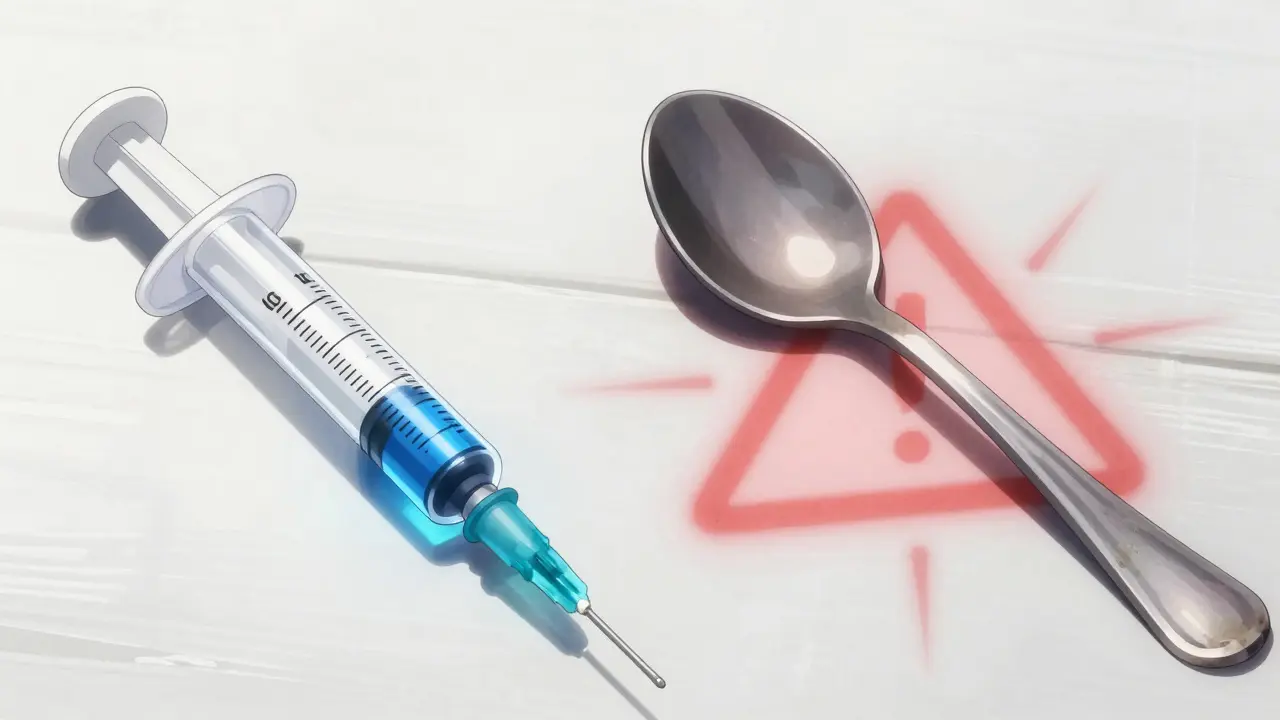
This is perhaps the most critical part of reading the label. The label will tell you to give a certain number of milliliters (mL) is the standard unit of volume for liquid medications. It will NOT tell you to use a kitchen spoon.
Household teaspoons vary wildly in size. A standard teaspoon holds about 5mL, but some hold 4mL, others 7mL. That variation can mean your child gets 40% more medicine than intended. The St. Louis Children’s Hospital notes that using kitchen utensils is a leading cause of dosing errors. In fact, 42% of medication errors reported by patients involved using kitchen spoons instead of proper devices.
Always use the device that came with the medicine. This could be a plastic cup, a syringe, or a specially marked spoon. These devices are calibrated to deliver exact mL amounts. If you lost the original device, buy a new one from the pharmacy. Do not improvise with cutlery from your drawer. Remember: 1 teaspoon (tsp) equals approximately 5mL, and 1 tablespoon (tbsp) equals approximately 15mL. Confusing tsp and tbsp is a common mistake that triples the dose instantly.
Common Pitfalls and How to Avoid Them
Even with clear labels, parents make mistakes. Here are the most frequent issues and how to sidestep them:
- Double-Dipping Active Ingredients: Many multi-symptom cold medicines contain acetaminophen. If you give your child Tylenol for a fever and then a cold syrup for a cough, you might be giving them twice the recommended dose of acetaminophen. Always check the "Active Ingredients" list on every product. If you are giving more than one medicine, talk to a pharmacist first.
- Ignoring the "Liver Warning": In February 2024, the FDA required all acetaminophen products to include a bold "Liver Warning" for children under 12. This is because acetaminophen overdose is the leading cause of acute liver failure in children. Never exceed the maximum daily dose listed on the label.
- Misreading Abbreviations: Labels use abbreviations like "q4h" (every 4 hours) or "PRN" (as needed). If you are not familiar with medical shorthand, ask someone to explain it. Don't assume you know what it means.
- Using Expired Medicine: Check the expiration date. Old medicine may not work effectively, or it could break down into harmful compounds. Dispose of expired meds properly at a pharmacy take-back location.
A study published in the Journal of Pediatric Pharmacology and Therapeutics found that 35% of parents still struggle with interpreting mL measurements. To help, some modern bottles now include QR codes that link to video instructions. If you see one, scan it. Visual guides can be incredibly helpful when you are tired and worried about a sick child.

When to Call the Doctor
Labels provide general guidance, but they cannot replace professional medical advice. You should call your pediatrician if:
- Your child is under 3 months old and has a fever. Do not give any medication without explicit instruction from your doctor.
- Your child weighs less than 12 lbs or more than 95 lbs, as standard charts may not cover extreme weights accurately.
- The fever persists for more than 3 days despite medication.
- Your child shows signs of an allergic reaction, such as hives, swelling, or difficulty breathing.
- You are unsure about the dose or have accidentally given too much. Call Poison Control immediately if you suspect an overdose.
Dr. Jennifer Shu, FAAP, reminds parents that "The correct dose for your child is based on their weight, not their age. Do not guess their weight." When in doubt, reach out. Your pediatrician would rather answer a quick question than treat a preventable error.
Practical Tips for Safe Dosing
To make the process smoother and safer, try these practical steps:
- Weigh Your Child Regularly: Keep a recent weight record in your phone or on the fridge. Weights change quickly in toddlers and young children. An outdated weight can lead to an incorrect dose.
- Use a Timer: Set a timer on your phone for when the next dose is due. This helps you track how many doses have been given in the last 24 hours, preventing accidental overuse.
- Read in Good Light: It is easy to misread numbers in the dark when your child is sick at night. Use your phone flashlight to illuminate the label clearly.
- Ask the Pharmacist: When you buy the medicine, ask the pharmacist to show you exactly how much to put in the syringe for your child's specific weight. They can mark the syringe with a pen for clarity (if allowed).
Safety starts with knowledge. By taking the time to understand the label, you empower yourself to care for your child confidently. The goal is not just to reduce a fever, but to do so safely and effectively. With the right tools and information, you can navigate OTC medications with ease.
Can I use infant drops and children's liquid interchangeably?
No, you should not switch between them without checking the concentration. While the FDA standardized children's acetaminophen to 160mg/5mL, some infant drops may still be available in older stocks or different formulations with higher concentrations. Always read the "Active Ingredients" section to compare mg per mL. Using the wrong formulation can lead to serious overdosing or underdosing.
What if my child's weight is between two categories on the label?
If your child's weight falls between two categories, it is generally safer to round down to the lower weight category. For example, if your child weighs 25 lbs and the chart has categories for 18-23 lbs and 24-35 lbs, use the dose for the 18-23 lb range. This prevents accidental overdosing. If you are uncertain, consult your pediatrician for precise guidance.
Is it safe to alternate acetaminophen and ibuprofen?
Alternating these medications can be effective for high fevers, but it increases the risk of dosing errors. It is easy to lose track of when each medicine was last given. Most pediatricians recommend sticking to one medication unless specifically instructed otherwise. If you do alternate, keep a written log of times and doses to avoid confusion.
Why shouldn't I use a kitchen teaspoon?
Kitchen teaspoons are not standardized and can vary in volume by 20-30%. A standard teaspoon is 5mL, but a household spoon might hold 4mL or 7mL. This variation can result in giving your child significantly more or less medicine than prescribed. Always use the calibrated dosing device provided with the medication or purchased from a pharmacy.
What should I do if I accidentally give my child too much medicine?
If you suspect an overdose, contact Poison Control immediately at 1-800-222-1222 (in the US) or your local emergency services. Do not wait for symptoms to appear. Have the medication bottle ready to provide details about the active ingredients and the estimated amount given. Quick action is crucial, especially with acetaminophen, which can cause silent liver damage.