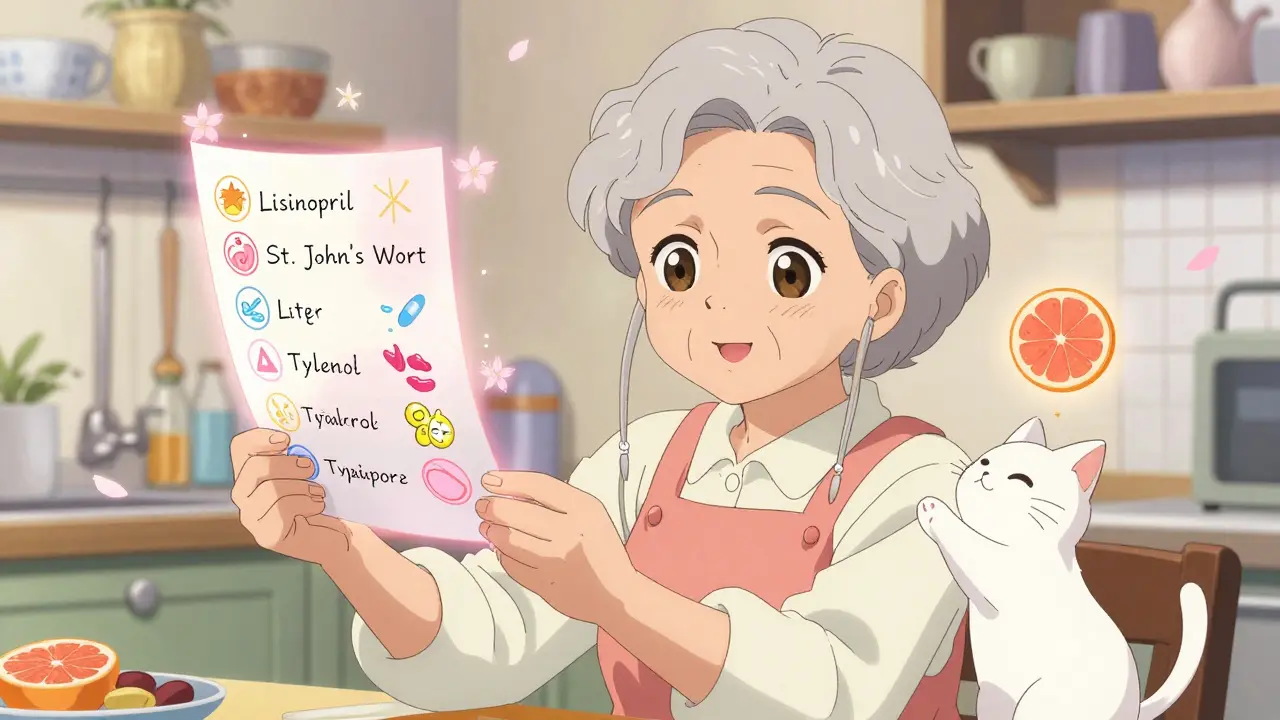
Every year, over 100,000 people in the U.S. die from adverse drug reactions-many of which could have been prevented with one simple step: sharing a complete, up-to-date medication list. It’s not just about prescriptions. It’s about the vitamins you take, the herbal supplements you swallow, the painkillers you grab off the shelf, and even the foods you avoid. If you’re on five or more medications-which 40% of adults over 65 are-you’re at higher risk. And if your doctors don’t know everything you’re taking, they can’t protect you.
What a Complete Medication List Actually Includes
A medication list isn’t just a note in your phone or a scribble on a napkin. A real, usable list has details that matter. For every medication, you need:- Exact name: Both brand and generic (e.g., "Lisinopril 10 mg" not just "blood pressure pill")
- Dosage and frequency: "Take 1 tablet twice daily"-not "once a day"
- Route: Oral, topical, injected? Specify.
- Reason for taking it: "For high blood pressure," "for arthritis pain," "for sleep"
- Start date: When did you begin? This helps spot patterns.
- Prescribing provider: Who wrote the script? Your GP? Cardiologist? Dentist?
- Special instructions: "Take on empty stomach," "avoid grapefruit," "take with food"
And don’t forget the stuff people leave out: over-the-counter meds like Tylenol Extra Strength (500 mg), vitamins like Vitamin D3 (2000 IU), and supplements like St. John’s Wort (300 mg). These aren’t "harmless." St. John’s Wort can make blood thinners like warfarin useless-or dangerously strong. The FDA reports that 30% of serious drug interactions involve these hidden ingredients.
Why Paper Lists Often Fail
Many people keep a paper list in their wallet. It sounds practical-until you’re rushed in an emergency room, fumbling through receipts and pill bottles. A 2022 study in the Journal of Patient Safety found paper lists were only 62% accurate during emergencies. Why? People forget to update them. They write down what they took last week, not what they started yesterday. They leave out supplements. They don’t note when a drug was stopped.And if you’re sharing a list with multiple doctors-say, your primary care physician, a cardiologist, and a rheumatologist-each one might have a different version. That’s how duplication happens: two doctors prescribe the same thing, not knowing the other already did. That’s how interactions slip through.
Digital Lists Are Better-But Only If Used Right
Smartphone apps like Medisafe or MyMeds help. They send reminders, track doses, and can even generate printable summaries. Studies show users of these apps improve adherence by 76-83%. But here’s the catch: 23% of adults over 65 don’t own smartphones, according to Pew Research. So digital isn’t universal.Even more importantly, most apps only track prescriptions. They rarely include supplements unless you manually add them. And if you don’t update them within 24 hours of a change, they’re worse than useless-they’re misleading.
The best approach? Use both. Keep a digital list synced to your phone, but also print a clean, one-page summary. Keep that printed copy in your wallet, purse, or car. Make sure it’s easy to find.
How Your Pharmacy Can Be Your Secret Weapon
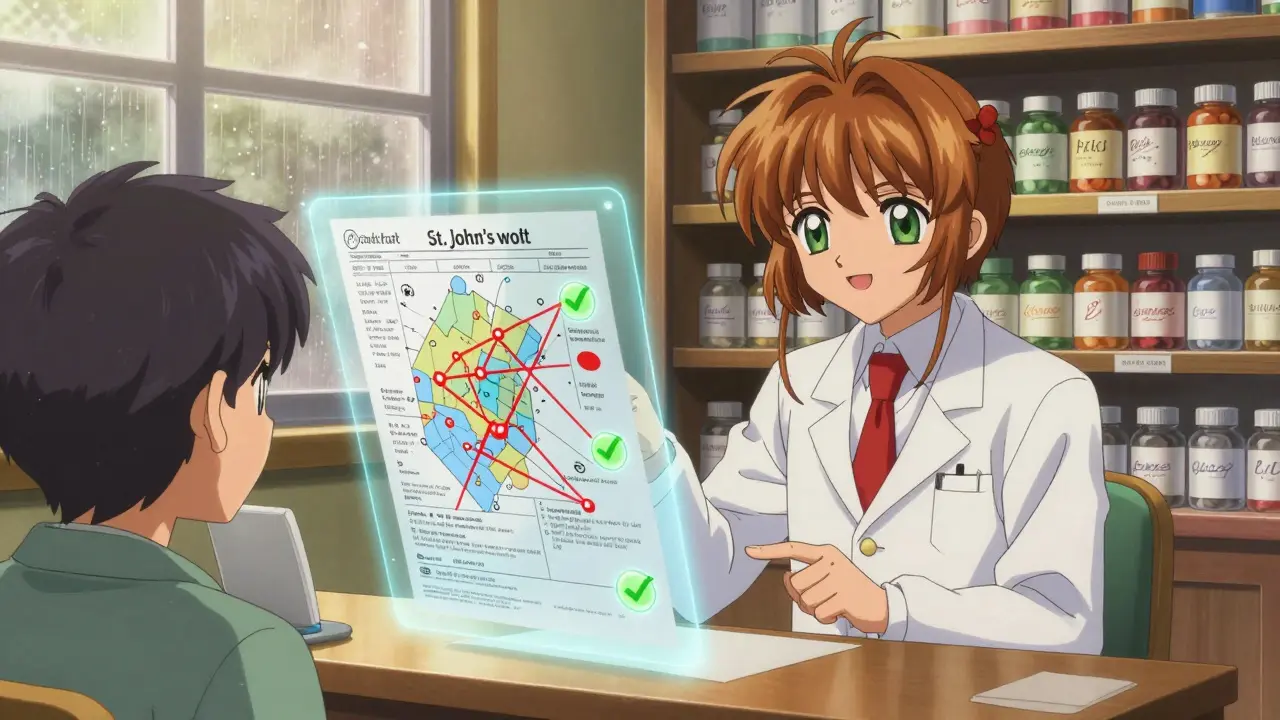
One of the most overlooked tools is your pharmacist. Independent pharmacies in the UK and U.S. use systems that check all your prescriptions against each other-prescription, OTC, and supplements-with a 92% accuracy rate for major interactions, according to FDA data. That’s higher than most hospital systems.Here’s what to do: Use one pharmacy for all your prescriptions. Even if you get scripts from different doctors, have them all filled at the same place. That way, the pharmacist sees everything you’re taking. When you pick up a new med, ask: "Could this interact with anything else I’m on?" Don’t wait for them to ask you. Most won’t.
Pharmacists at Johns Hopkins Hospital reduced adverse drug events by 41% just by asking patients to bring their full list to every visit. That’s not magic-it’s basic safety.
What Providers Don’t Tell You (But Should)
A 2022 Medscape survey found that 76% of patients keep some kind of medication list-but only 32% include all supplements and OTC drugs. Why? Because most providers don’t ask for them. In fact, 63% of doctors don’t routinely request a full list, according to MedlinePlus.So don’t wait. Walk into every appointment-whether it’s your GP, a specialist, or the ER-with your list in hand. Hand it to the nurse or doctor before they even sit down. Say: "Here’s my full list. Can you check for interactions?"
And if you see three or more specialists, designate one provider-usually your primary care doctor-as your medication coordinator. They’re the only one who sees the full picture. Ask them to review everything every six months.
The Biggest Mistakes People Make
The Institute for Safe Medication Practices tracked the top six errors that lead to harm:- Leaving out over-the-counter meds (37% of errors)
- Forgetting to note when a drug was stopped (28%)
- Wrong dosage or frequency (22%)
- No allergy info (19%)
- Missing timing instructions (15%)
- Not updating the list for over a month (52%)
Most of these are fixable. Take five minutes every Sunday to check your list. Compare it to your pill bottles. Update it if anything changed. Take a photo of each bottle with your phone-front and back. That way, if you forget a name, you’ve got a visual backup.
Timing Matters More Than You Think
It’s not just what you take-it’s when. Take levothyroxine (thyroid med) 30-60 minutes before breakfast. Take metformin with food to avoid stomach upset. Take statins in the evening-they work better then. Take calcium supplements at least four hours apart from thyroid meds or antibiotics.These aren’t suggestions. They’re science. Miss the timing, and the drug might not work-or it could cause side effects. Write these instructions on your list. Don’t rely on memory.

What to Say to Your Doctor
Don’t just hand over the list and hope they’ll read it. Ask the right questions:- "Could any of these medications interact with each other?"
- "Should I avoid any foods, drinks, or supplements while taking these?"
- "Is there a simpler way to take these? I’m on a lot right now."
- "Is there one I can stop?"
Patients who ask these questions are 40% more likely to catch a dangerous interaction, according to the National Council on Patient Information and Education. Your doctor isn’t mind-reading. You have to lead.
What’s Changing in 2025
The system is slowly catching up. The Office of the National Coordinator for Health IT launched "My Health Record" in early 2023, letting patients pull all their pharmacy data into one digital account. AI tools like IBM Watson Health now detect 94% of clinically significant interactions. By 2026, 75% of digital health records will include patient-reported supplements and OTC meds-thanks to new standards.But until then, you’re still the most important link in the chain. No app, no EHR, no AI can replace you knowing what’s in your medicine cabinet and speaking up.
Real Stories, Real Results
On Reddit, a user named "MedSafetyMom" shared how she saved her husband’s life. He was on warfarin for a blood clot. He started taking St. John’s Wort for low mood. Three specialists missed it. His INR levels spiked dangerously. She brought the full list-including the supplement-to his next appointment. The pharmacist caught it. They stopped the supplement. He was fine.That’s not rare. On Yelp, 217 reviews from independent pharmacies in early 2023 credit pharmacists with "catching a dangerous interaction" because the patient brought their full list. These aren’t miracles. They’re preventable.
Every time you update your list, you’re not just being organized. You’re protecting your life.
What should I do if I can’t remember all my medications?
Take a photo of every pill bottle in your medicine cabinet-front and back. That includes prescriptions, OTC meds, vitamins, and supplements. Use your phone’s camera roll as your backup. You don’t need to memorize names-just match the bottle to your list. Many apps let you scan barcodes to auto-fill details. If you’re unsure, bring the actual bottles to your appointment.
Do I need to update my list every time I get a new prescription?
Yes. Update your list within 24 hours of any change-whether it’s a new drug, a dose change, or something you stopped. Outdated lists are the #1 cause of medication errors. Even if your doctor says "I’ll update it," write it down yourself. Don’t rely on someone else to remember.
Can I just rely on my electronic health record?
No. EHRs are only 52% accurate for over-the-counter meds and 38% accurate for supplements. Hospitals and clinics don’t always capture what you buy at the pharmacy or take on your own. Your personal list is your backup-and your best protection.
What if my doctor doesn’t look at my list?
Hand it to them at the start of the visit. Say: "I’ve updated my list. Could you check for interactions?" If they ignore it, ask again. If they still don’t care, consider switching providers. Your safety matters more than their convenience.
Are there free tools I can use to make a medication list?
Yes. The FDA offers a free "My Medicine Record" form you can print or fill out online. The American Academy of Family Physicians also has a printable template. Apps like Medisafe and MyMeds have free versions. Use any of them-just make sure you update them and carry a printed copy.
How often should I review my medication list?
Review it every month. Compare it to your pill bottles. Update it if anything changed. Every six months, schedule a full review with your primary care provider. If you’re on five or more meds, ask your pharmacist to do a free medication therapy review-they’re trained to spot hidden risks.
Melissa Taylor
December 15, 2025 AT 22:15Every Sunday night, I sit with my pill organizer and match each pill to my printed list. It takes five minutes, but it’s saved me from two near-misses already. I keep the list in my wallet and in my phone’s notes-just in case. This isn’t about being obsessive; it’s about being smart.
John Brown
December 17, 2025 AT 16:37My grandma used to carry her meds in a shoebox labeled ‘stuff I take.’ She didn’t know the names, just the colors. I got her a Medisafe app, showed her how to scan bottles, and now she brings a printed copy to every appointment. She says it makes her feel like she’s actually in control for once. Small wins matter.
John Samuel
December 19, 2025 AT 14:37It is, without hyperbole, a moral imperative that every individual who consumes pharmacological agents-whether prescribed, over-the-counter, or derived from botanical sources-maintains a meticulously curated, chronologically annotated, and universally accessible pharmacopeia. The absence of such diligence constitutes not mere negligence, but a form of self-endangerment that reverberates across the entire healthcare ecosystem. The FDA’s own data, corroborated by peer-reviewed literature, unequivocally establishes that polypharmacy-related morbidity is not an inevitability-it is a failure of personal accountability. Let us not mistake convenience for competence.
Michelle M
December 20, 2025 AT 00:08I used to think my meds were just… mine. Like my socks or my coffee mug. But then I realized: they’re not. They’re part of a system I don’t control. A system where doctors forget, apps glitch, and supplements slip through like ghosts. I started writing down everything-even the magnesium I take at night. It didn’t change my life. But it changed how I feel about it. Like I’m not just surviving my meds. I’m managing them. And that’s a quiet kind of power.
RONALD Randolph
December 21, 2025 AT 01:59STOP. JUST STOP. If you can't remember what you're taking, you shouldn't be taking it. This isn't 'self-care.' This is basic responsibility. You don't get to be irresponsible and then blame the system. Your pharmacist isn't your babysitter. Your doctor isn't your librarian. You have one brain. Use it. Write it down. Update it. Print it. Carry it. Or don't complain when you end up in the ER because you forgot you took two Tylenol with your blood thinner. I've seen it. It's pathetic.
Mike Nordby
December 22, 2025 AT 00:47There’s a critical flaw in the assumption that digital tools solve this problem. Many elderly patients, especially in rural areas, lack reliable internet or digital literacy. Even when they have smartphones, they may not trust apps with health data. The most effective solution remains the printed, hand-written list-updated weekly, carried consistently, and presented proactively. Technology should augment, not replace, human diligence.
Christina Bischof
December 22, 2025 AT 12:32I just started keeping a list after my mom had that scare with the St. John’s Wort. I didn’t even know it could mess with blood thinners. Now I take a pic of every bottle when I get a new one. I don’t overthink it. Just snap, save, update. It’s not perfect, but it’s better than guessing.
Jocelyn Lachapelle
December 23, 2025 AT 12:01My pharmacist asked me last week if I was taking turmeric. I said no. He said my prescription showed it. Turns out I’d been taking it in a smoothie every morning. He laughed. I blushed. We fixed it. He didn’t judge. He just helped. That’s the kind of care we need more of.
Sai Nguyen
December 25, 2025 AT 07:57Why do Americans need so many pills? In India, we take one or two. We trust nature. We don't over-medicate. This list obsession is a symptom of a broken system.
Lisa Davies
December 25, 2025 AT 19:20Just started using the FDA’s My Medicine Record form. Printed it, laminated it, stuck it in my purse. My mom’s 78 and doesn’t use a phone. This is her lifeline now. And yes-I cried when she said, ‘I finally feel like someone’s listening.’ 💙