
Using a pill organizer can save your life - or end it. It sounds extreme, but it’s true. Every year, thousands of people accidentally take too much medication because they misused a simple plastic box with compartments. The problem isn’t the organizer. It’s how people fill it, store it, or assume it’s foolproof. If you’re managing multiple pills a day, especially for chronic conditions like high blood pressure, diabetes, or heart disease, a pill organizer is a tool - not a shortcut. Use it right, and you’ll avoid missed doses and dangerous double-ups. Use it wrong, and you could end up in the hospital - or worse.
Not All Pills Belong in a Pill Organizer
Before you even open your organizer, check what’s inside your pill bottles. Some medications simply shouldn’t go in a pill box. Liquid medications, like cough syrups or insulin, can leak and ruin other pills. Soft gel capsules, like fish oil or vitamin E, stick together in humid conditions. Chewable or dissolvable tablets can crumble or lose potency. And if your medicine needs to be kept cold - like some antibiotics or biologics - don’t even think about putting it in a drawer or bathroom cabinet. Most pill organizers aren’t refrigerated, and heat and moisture destroy these drugs faster than you think.
The biggest danger? Putting "as needed" pills in your daily compartments. That’s painkillers like ibuprofen or oxycodone, sleep aids, or anti-anxiety meds you take only when symptoms hit. If you put them in the same slots as your daily blood pressure pills, you might grab one thinking it’s part of your routine. That’s how overdoses happen. One study found that 38% of accidental overdoses from pill organizers came from mixing scheduled meds with "as needed" ones. Keep PRN meds in their original bottles, clearly labeled, and store them separately. Treat them like a fire extinguisher - only use when necessary, not as part of your morning ritual.
Fill One Medication at a Time - No Exceptions
Most people try to save time by dumping all their pills into the organizer at once. Big mistake. You’re not just organizing - you’re verifying. Each pill needs to be checked against your current prescription list. A 2023 study from Memorial Sloan Kettering found that filling one medication at a time cuts double-dosing errors by 63%. Here’s how to do it right:
- Wash your hands with soap for at least 20 seconds. Clean hands prevent contamination.
- Gather all your medication bottles and your current medication list - the one your doctor gave you last month, not the one from last year.
- Take one medication bottle at a time. Open it. Read the label. Count out the correct number of pills for each time of day.
- Place them only into the correct compartment - morning, afternoon, evening, night - based on the label.
- Before moving to the next pill, look at the compartment you just filled. Does it match what’s on the bottle? Does it match your list? If not, stop. Double-check.
Never fill more than one day at a time if you’re unsure. If you’re switching meds, waiting for a refill, or just got new instructions from your pharmacist - wait. Fill your organizer only after you’ve confirmed everything with your provider. Skipping this step is how 49% of overdose incidents happen, according to Reddit’s r/MedicationAdherence community.
Never Store Your Organizer in the Bathroom
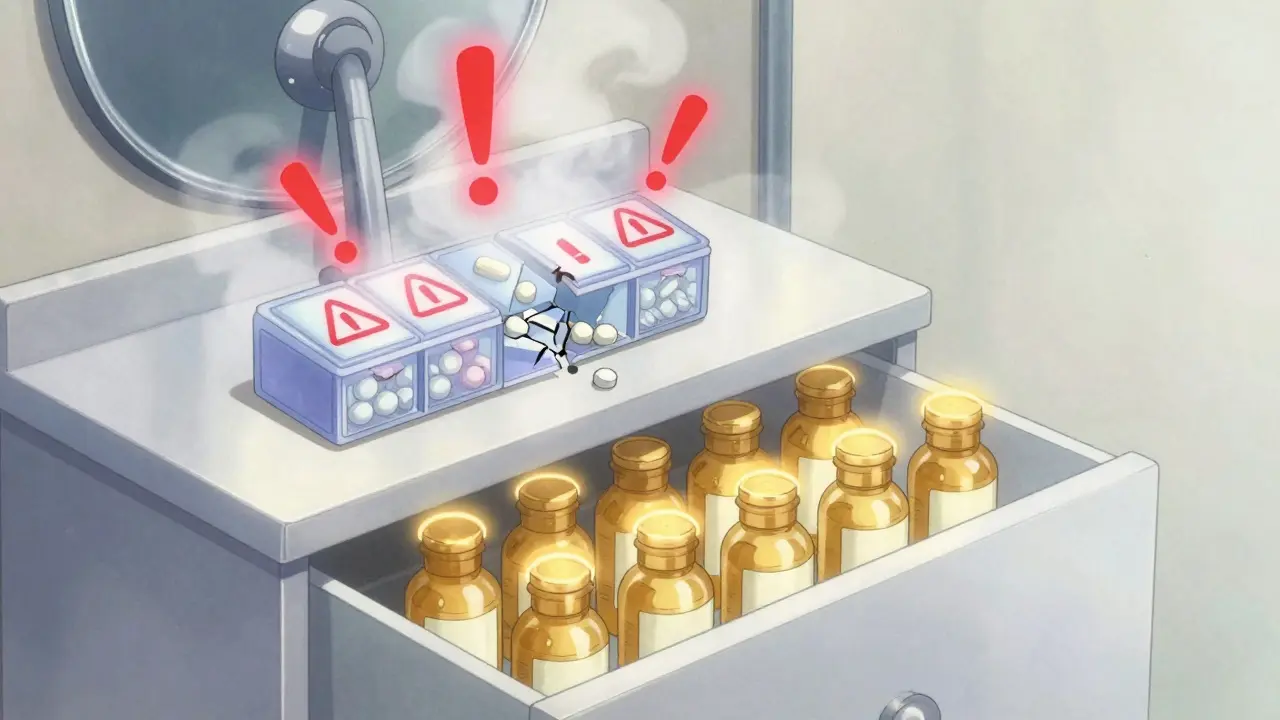
It’s convenient. You brush your teeth, wash your face, and grab your pills. But bathrooms are the worst place to store medication. Steam from showers raises humidity. Heat from hot water and dryers raises temperature. Pill organizers are made of plastic, not climate-controlled vaults. High humidity causes pills to break down, stick together, or lose strength. A 2022 study showed that pills stored in a bathroom degraded 47% faster than those kept in a cool, dry place.
Store your organizer in a drawer in your bedroom, a kitchen cabinet away from the stove, or a shelf in your hallway - anywhere cool, dry, and out of reach of kids or pets. The CDC recommends keeping the temperature below 86°F (30°C) and humidity under 60%. If you live in a humid climate like Bristol, keep a small dehumidifier in the room, or use a silica gel packet inside the organizer’s storage area. Never leave it on the counter near the sink.
Use Original Bottles as Your Backup
Your pill organizer is a helper - not your primary record. The original bottles have the most accurate info: dosage, expiration date, prescribing doctor, pharmacy phone number. If you’re ever confused about what’s in a compartment, your first stop should be the bottle. But 68% of users don’t keep them nearby, according to Hero Health’s 2023 survey. That’s a recipe for disaster.
Keep your medication bottles within arm’s reach while you fill your organizer. After you’ve filled it, place the bottles next to it - not in a closet or junk drawer. When you take your pills, glance at the bottle before you pop one into your mouth. This simple habit reduces verification errors by 31%, according to Memorial Sloan Kettering. If you’re worried about clutter, use a small basket or tray. Label it: "Medication Reference."
Smart Features Can Help - But They’re Not Magic
Electronic pill organizers with alarms, app alerts, and compartment sensors sound like the perfect solution. And for some, they are. But they’re expensive - $25 to $100 - and they don’t fix bad habits. If you don’t fill them correctly, the alarm just reminds you to take the wrong pill. Some models can detect if you’ve opened a compartment too often and send an alert to a family member. That’s useful if you have dementia or memory issues.
But here’s the catch: even the smartest organizer can’t tell if you’ve put the wrong pill in. If you swap your blood pressure pill for your cholesterol pill, the alarm will still beep. That’s why Medicare started covering smart organizers in January 2023 - but only for people with four or more chronic conditions and a documented history of missed doses. If you’re considering one, ask your pharmacist to help you set it up. Don’t rely on the manual.
Check Expiration Dates - Even in the Organizer
Pills don’t expire the day the bottle says. They expire when they’re exposed to heat, light, or moisture - and putting them in a plastic box doesn’t stop that. Most solid pills stay stable for about 30 days in a properly stored organizer. After that, potency drops. Some medications, like nitroglycerin for heart conditions, lose effectiveness in weeks. If you refill your organizer weekly, you’re fine. But if you fill it for a month because you’re "too busy," you’re risking ineffective doses or, worse, toxic buildup from degraded pills.
Write the date you filled your organizer on a sticky note and stick it to the top. Every Sunday, toss out last week’s pills and refill. Never reuse old compartments. Even if the pills look fine, they’re not guaranteed to work. If you’re unsure, call your pharmacy. They’ll tell you if it’s safe.
Teach Others - Or Get Help
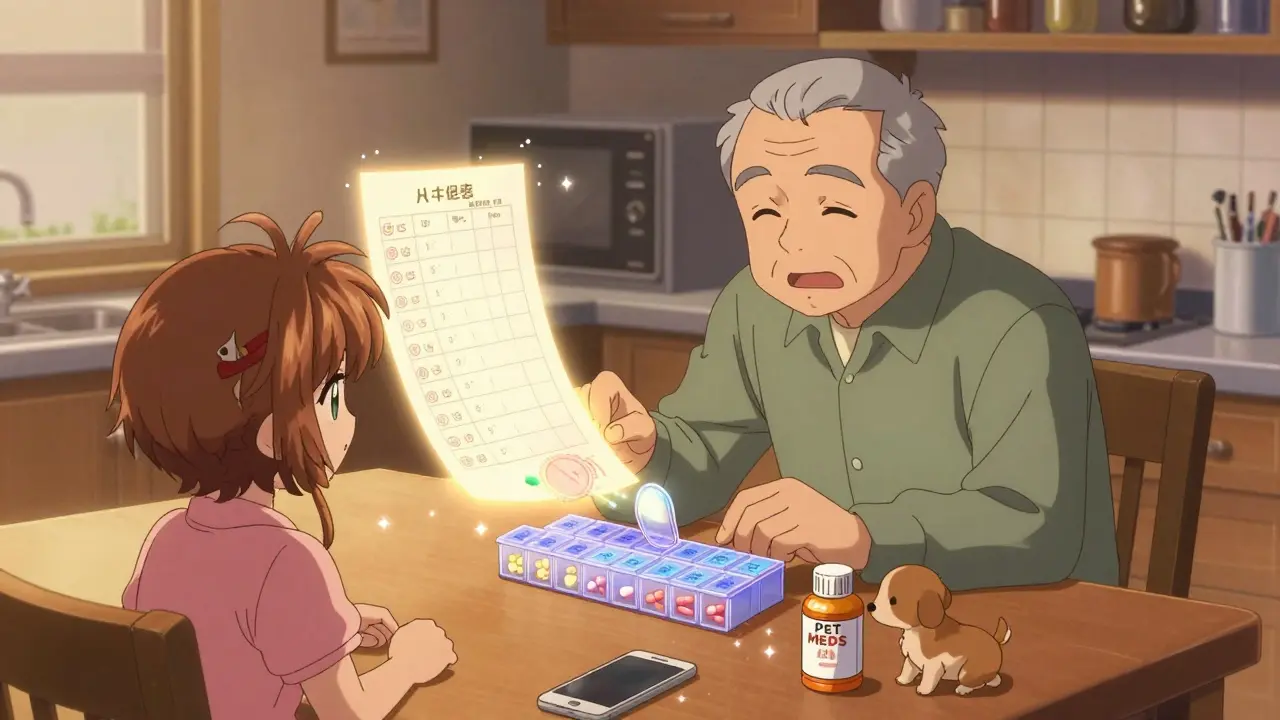
If you’re helping someone else manage their meds - a parent, spouse, or friend - don’t assume they know how to use the organizer. Many seniors were never taught. They rely on memory or guesswork. A 2023 survey found that 28% of medication errors in older adults happened because they didn’t understand how to read the compartments.
Set up a weekly check-in. Every Sunday, sit with them while they fill their box. Watch. Ask questions. "What’s this for?" "When do you take this?" If they hesitate, stop. Recheck the bottle. If they’re confused, contact their pharmacist. Many U.S. pharmacies now offer free filling services with pharmacist verification - and that’s worth using. It cuts errors by 52%.
And if you’re a caregiver, never let someone else’s pills sit unattended. Children and pets have been poisoned by grabbing what they think are candy. Use organizers with child-resistant locks - they meet ASTM F3130-15 standards. If yours doesn’t have one, buy a new one. The cost is $5. The risk is death.
What to Do If You Think You’ve Taken Too Much
Accidents happen. Maybe you took your evening pill in the morning. Maybe you didn’t realize you already took your painkiller. If you suspect you’ve overdosed - even slightly - don’t wait. Call your pharmacist. Call Poison Control at 1-800-222-1222. Or go to the nearest ER. Don’t Google it. Don’t wait to see if you feel worse. Some overdoses don’t show symptoms for hours.
Keep a list of all your medications - names, doses, times - in your wallet or phone. If you end up in the hospital, that list saves lives. And if you’ve had a close call, talk to your doctor. Adjust your regimen. Maybe you don’t need five pills a day. Maybe you can switch to a combo pill. There’s always a safer way.
Can I put all my pills in one organizer if I take them at the same time?
Yes - but only if they’re all meant to be taken together at the same time of day. For example, if you take three pills every morning after breakfast, you can put them in the "morning" compartment. But if one is for blood pressure, another for thyroid, and a third for pain, and they’re not prescribed to be taken together, don’t mix them. Always follow your doctor’s instructions on timing.
Is it safe to use a pill organizer past its expiration date?
The organizer itself doesn’t expire, but the plastic can crack, labels fade, and compartments warp over time - especially if exposed to heat or sunlight. If your organizer is more than 2 years old, has sticky compartments, or the lids don’t seal properly, replace it. A broken organizer is a safety risk. New ones cost under $10 and are often free from pharmacies.
What should I do if I miss a dose and my organizer is already filled?
Don’t take the missed pill from the next compartment. That’s how double-dosing starts. Instead, check your medication’s instructions. Some pills can be taken up to 4 hours late. Others should be skipped entirely. When in doubt, call your pharmacist. Never guess. Then, refill your organizer correctly the next day - don’t try to "catch up."
Are pill organizers covered by insurance?
Basic pill organizers are rarely covered. But if you have Medicare Part D and take four or more chronic medications, you may qualify for a free smart organizer with alarms and tracking. Ask your pharmacy or Medicare provider. Some private insurers also cover them if your doctor writes a letter of medical necessity.
Can I use a pill organizer for my pet’s medication?
No. Pet medications are not regulated like human drugs, and many are toxic if taken by humans. Never use the same organizer for both. Also, pets often need liquid or chewable forms that don’t work in standard organizers. Always keep pet meds separate and clearly labeled.
If you’re taking multiple medications, your pill organizer should be your safety net - not your crutch. It’s not about convenience. It’s about survival. Take the time to do it right. Double-check every pill. Keep your bottles nearby. Store it safely. And if you’re ever unsure - ask. A pharmacist is just a phone call away. Your life depends on it.
phara don
February 3, 2026 AT 00:49Just filled my organizer for the first time in months... and holy crap, I put my oxycodone in the morning slot. 😅 Thanks for the wake-up call. Going to redo it right now.
Ellie Norris
February 3, 2026 AT 03:32OMG i so needed this!! i’ve been keeping my pills in the bathroom since i moved in 2 yrs ago 😅 i just thought it was convienent!! now im gonna move it to my nightstand and put a silica gel pack in there!! thx!!
Marc Durocher
February 3, 2026 AT 07:40Look, I get it. We all think we’re too busy to read labels. But here’s the thing - if you’re the kind of person who fills a pill organizer while scrolling TikTok, you probably shouldn’t be managing five meds at once. Not because you’re dumb - because you’re tired. And that’s okay. Just get help. Your pharmacist doesn’t bite. I promise.
larry keenan
February 4, 2026 AT 04:27While the article presents a comprehensive framework for medication adherence via pill organizer utilization, it is imperative to acknowledge the confounding variable of cognitive load in geriatric populations. The cognitive burden associated with daily verification protocols may exacerbate non-adherence in patients with executive dysfunction, thereby necessitating a paradigm shift toward automated dispensing systems integrated with clinical decision support tools. The reliance on manual cross-referencing, while statistically sound, is not scalable for populations with diminished neurocognitive reserve.
Nick Flake
February 6, 2026 AT 01:10Bro. This isn’t just about pills. This is about dignity. 🫂
Every time you double-check a label, you’re saying: ‘I matter.’
Every time you store your meds away from the sink, you’re telling your future self: ‘I’m worth the effort.’
And every time you call your pharmacist instead of Googling - you’re choosing life over laziness.
Don’t let convenience kill you. You’re not a robot. You’re a human trying to survive. And that’s enough.
Chinmoy Kumar
February 6, 2026 AT 08:05i read this while on my way to work and i think i need to change my habit... i fill my organizer every week but i dont write the date on it... and sometimes i mix my moms pills with mine cause we both take blood pressure... maybe i should get separate ones... thanks for the reminder 😊
Vatsal Srivastava
February 6, 2026 AT 14:21Overstated. Most people aren’t idiots. If you can’t read a label, maybe don’t take pills. The whole article reads like a fear campaign for pharmaceutical companies selling smart organizers. Also, bathrooms are fine. My grandma used one for 40 years and she’s 92. You’re overengineering survival.
Brittany Marioni
February 7, 2026 AT 11:20PLEASE, PLEASE, PLEASE - if you’re using a pill organizer - WRITE THE DATE ON IT! - AND - DON’T - REUSE - OLD - COMPARTMENTS! - I’VE SEEN PEOPLE DO THIS - AND - IT’S - TERRIFYING! - YOUR LIFE ISN’T A GAME OF CHANCE! - GET A NEW ORGANIZER - IT’S $8 - AND - YOU’RE WORTH IT! -
Akhona Myeki
February 9, 2026 AT 10:32In South Africa we don't have the luxury of pill organizers. We use plastic bags tied with string. And we still survive. This is American overkill. You have a system? Great. But don't act like everyone else is incompetent because they don't have a $60 smart box with Bluetooth. We manage with less. And we're still alive.
clarissa sulio
February 11, 2026 AT 04:22I’ve been doing this for 12 years. I fill my organizer every Sunday, keep bottles next to it, and never touch PRN meds unless I’m in agony. I’m not special. I just didn’t wait for a near-death experience to start caring. If you’re reading this and you’re still mixing your pain meds with your blood pressure pills - stop. Now. Go do it right. Your future self will thank you.