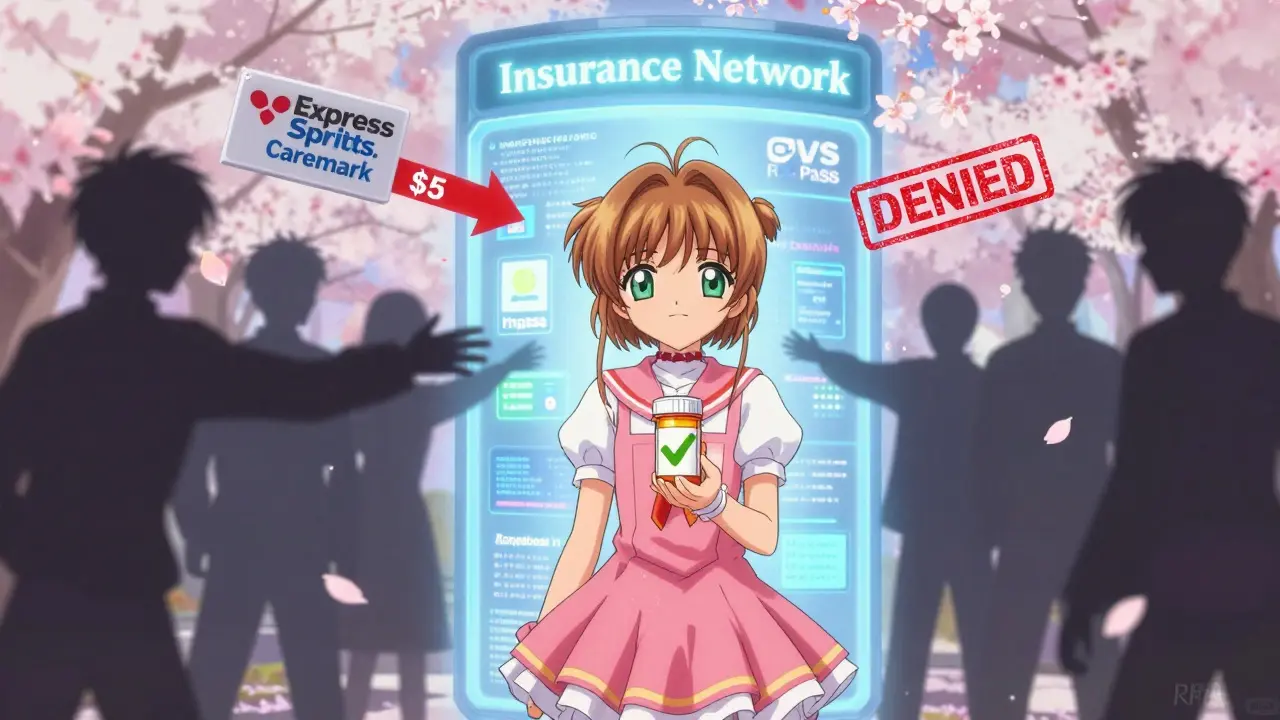
When you buy generic drugs from an online pharmacy, your insurance might not cover it - even if the drug is the same one your doctor prescribed. That’s because not all online pharmacies are created equal. Some are part of your health plan’s network, while others are just regular online stores that happen to sell medicine. Knowing the difference could save you hundreds a year - or cost you more than you expected.
How Insurance Actually Covers Generic Drugs
Most health insurance plans use something called a formulary a list of drugs approved for coverage under a specific health plan, organized into cost tiers. Generic drugs are almost always in the lowest tier because they cost way less than brand-name versions. For example, a 30-day supply of a generic blood pressure pill might cost you just $5 at a network pharmacy. A 90-day supply through mail-order might be $10. That’s not a typo - you pay less per pill when you order more at once. But here’s the catch: your insurance only covers drugs from pharmacies that are part of your plan’s network. If you order from an online pharmacy that isn’t in that network, your insurance won’t pay a cent. You’ll have to pay full price and then file a claim for reimbursement - if your plan even allows it. Many don’t.Mail-Order vs. Independent Online Pharmacies
There’s a big difference between mail-order pharmacies pharmacy services operated by your insurer’s Pharmacy Benefit Manager (PBM), offering 90-day supplies with lower copays and independent online pharmacies third-party websites like Amazon Pharmacy or Honeybee Health that may or may not accept your insurance. Mail-order pharmacies - like Express Scripts, CVS Caremark, or Optum Rx - are built into your insurance plan. They’re part of the same system that processes your prescriptions at your local pharmacy. You get your meds delivered to your door, usually in 90-day supplies. Copays are lower because the plan encourages long-term use of maintenance drugs like diabetes or cholesterol meds. Independent online pharmacies? They’re not connected to your insurer. Amazon Pharmacy, for instance, doesn’t process claims through your PBM. Instead, it offers a flat $5 monthly fee for hundreds of common generics through its RxPass a subscription model by Amazon Pharmacy that provides unlimited access to a list of common generic medications for a flat $5 monthly fee program. But only if you’re a Prime member. And only for drugs on their list. Your thyroid med? Your migraine drug? They might not be included.Why Your Insurance Might Force You to Switch to a Generic
You might not even get a say in what drug you get. Many insurers now practice non-medical switching a policy where insurers require patients to use generic drugs instead of brand-name alternatives, even when the prescribing physician prefers the brand. That means if your doctor writes a prescription for a brand-name drug, your insurer will automatically substitute the generic - no consultation needed. This isn’t about safety. It’s about cost. Generic drugs cost 80-85% less than brand-name versions. For insurers, it’s a no-brainer. But for patients? It can be risky. One user on PatientAdvocate.org reported that after being switched from Copaxone to a generic for multiple sclerosis, they had severe side effects and ended up in the ER. The insurer didn’t ask the doctor. They just did it. If you need the brand name for medical reasons, you can ask for a formulary exception a formal request submitted by a physician to override a plan’s coverage restrictions and allow coverage of a non-preferred drug. Your doctor has to submit paperwork explaining why the generic won’t work for you. It’s not guaranteed, but it’s your right.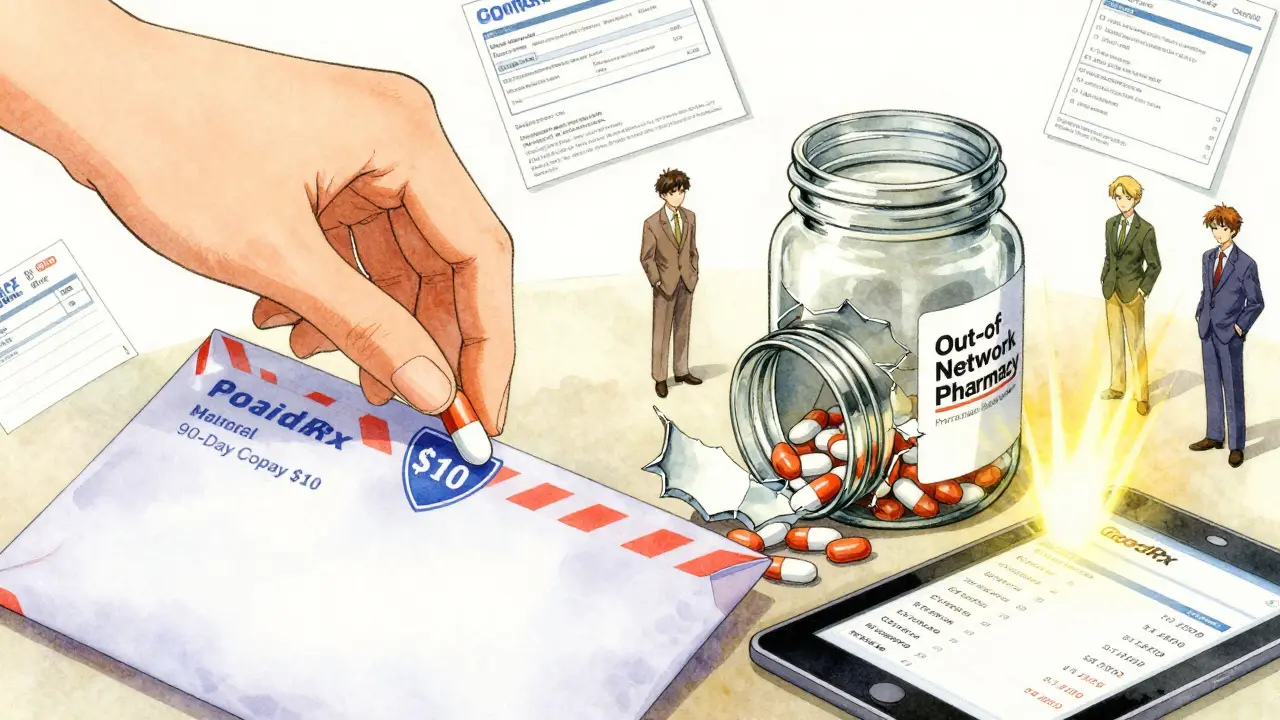
How Much You Really Pay - And Where
Let’s say you take a generic cholesterol drug. Here’s how the costs break down:- Retail pharmacy (in-network): $5 copay for 30-day supply
- Mail-order (in-network): $10 copay for 90-day supply
- Walmart or Kroger (no insurance): $10 for 90-day supply (yes, same price as mail-order, no insurance needed)
- Independent online pharmacy: $25 if you pay out-of-pocket - or $0 if they don’t accept your insurance
What You Need to Do Right Now
Don’t guess. Don’t assume. Do this:- Check your plan’s formulary. Go to your insurer’s website. Search for your drug. See what tier it’s on. Is it covered?
- Confirm the pharmacy. Is the online pharmacy you’re using part of your network? Call them. Ask: “Do you accept my insurance plan?” Then give them your plan name and ID.
- Compare prices. Use tools like GoodRx or SingleCare. Enter your drug and zip code. See what cash price you’d pay at Walmart, CVS, or a mail-order service - even if you have insurance.
- Ask about alternatives. If your drug isn’t covered, ask your doctor if there’s another generic that is. Sometimes, switching to a similar drug saves you money.
- Use your insurer’s 24/7 nurse line. Most plans have one. Call 1-800-556-1555 (MHBP example) or check your member portal. Nurses can tell you exactly how much you’ll pay.
The Bigger Picture: Who Controls Your Prescriptions?
Over 90% of U.S. prescription plans are managed by just three Pharmacy Benefit Managers (PBMs) third-party administrators that manage drug benefits for health insurers, negotiating prices and controlling formularies: CVS Caremark, Express Scripts, and Optum Rx. They decide which drugs are covered, how much you pay, and which pharmacies you can use. They’re not your doctor. They’re not your pharmacist. They’re middlemen - and their job is to cut costs. That’s why they push mail-order, why they force generic switches, and why they limit which online pharmacies you can use. New models like Amazon RxPass or Honeybee Health are trying to break that system. They cut out the PBM entirely. But right now, they cover less than 1.5% of all generic prescriptions. They’re promising - but not yet mainstream.What’s Changing in 2026
More states are passing laws that cap how much you pay for generics. As of August 2023, 28 states had such laws. More are coming. Some states now cap generic copays at $10 - no matter your plan. The Medicare Drug Price Negotiation Program, launched in 2023, is starting to affect commercial plans too. Insurers are now looking at Medicare’s negotiated prices as a benchmark. That means even if you’re not on Medicare, your drug costs might drop. By 2025, over 45% of maintenance generics will be delivered by mail or home delivery - up from 32% in 2022. That’s not a trend. It’s a shift. If you take daily meds for blood pressure, diabetes, or cholesterol, you’ll probably be ordered through mail-order soon.Final Advice: Don’t Let Your Insurance Decide for You
Your doctor picked your medication for a reason. Your insurance picked it because it’s cheaper. You’re caught in the middle. Don’t just accept what your insurer says. Verify. Compare. Ask. If you’re paying more than $15 for a generic drug you’ve been on for years, you’re probably overpaying. Use GoodRx. Call your local pharmacy. Check your mail-order option. Talk to your nurse line. The system is stacked to save money - not to make things simple. But you don’t have to be passive. With a little digging, you can find the cheapest, safest way to get your meds - whether it’s through insurance, a subscription, or cash.Do all online pharmacies accept my insurance?
No. Only pharmacies that are part of your insurance plan’s network accept your coverage. Most independent online pharmacies - including Amazon Pharmacy - don’t process insurance claims. They may let you submit your insurance card manually, but they often don’t cover the cost. Always call the pharmacy before ordering.
Can I use my insurance at Walmart for generics?
Yes, if Walmart is in your plan’s network. Many insurers have deals with Walmart and Kroger for their $10 generic program. But you must use your insurance card at checkout. If you pay cash, you might pay less than your insurance copay - especially if you haven’t met your deductible yet.
Why does my insurance switch my brand drug to a generic without asking?
Insurers use non-medical switching to cut costs. If a generic version exists, they automatically substitute it - even if your doctor prefers the brand. This is legal and common. If the switch causes side effects, you can request a formulary exception through your doctor.
Is Amazon RxPass better than insurance?
It depends. If you take one or two common generics and are a Prime member, RxPass at $5/month is cheaper than most copays. But it doesn’t cover all drugs - only about 100. If you take specialty meds or need more than what’s on the list, insurance or cash pricing may still be better.
What should I do if my insurance denies coverage for a generic?
First, double-check that the drug is on your plan’s formulary. If it is, contact your insurer to ask why it was denied. Sometimes it’s a system error. If the drug is excluded, ask your doctor to submit a prior authorization or formulary exception. If all else fails, pay cash - many generics cost less than $10 at retail pharmacies.
Can I get reimbursed if I pay out-of-pocket at an online pharmacy?
Sometimes. Only if your plan allows out-of-network reimbursement - and most don’t. If they do, you’ll need to submit a claim with your receipt, prescription, and insurance card. But the reimbursement amount is often based on the plan’s allowed amount, not what you paid. You might get back less than you spent.
Why is mail-order cheaper than retail?
Mail-order pharmacies buy in bulk and deliver directly to you, cutting out the overhead of retail locations. Insurers encourage this by lowering copays for 90-day supplies. You pay $10 for 90 days instead of $15 for 30 - that’s 33% less per dose. It’s a financial incentive built into your plan.
Are there any legal limits on how much I pay for generics?
Yes. As of 2026, 28 states have laws that cap out-of-pocket costs for generics at $10-$15 per prescription. Federal rules also cap insulin at $35/month for Medicare, and commercial plans are starting to follow. Check your state’s laws - you might be protected even if your insurer says otherwise.
Manish Singh
March 17, 2026 AT 17:13Man, I’ve been buying my blood pressure meds from an Indian online pharmacy for years. Paying $3 for 90 days in rupees, then converting it. My US insurance? Wouldn’t cover it even if I sent them the receipt. But hey, I’m alive, my BP’s stable, and I’ve saved enough to buy a second bike. Sometimes the system’s broken - but you don’t have to let it break you.
Also, if you’re in India, just use Netmeds or 1mg. They’re legit, cheap, and ship fast. No need to overthink it.
Insurance isn’t a savior. It’s a middleman with a spreadsheet.
Nilesh Khedekar
March 18, 2026 AT 11:41so uhhh… i think the whole system is rigged. like, why do 3 companies control EVERYTHING? CVS, Express Scripts, Optum? sounds like a cartel. i mean, who even ARE these people? are they doctors? no. are they pharmacists? no. they’re just dudes in suits with powerpoint decks telling your doc what drugs you can get. and if you complain? they say ‘it’s for your own good.’
and amazon rxpass? yeah right. they’re just getting you hooked on prime so you never leave. next thing you know, they’re tracking your bowel movements via your laxative orders. #bigpharma #amazoniswatching
Robin Hall
March 19, 2026 AT 18:15It is imperative to recognize that the structural hegemony of Pharmacy Benefit Managers (PBMs) constitutes a systemic violation of patient autonomy and clinical sovereignty. These entities, operating under opaque rebate structures and tiered formularies, function as non-licensed arbiters of therapeutic efficacy - a profound dereliction of fiduciary duty.
Furthermore, the normalization of non-medical switching, absent physician consultation, constitutes a breach of the Hippocratic Oath’s foundational tenets. The U.S. healthcare infrastructure has been corporatized to such an extent that cost containment has replaced clinical judgment as the primary metric of care.
Legislative intervention is not merely advisable - it is a moral imperative. We must demand transparency, enforce fiduciary accountability, and abolish the PBM model entirely.
jared baker
March 20, 2026 AT 16:26Simple truth: if you’re on a high-deductible plan, always check cash prices first. Walmart’s $10 for 90 days? That’s cheaper than your $15 copay if you haven’t met your deductible. Insurance doesn’t always save you - sometimes it just makes you jump through hoops.
Use GoodRx. Call your local pharmacy. Ask for the cash price. Most generics cost less than your coffee. No need to overcomplicate it.
Michelle Jackson
March 22, 2026 AT 06:06Wow. So you’re telling me people actually think they can outsmart the system? Like, you’re going to ‘compare prices’ and ‘ask your doctor’? That’s adorable. The system is designed to make you feel like you have control while you’re actually just feeding data into a profit engine. You think you’re saving money? You’re just participating in a rigged game.
And don’t get me started on Amazon RxPass. It’s not a service - it’s a trap. They’re gathering your medical data so they can sell ads to your relatives when you’re 70 and on oxygen. You’re not a patient. You’re a product.
becca roberts
March 22, 2026 AT 20:20Oh wow, so you’re telling me insurance companies are… evil? Groundbreaking. I never would’ve guessed.
Let me guess - next you’ll tell me PBMs don’t care about your health, they care about their quarterly profits? And that generics aren’t always interchangeable? I’m shaking in my boots.
Meanwhile, I’m over here on a $5 monthly subscription for my meds, paying cash at Walmart, and still managing to afford avocado toast. Maybe the real problem isn’t the system - it’s that we keep treating it like a mystery instead of a business.
David Robinson
March 24, 2026 AT 07:20Why are people still using insurance for generics? It’s 2026. You’re paying $15 for a 30-day supply when Walmart gives you 90 days for $10? That’s not laziness - that’s stupidity.
I’ve been doing this for 8 years. I never use my insurance for anything under $50. I go to the pharmacy. I ask for the cash price. I pay. Done.
And if your doctor says ‘you have to use the mail-order’? Tell them to go to hell. They don’t own your money. You do. And if your insurer tries to force a switch? File a complaint with your state AG. It’s not that hard.
Stop letting corporations decide what’s best for you. You’re not a patient. You’re a consumer. Act like it.
Laura Gabel
March 25, 2026 AT 09:36Insurance is trash
Walmart cheaper
Amazon rxpass only for prime
Stop overthinking
Pay cash
gemeika hernandez
March 26, 2026 AT 08:24Okay but have you even thought about how this affects elderly people? My grandma took her blood pressure med for 12 years, then they switched her to a generic and she started getting dizzy, falling, had to go to the ER. They didn’t even call her doctor. Just flipped the switch. And now she’s on 4 different meds because of side effects.
And don’t tell me ‘just use GoodRx’ - she doesn’t have a smartphone. She doesn’t know what a PBM is. She just wants to feel okay.
And now they’re pushing mail-order? You think she’s gonna sit around waiting 5 days for a package? She needs it now. Today. Not next week.
Everyone’s talking about savings and convenience but what about the people who can’t navigate the system? Who’s protecting them? Because I’m telling you - no one is.