
Macrolide Arrhythmia Risk Calculator
Assess your personal risk of heart rhythm problems when taking macrolide antibiotics like azithromycin or clarithromycin based on clinical factors.
When you take an antibiotic like azithromycin or clarithromycin for a bad sinus infection or pneumonia, you’re probably not thinking about your heart. But for some people, these common drugs can trigger a dangerous electrical disturbance in the heart - one that can lead to a life-threatening rhythm called Torsades de pointes. This isn’t a rare side effect you’ll read about in fine print. It’s a real, documented risk that doctors now actively screen for - especially in patients with certain health conditions.
How Macrolides Disrupt Heart Rhythm
Macrolide antibiotics - including azithromycin, clarithromycin, and erythromycin - work by stopping bacteria from making proteins. But they also accidentally interfere with a key electrical channel in your heart called the hERG channel. This channel helps your heart reset after each beat by letting potassium flow out of heart cells. When macrolides block it, the heart takes longer to recharge, which shows up on an ECG as a prolonged QT interval.
This delay doesn’t just sit there quietly. It creates a perfect storm for an arrhythmia. The heart’s lower chambers (ventricles) start firing off random, chaotic signals. That’s Torsades de pointes - a twisting pattern on the ECG that can degenerate into cardiac arrest. It’s rare, but it’s deadly. And unlike some side effects that show up after weeks, this can happen within the first few days of starting the drug.
Not All Macrolides Are Created Equal
It’s easy to think all macrolides are the same. They’re not. Clarithromycin is the most dangerous. It doesn’t just block potassium channels - it also shuts down a liver enzyme called CYP3A4, which breaks down other drugs. That means if you’re taking clarithromycin with another QT-prolonging medication - like a statin, antidepressant, or even some antifungals - those drugs build up in your system. The risk multiplies.
Erythromycin is less potent at blocking hERG, but it causes serious stomach upset. That leads to vomiting and diarrhea, which lowers potassium levels. Low potassium = more risk for arrhythmias. Azithromycin used to be considered the safest. It barely touches CYP3A4 and has weaker hERG blockade. But data from a 2012 study of over a million prescriptions showed azithromycin still carried a 2.85-fold higher risk of cardiovascular death compared to amoxicillin in the first five days of use. That’s not negligible.
Who’s at Highest Risk?
If you’re young, healthy, and have no other medications, your risk is extremely low. But if you have even one or two of these factors, your risk jumps dramatically:
- Age over 65 (2.4 times higher risk)
- Female sex (68% of TdP cases occur in women)
- Baseline QTc over 450 ms (4.7 times higher risk)
- Heart failure or structural heart disease (5.3 times higher risk)
- Low potassium or magnesium levels (3.1 times higher risk)
- Taking other QT-prolonging drugs (1.8 times higher risk per additional drug)
And here’s the tricky part: some people have hidden long QT syndrome - no symptoms, no family history, normal ECG. But when they take a macrolide, their heart’s "repolarization reserve" collapses. That’s why doctors now ask about sudden deaths in the family, even if the patient seems fine.
What Doctors Do Now
In 2020, the American Heart Association officially classified clarithromycin, erythromycin, and azithromycin as drugs with "Known Risk of Torsades de Pointes." That changed prescribing habits. Clarithromycin now carries a black box warning in the U.S. Azithromycin has a warning, but no box - which is why it’s still prescribed 65% of the time.
But guidelines have tightened. The American College of Cardiology now recommends an ECG before prescribing macrolides if you have two or more risk factors. If your QTc is above 470 ms in men or 480 ms in women - or if it increases by more than 60 ms from your baseline - you shouldn’t get a macrolide. The FDA also says avoid all macrolides if you’ve had TdP before, or if you’re on drugs like amiodarone or sotalol.
Monitoring isn’t just a formality. A 2023 study showed that patients on azithromycin combined with hydroxychloroquine during the pandemic had their QTc increase by an average of 26.2 milliseconds - enough to push many into dangerous territory.
Real-World Impact
Since the AHA’s 2020 warning, clarithromycin prescriptions dropped by 23.5% among Medicare patients. Overall macrolide use fell 18.7% between 2010 and 2020. But azithromycin still dominates - not because it’s safe, but because it’s perceived as safer.
There’s a cost to this caution. Every time a doctor orders an ECG before prescribing a macrolide, it adds about $14.30 to the bill. In the U.S. alone, that totals nearly $29 million a year. But compared to the cost of treating cardiac arrest - which can exceed $500,000 per case - it’s a bargain.

New Tools to Manage the Risk
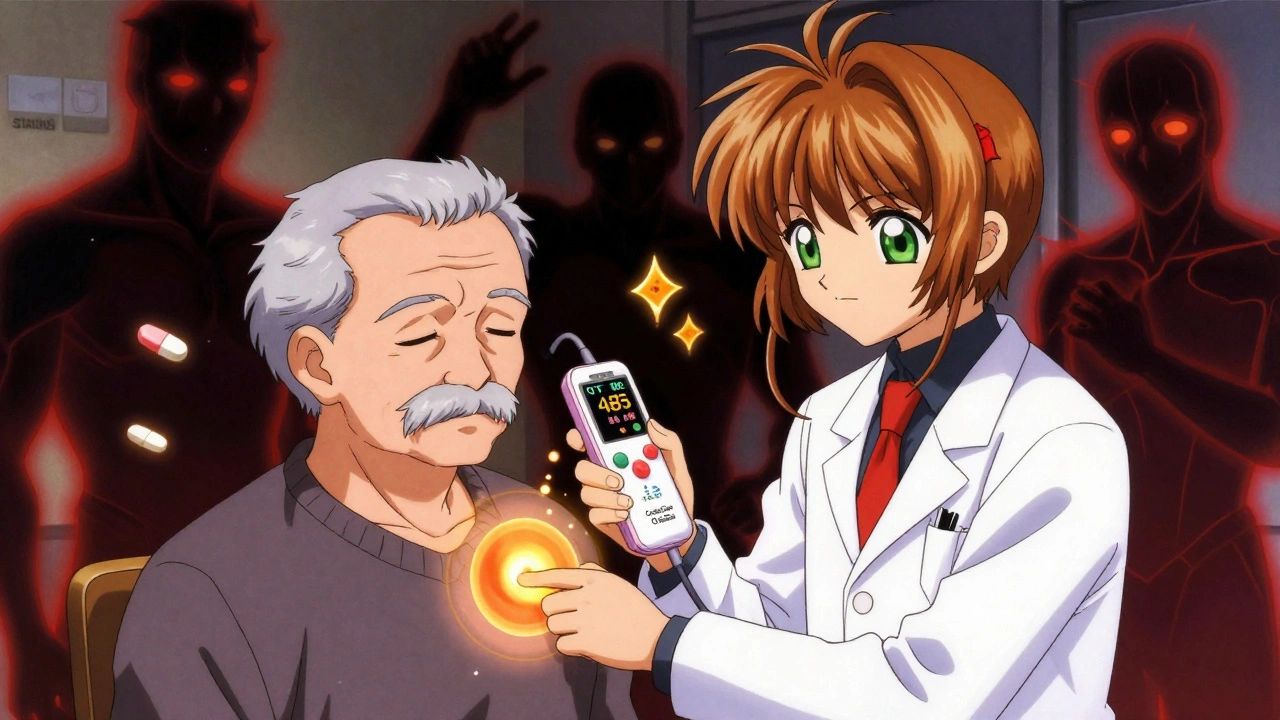
Technology is catching up. In 2023, the FDA approved the CardioCare QT Monitor - a handheld ECG device that gives accurate QTc readings in seconds. It’s being rolled out in urgent care centers and pharmacies. No more waiting days for a lab ECG.
Even better, researchers at Brigham and Women’s Hospital launched the Macrolide Arrhythmia Risk Calculator (MARC) in 2024. It uses 12 variables - age, sex, kidney function, meds, baseline QT, electrolytes - to predict your personal risk of TdP with 89% accuracy. Doctors can plug in your data and get a green, yellow, or red flag before writing the prescription.
What’s Next?
Scientists are working on "cardiosafe" macrolides. Solithromycin showed 78% less hERG blockade than clarithromycin in trials - but was pulled from development due to liver toxicity. That’s the catch: tweak the molecule to protect the heart, and you might hurt the liver.
Right now, the biggest frontier is genetics. Early data suggests 15% of people carry a genetic variant in the hERG channel that makes them 4.2 times more sensitive to macrolide-induced QT prolongation. Imagine a simple blood test before prescribing - identifying those who should never get a macrolide, no matter how mild their infection.
Another promising path: using potassium channel openers like nicorandil to counteract the block. Early trials show they can shorten the QTc by over 30 milliseconds. That’s enough to bring a high-risk patient back into the safe zone.
Bottom Line
Macrolide antibiotics save lives. But they’re not risk-free. The key isn’t avoiding them entirely - it’s knowing who’s vulnerable. If you’re over 65, have heart disease, take other meds, or have low potassium, ask your doctor: "Is there a safer alternative?" Don’t assume azithromycin is automatically safe. If you’ve ever passed out for no reason, or have a family history of sudden death before age 50, say so. That one detail could prevent a cardiac arrest.
Antibiotics are powerful tools. But like any tool, they need to be used with awareness - not just for the infection you’re treating, but for the body you’re protecting.
Can azithromycin really cause heart problems?
Yes. While azithromycin is considered the safest macrolide, it still carries a known risk of QT prolongation and Torsades de pointes. A large 2012 study found it increased cardiovascular death risk by 2.85 times in the first five days of use compared to amoxicillin. The risk is low in healthy people but rises sharply with age, heart disease, or other QT-prolonging drugs.
Is clarithromycin more dangerous than azithromycin?
Yes, significantly. Clarithromycin is a stronger blocker of the hERG potassium channel and also inhibits the liver enzyme CYP3A4, which causes other QT-prolonging drugs to build up in your system. This dual effect makes it the most arrhythmogenic macrolide. It carries a black box warning in the U.S., while azithromycin has a standard warning.
Should I get an ECG before taking a macrolide?
If you have two or more risk factors - like being over 65, having heart failure, taking other QT-prolonging drugs, or having low potassium - then yes. Guidelines from the American College of Cardiology recommend a baseline ECG in these cases. If your QTc is over 470 ms (men) or 480 ms (women), or if it’s increased by more than 60 ms from your normal, you should avoid macrolides.
Can I take azithromycin if I have a history of arrhythmias?
No. If you’ve had Torsades de pointes before, or if you have congenital long QT syndrome, macrolides are contraindicated. Even azithromycin can trigger a recurrence. Your doctor should prescribe an alternative antibiotic like amoxicillin, doxycycline, or a cephalosporin, depending on your infection.
Are there any new antibiotics that are safer for the heart?
Solithromycin was designed to be much less harmful to the heart - it blocked 78% less of the hERG channel than clarithromycin. But it was discontinued due to liver toxicity. Research is ongoing into next-generation macrolides and drugs like nicorandil that may protect the heart during treatment. For now, the safest approach is choosing the right antibiotic for your condition and monitoring risk factors closely.
Ignacio Pacheco
December 2, 2025 AT 09:55So let me get this straight - we’re now requiring ECGs before giving out azithromycin like it’s a controlled substance, but we still let people buy Sudafed without a prescription? The system’s broken, and everyone’s just playing whack-a-mole with side effects.
parth pandya
December 3, 2025 AT 13:50hey just wanna say i had a friend take azithro for bronchitis and got dizzy af - doc said it was just dehydration but then he found out his qt was 510. never took another macrolide after that. get checked if you’re on meds or over 50. simple.
Rashi Taliyan
December 4, 2025 AT 01:43I’m a nurse in Mumbai, and I’ve seen this happen twice - young women, no history, just took azithromycin for a cold… and collapsed. No one warned them. No ECG. Just a script. We need better awareness here. Not just in the US.
Gene Linetsky
December 5, 2025 AT 07:19Let’s be real - Big Pharma doesn’t care about your heart. They pushed azithromycin as "safe" because it’s cheap and easy to prescribe. The 2012 study? Buried for years. Now they’re selling you a $14 ECG and a "risk calculator" like it’s some miracle fix. Meanwhile, they’re already designing the next antibiotic that’ll mess with your liver. Wake up.
Jim Schultz
December 7, 2025 AT 05:01Oh, wonderful. So now we’re treating every 68-year-old with hypertension like they’re about to go into TdP on a Tuesday morning. Let’s just give everyone a wearable ECG and a potassium IV drip with their coffee. Meanwhile, the real problem? Doctors who still prescribe macrolides like they’re candy. And yes, I’m talking to YOU, Dr. Johnson, who prescribed clarithromycin to Mrs. Henderson who’s on amiodarone. You’re not a doctor. You’re a liability.
Joykrishna Banerjee
December 9, 2025 AT 00:03While the clinical data is compelling, one must consider the epistemological framework underpinning the hERG channel hypothesis - it is, after all, a reductionist model that ignores systemic bioelectrical homeostasis. Furthermore, the MARC algorithm’s reliance on binary risk stratification (green/yellow/red) is a gross oversimplification of a multidimensional physiological phenomenon. One wonders if this is medicine… or algorithmic theater.
Kara Bysterbusch
December 10, 2025 AT 00:48As someone who grew up in a family where sudden cardiac death was a silent legacy, I want to say thank you for writing this. My mom passed at 47 - no warning, no symptoms. Now I carry my ECG results in my phone. If you’ve ever fainted for no reason, or lost someone young - please, don’t be shy. Ask your doctor: "Could this hurt my heart?" It’s not being paranoid. It’s being wise.
Myson Jones
December 11, 2025 AT 12:04Thank you for sharing this important information with such clarity and compassion. I’ve seen too many patients dismissed because they "look healthy" - but the heart doesn’t care how you look. If you’re taking multiple medications, or have even one risk factor, please advocate for yourself. Your life is worth more than the convenience of a quick script. We’re here to protect you - not just treat you.