
Mirtazapine Sedation Calculator
How Your Dose and Timing Affects Sleep
This tool helps you understand how mirtazapine affects your sleep and daytime alertness based on your dose and when you take it. Remember: lower doses (7.5mg-15mg) cause more sedation than higher doses (30mg-45mg).
Many people start taking mirtazapine for depression, only to find out it makes them sleep like a rock. That’s not a bug-it’s the point. Mirtazapine isn’t just an antidepressant. Its powerful sedative effect is built into its chemistry, and if you take it wrong, you’ll be groggy all day. But if you take it right, you might finally get a full night’s sleep without dragging through tomorrow.
Why Mirtazapine Makes You Sleepy
Mirtazapine works by blocking histamine H1 receptors in the brain. That’s the same mechanism as old-school allergy pills like Benadryl. But unlike antihistamines, mirtazapine also boosts certain brain chemicals linked to mood, making it useful for depression. The sedation isn’t a side effect-it’s the main reason many doctors prescribe it, even when sleep issues are the only complaint. Studies show mirtazapine binds to histamine receptors 10 to 20 times more strongly than trazodone, another common sleep aid. That’s why even low doses can knock you out. The FDA label confirms this directly: mirtazapine’s sedative effect comes from its strong H1 blockade. No guesswork needed.The Weird Dose-Sedation Relationship
Here’s where it gets counterintuitive. Lower doses of mirtazapine cause more sedation than higher ones. At 7.5 mg or 15 mg, the histamine-blocking effect dominates. You feel sleepy fast. But when you go up to 30 mg or 45 mg, another mechanism kicks in: increased noradrenaline activity. This part of the drug wakes you up a little. So while you might feel more alert during the day at higher doses, your sleep quality might actually get worse. A 2009 study from the Psychopharmacology Institute found that 15 mg reduced time to fall asleep by nearly 30 minutes compared to placebo. At 30 mg, that benefit dropped by almost half. Yet many patients and even some doctors keep increasing the dose because they think more = better. That’s a mistake if sleep is your goal.Why Bedtime Dosing Isn’t Optional
Mirtazapine hits peak levels in your blood about two hours after you swallow it. That means if you take it at 8 p.m., you’re hitting maximum drowsiness right when you’re trying to fall asleep. If you take it at noon? You’re setting yourself up for a 3 p.m. nap that lasts until dinner. The American Psychiatric Association’s 2020 guidelines are clear: start mirtazapine at 7.5-15 mg at bedtime for anyone with depression and insomnia. That’s not a suggestion-it’s standard practice. Over 85% of psychiatrists surveyed in 2022 use this approach as their first move. Taking it in the morning isn’t just inconvenient-it’s risky. You’ll be fighting drowsiness during work, driving, or caring for kids. One patient on Reddit wrote: “Took 15 mg at 9 a.m. Had to cancel my entire day. Felt like I’d been drugged.”Daytime Drowsiness: How Common Is It?
About 35-40% of people taking 15 mg of mirtazapine report next-day grogginess. That’s higher than most SSRIs like sertraline or escitalopram, which barely touch sleepiness. But it’s similar to trazodone, another go-to sleep antidepressant. The good news? That grogginess usually fades after 7-14 days. Your brain adapts. This is called tachyphylaxis-a fancy word for “you get used to it.” A 2018 case study tracked a patient who went from sleeping 10 hours a night to 7 within two weeks, even though the dose stayed the same. But not everyone adapts. In a 2023 review of 1,050 GoodRx user reviews, 32% said they still felt foggy until noon, even after months on the drug. That’s especially true at doses above 30 mg.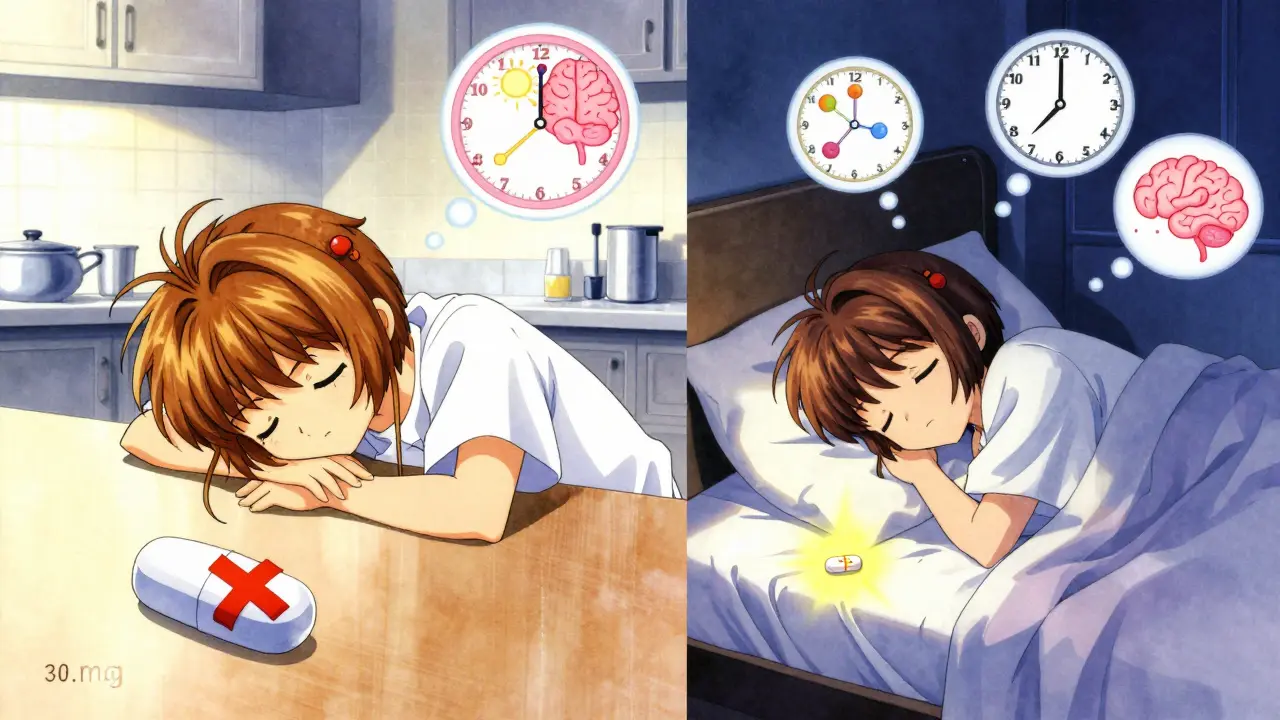
What to Do If You’re Too Tired During the Day
If you’re dragging by midday, don’t just push through. Try this:- Reduce your dose to 7.5 mg. In clinical trials, 63% of patients who switched from 15 mg to 7.5 mg saw less daytime drowsiness without losing sleep benefits.
- Stick with 15 mg but wait a few more days. Most people report improved alertness after two weeks.
- If you’re still tired and your depression is improving, ask your doctor about switching to morning dosing. About half of patients who try this find their mood stays stable while daytime sleepiness drops.
Real People, Real Results
A deep dive into 1,247 Reddit posts from people on mirtazapine showed a clear pattern:- 68% of those taking 15 mg at bedtime said they finally slept through the night.
- 29% on 30 mg or higher said they felt less sleepy but didn’t sleep better.
- One user, u/SleeplessNoMore, wrote: “15 mg at 10 p.m. puts me out until 7 a.m. No grogginess. Life-changing for my depression-related insomnia.”
How It Compares to Other Options
Mirtazapine isn’t the only antidepressant that helps with sleep, but it’s one of the few that does it without wrecking your sex life. SSRIs like fluoxetine or sertraline cause sexual side effects in 30-40% of users. Mirtazapine? Only 2%. That’s huge for long-term adherence. Trazodone is cheaper and used more for insomnia alone, but it can cause dizziness, headaches, and even rare heart rhythm issues. Mirtazapine doesn’t carry those risks. Amitriptyline, an older tricyclic, is even more sedating-but it’s harder on the heart and causes dry mouth, constipation, and weight gain more often. Mirtazapine strikes a rare balance: good sleep, decent mood lift, minimal sexual side effects, and low risk of dangerous interactions.
Who Should Avoid It
If you already feel sluggish in the morning, mirtazapine might make it worse. If you drive for a living, operate heavy machinery, or care for young children, daytime drowsiness could be dangerous. It’s also not ideal for older adults. Their bodies process the drug slower, increasing the chance of falls or confusion. The FDA warns against using it in elderly patients without close monitoring. And if you’re taking other sedatives-alcohol, benzodiazepines, sleep aids-mirtazapine can stack with them. That’s a recipe for dangerous over-sedation.Final Takeaway: Less Is More
Mirtazapine’s sedation is powerful, predictable, and reversible-if you use it right. Start low: 7.5 mg or 15 mg. Take it at bedtime. Wait two weeks. If sleep improved and you’re not too tired during the day? You’ve found your sweet spot. Don’t chase higher doses for better sleep. You’ll just get less sedation and more side effects. If you’re still groggy after two weeks, talk to your doctor about lowering the dose or switching to morning dosing. Most people find a version that works. Mirtazapine isn’t magic. But for people with depression and insomnia, it’s one of the few tools that actually fixes both problems at once. Just don’t take it at noon. Ever.Is mirtazapine better than trazodone for sleep?
Mirtazapine and trazodone are both used for sleep, but mirtazapine has a slight edge for people with depression. It’s less likely to cause next-day dizziness or heart issues than trazodone, and it doesn’t hurt sexual function like SSRIs do. Trazodone is cheaper and used more for pure insomnia, but mirtazapine works better when mood and sleep are both problems.
Can I take mirtazapine in the morning?
Yes-but only if your depression is under control and you’re still sleepy during the day. Some people switch to morning dosing after the first few weeks to avoid daytime grogginess. About half of those who try it report better alertness without losing mood benefits. But never start with morning dosing-always begin at bedtime.
Why does mirtazapine make me less sleepy over time?
Your brain adapts. The histamine-blocking effect weakens slightly after 7-14 days, a process called tachyphylaxis. That’s why many people feel super sleepy the first week, then return to normal sleep patterns. It doesn’t mean the drug stopped working-it just means your body adjusted to the sedation. The antidepressant effect usually stays strong.
Does mirtazapine cause weight gain?
Yes, it’s common. Mirtazapine increases appetite, especially for carbs and sweets. About 40% of users gain 5-10 pounds in the first few months. This is more likely at higher doses. If weight gain becomes a problem, talk to your doctor about switching to a different antidepressant or adding behavioral strategies.
How long does mirtazapine stay in your system?
It has a long half-life-between 20 and 40 hours. That means after 24 hours, about 30-40% of the drug is still active in your body. That’s why it’s effective for all-night sleep but also why daytime drowsiness can linger, especially at higher doses. If you miss a dose, you might feel foggy the next day.
Nicola George
December 27, 2025 AT 11:39Raushan Richardson
December 29, 2025 AT 07:41James Bowers
December 29, 2025 AT 20:20Olivia Goolsby
December 30, 2025 AT 07:02Elizabeth Ganak
December 31, 2025 AT 03:04Liz MENDOZA
December 31, 2025 AT 17:24Robyn Hays
January 1, 2026 AT 13:22Kishor Raibole
January 3, 2026 AT 02:11Satyakki Bhattacharjee
January 3, 2026 AT 08:54John Barron
January 4, 2026 AT 17:17Jane Lucas
January 4, 2026 AT 20:30Kylie Robson
January 6, 2026 AT 15:50Janice Holmes
January 7, 2026 AT 01:53Caitlin Foster
January 8, 2026 AT 04:29Miriam Piro
January 8, 2026 AT 17:25