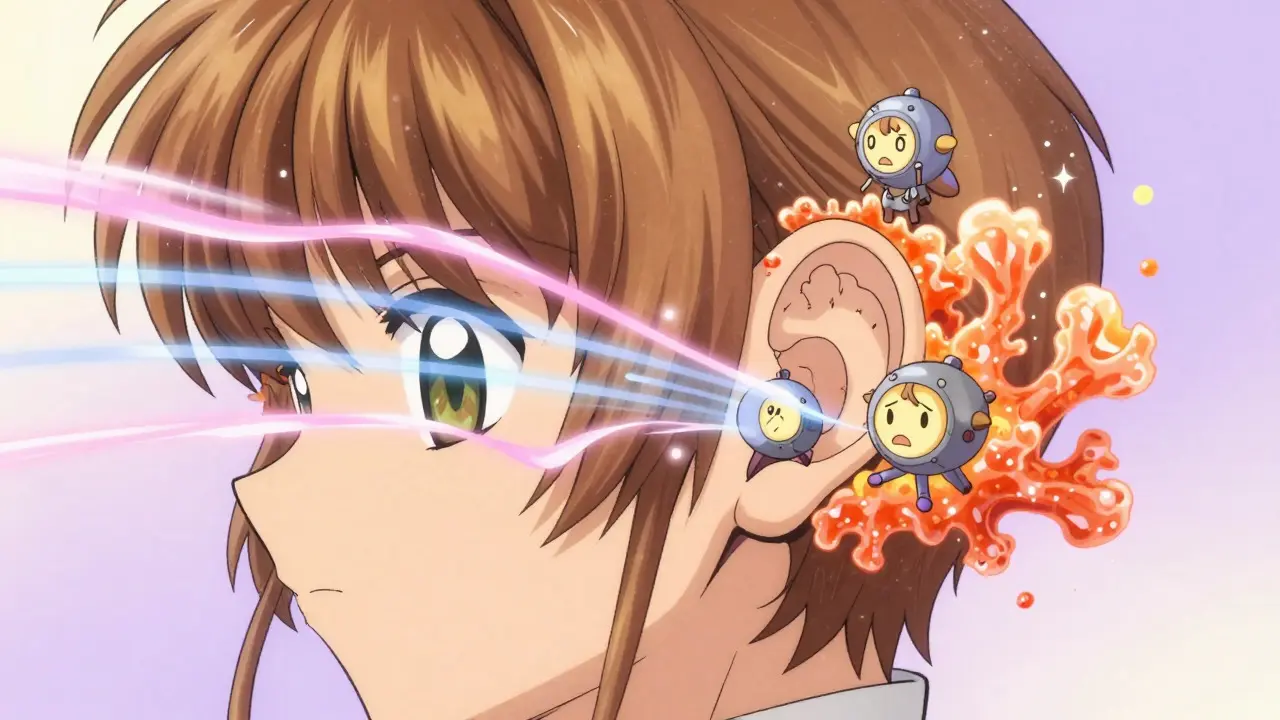
Imagine trying to hear a whisper in a crowded room, only to realize the problem isn't the noise around you-it's inside your own head. For millions of people, this frustrating scenario is caused by Otosclerosis, a condition where abnormal bone growth traps the tiny bones in the middle ear, leading to progressive hearing loss. It sounds complex, but the mechanism is actually quite straightforward: a small piece of bone gets stuck, and sound can no longer travel properly to your inner ear.
You might be wondering if this is just age-related wear and tear. It’s not. Otosclerosis typically strikes adults between the ages of 30 and 50, making it one of the most common causes of hearing loss in younger populations. In fact, data from the NHS indicates that roughly 1 in 200 people in the United Kingdom live with this condition. The good news? It rarely leads to total deafness, and modern treatments are incredibly effective at restoring hearing.
What Is Happening Inside Your Ear?
To understand otosclerosis, we need to look at the anatomy of the middle ear. Sound waves hit your eardrum, which vibrates three tiny bones known as the auditory ossicles: the malleus (hammer), incus (anvil), and stapes (the stirrup-shaped bone that connects to the inner ear). The stapes is the smallest bone in the human body, measuring just about 3.2 millimeters in length. Its job is to vibrate against the oval window, transmitting sound energy into the fluid-filled cochlea.
In a healthy ear, these movements are precise and fluid. In an ear affected by otosclerosis, the body starts remodeling the bone around the stapes incorrectly. Instead of normal, dense bone, the area becomes filled with spongy, vascular tissue that eventually hardens. This process fuses the stapes to the surrounding structures, effectively locking it in place. When the stapes can’t move, sound transmission is blocked, resulting in what doctors call conductive hearing loss.
This isn't a sudden event. It’s a slow, progressive change. Early on, you might notice difficulty hearing low-pitched sounds, like a man’s voice or the rumble of distant traffic. As the fusion worsens, the gap between what you hear through air conduction versus bone conduction widens-a metric audiologists measure as the "air-bone gap." Without treatment, this gap can widen by 15 to 20 decibels over five years.
Spotting the Signs: Symptoms and Diagnosis
One of the trickiest parts of otosclerosis is that its symptoms often mimic other, more common ear issues. Many patients report feeling like their ears are full or stuffed, similar to the sensation you get when flying or diving. You might also experience tinnitus-a ringing, buzzing, or hissing sound in one or both ears. Surveys indicate that up to 80% of people with otosclerosis struggle with bothersome tinnitus, with some describing it as severely disruptive to sleep.
How do you know if it’s otosclerosis and not just wax buildup or an infection? A proper diagnosis requires a combination of physical examination and specialized testing. An audiologist will perform pure-tone audiometry to map out your hearing thresholds. If you have otosclerosis, the test will typically show:
- Conductive hearing loss: Difficulty hearing sounds transmitted through the air.
- Air-bone gap: A difference of at least 15 dB between air and bone conduction scores.
- Preserved speech discrimination: You can usually understand speech clearly if it’s loud enough, unlike sensorineural loss where clarity drops significantly.
Doctors may also use temporal bone CT scans to visualize the abnormal bone growth. These scans can reveal characteristic radiolucent foci-small areas where the bone structure has changed-measuring between 0.5 and 2.0 millimeters in early stages.

Who Gets Otosclerosis? Risk Factors and Genetics
If you’ve been diagnosed, you might ask yourself, "Why me?" While the exact cause remains under investigation, genetics play a significant role. Research published in the Journal of Medical Genetics identified 15 distinct genetic loci associated with the condition, with the RELN gene on chromosome 7q22 being particularly notable. About 60% of people with otosclerosis have a family history of the disorder.
Demographics also matter. Studies show that women are affected more frequently than men, accounting for roughly 70% of cases. Hormonal changes during pregnancy can sometimes accelerate the progression of the disease, which is why monitoring hearing health during gestation is important for those with a known history.
Ethnicity is another factor. Global prevalence varies significantly, with higher rates observed in Caucasian populations of European descent (0.3-0.4%), intermediate rates in Asian populations (0.2-0.3%), and lower rates in African populations (0.1%). This suggests that genetic predisposition interacts with environmental factors in ways scientists are still unraveling.
Treatment Options: Surgery vs. Hearing Aids
When it comes to managing otosclerosis, you generally have two main paths: surgical intervention or amplification with hearing aids. Both are highly effective, but they serve different needs and lifestyles.
| Feature | Stapedectomy/Stapedotomy | Hearing Aids |
|---|---|---|
| Success Rate | 90-95% achieve significant improvement | High satisfaction, depends on fitting |
| Invasiveness | Surgical procedure under local/general anesthesia | Non-invasive, wearable device |
| Risks | ~1% risk of profound hearing loss; taste disturbance | Minimal; potential feedback or discomfort |
| Cost | $8,500-$12,000 (US average); covered by NHS in UK | Variable; often partially covered by insurance |
| Maintenance | Long-term stability; rare revision needed | Battery replacement, cleaning, adjustments |
Surgery (Stapedectomy/Stapedotomy): This is the gold standard for correcting the mechanical blockage. During the procedure, an otolaryngologist removes part or all of the fused stapes and replaces it with a tiny prosthesis. Recent advancements, like the FDA-approved StapesSound™ prosthesis with titanium-nitride coating, have improved outcomes by reducing postoperative adhesions. Clinical trials show a 94% success rate at 12 months for newer prostheses compared to 89% for traditional ones.
Hearing Aids: Not everyone wants or needs surgery. For many, especially those with mild to moderate loss, hearing aids provide excellent relief. They amplify sound to overcome the conductive barrier. Modern digital aids can be programmed specifically to boost low frequencies, addressing the unique profile of otosclerosis-related loss.

Living with Otosclerosis: Practical Tips
Whether you choose surgery, hearing aids, or a monitoring approach, there are steps you can take to manage your hearing health effectively:
- Regular Audiograms: If you’re monitoring mild cases, get tested annually. Tracking the progression helps determine the right time for intervention.
- Protect Your Ears: Avoid loud noises that could damage the inner ear further, especially if you have mixed hearing loss components.
- Consider Sodium Fluoride: Some studies suggest sodium fluoride supplements may slow bone remodeling. However, this should only be done under medical supervision due to potential side effects.
- Join Support Groups: Organizations like the Hearing Loss Association of America offer communities where you can share experiences and coping strategies.
Don’t let diagnostic delays hold you back. Misdiagnosis as Eustachian tube dysfunction is common, with some patients waiting an average of 18 months for correct identification. If you suspect something is wrong, seek a specialist evaluation early.
The Future of Otosclerosis Care
Research is moving fast. Genetic screening protocols are being developed to identify high-risk individuals before symptoms even appear. Imagine knowing your predisposition and taking preventive measures decades in advance. Additionally, new prosthetic materials and surgical techniques continue to refine outcomes, making procedures safer and more effective.
Despite concerns about fewer surgeons specializing in stapes surgery, the demand remains steady. With improved awareness and better screening tools, we’re likely to see earlier diagnoses and more personalized treatment plans in the coming years.
Is otosclerosis hereditary?
Yes, genetics play a major role. About 60% of people with otosclerosis have a family history of the condition. Specific genes, such as the RELN gene, have been linked to increased susceptibility. If a close relative has it, you may want to monitor your hearing more closely.
Can otosclerosis cause complete deafness?
It is rare. While untreated otosclerosis can lead to significant hearing loss, it seldom results in total deafness. Most cases involve conductive loss that can be corrected with surgery or managed with hearing aids. In about 10-15% of cases, it may affect the inner ear, causing mixed or sensorineural loss, but even then, total silence is uncommon.
What is the success rate of stapedectomy surgery?
Stapedectomy is highly successful, with 90-95% of patients experiencing significant improvement in hearing. Newer prostheses and refined techniques have pushed success rates even higher. However, there is a small risk (about 1%) of complications, including profound hearing loss, so thorough consultation with an experienced surgeon is essential.
Does otosclerosis affect balance?
Generally, no. Unlike Meniere's disease, otosclerosis primarily affects hearing rather than balance. Vertigo or dizziness is not a typical symptom unless the condition extends significantly into the inner ear or if surgery affects nearby structures. If you experience frequent vertigo, other conditions should be ruled out.
How quickly does hearing loss progress in otosclerosis?
Progression varies but is typically slow. On average, untreated cases may lose 0.5 to 1.0 decibel per year. Over five years, this can amount to a 15-20 dB decline. Regular monitoring helps catch changes early, allowing for timely intervention before daily communication becomes difficult.