
It’s frustrating when a treatment makes your skin worse instead of better. You apply a cream for eczema or a rash, and instead of calming down, your skin turns redder, itches more, and starts to flake or blister. You might think it’s getting worse because the treatment isn’t working - but what if the cream itself is the problem? That’s the hidden truth behind topical medication allergies - a condition that’s more common than most doctors realize.
What Is Contact Dermatitis?
Contact dermatitis is a skin reaction triggered by something touching your skin. It comes in two forms: irritant and allergic. Irritant contact dermatitis happens when a substance - like soap, detergent, or even too much water - physically damages your skin’s outer layer. It’s not an allergy. It’s just wear and tear. But allergic contact dermatitis? That’s different. It’s your immune system overreacting to a specific chemical, even if you’ve used it safely for years. The reaction doesn’t show up right away. It takes 24 to 72 hours. That’s why people often blame a new soap, a change in laundry detergent, or even a new moisturizer - when the real culprit is the medication they’ve been using for weeks.
Think of it like this: your skin is like a security system. Normally, it lets harmless stuff through. But when it starts recognizing something like neomycin or hydrocortisone as an invader, it sounds the alarm. The result? Itchy, swollen, cracked skin - sometimes with oozing blisters. It can look like poison ivy. It can look like a bad sunburn. But it’s not. It’s a delayed allergic reaction.
Which Medications Cause the Most Allergies?
Not all topical drugs are created equal when it comes to triggering allergies. Some are notorious. According to data from the North American Contact Dermatitis Group, the top offenders are:
- Neomycin - found in over-the-counter antibiotic ointments like Neosporin. It’s in nearly 10% of positive patch tests.
- Bacitracin - another common antibiotic in first-aid creams. About 7.5% of allergic reactions trace back to this one.
- Corticosteroids - yes, the very drugs used to treat rashes. Hydrocortisone, triamcinolone, clobetasol - all can cause allergic contact dermatitis. About 0.5% to 2.2% of people using them develop an allergy to them.
- Benzocaine - a local anesthetic in numbing creams and sprays. Found in 2.1% of patch test positives.
- Ketoprofen - a topical NSAID used for muscle pain. Still a major player, especially in Europe.
Here’s the twist: if you’re using a steroid cream for eczema and your skin gets worse, your doctor might just increase the strength. But that’s like pouring gasoline on a fire. Studies show that 15% to 20% of people diagnosed with “worsening eczema” actually have a steroid allergy. The same goes for antibiotic creams. People use them for cuts, burns, or even acne - and end up with a full-blown allergic reaction they didn’t see coming.
How Is It Diagnosed?
Most doctors won’t suspect a medication allergy unless you specifically mention it. That’s why so many people go months - even years - with the wrong diagnosis. The gold standard for confirming a topical medication allergy is patch testing.
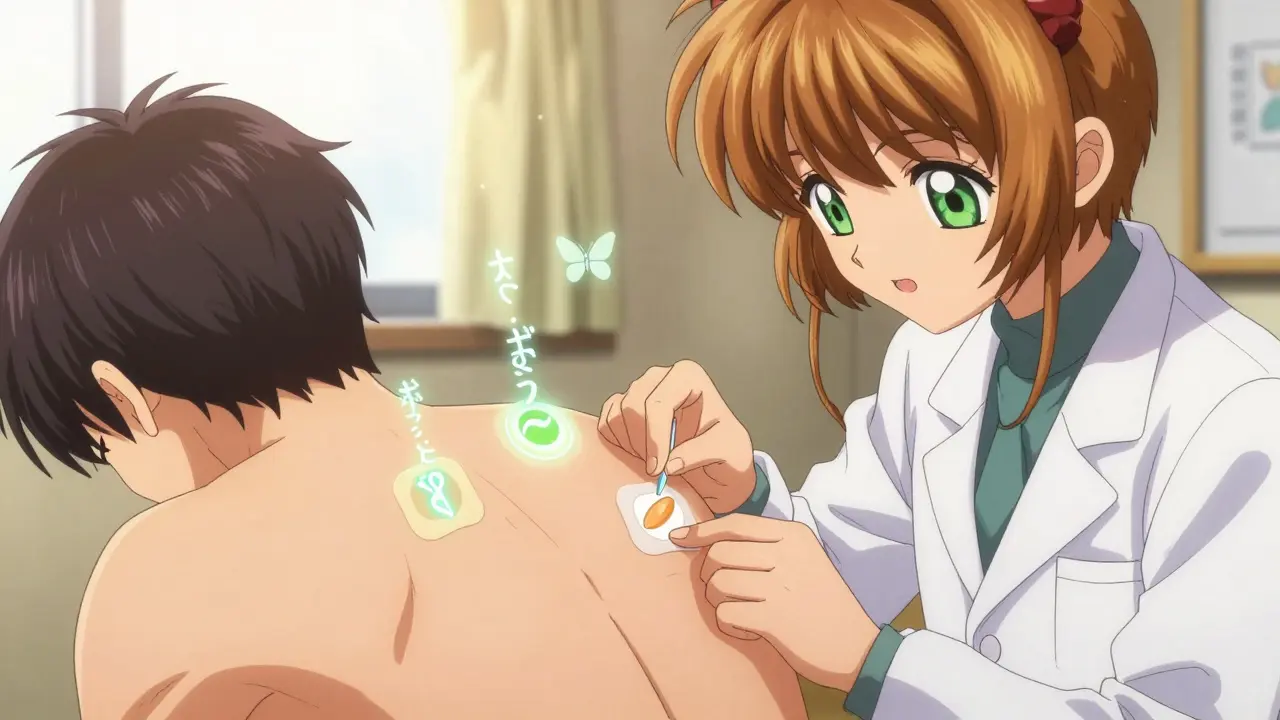
Here’s how it works: small amounts of common allergens - including 20 to 30 different medications - are taped to your back in tiny patches. You leave them on for 48 hours. Then the patches are removed, and your skin is checked. A second reading happens at 72 hours. Why? Because allergic reactions don’t show up instantly. They’re slow, sneaky, and often mistaken for a flare-up of the original condition.
When done right, patch testing finds the cause in about 70% of cases. But here’s the catch: many clinics don’t test for medications unless you ask. And even fewer test the actual products you’re using - only the pure ingredients. That’s why bringing your own creams, ointments, and even wipes to your appointment is critical. About 30% of allergens are hiding in over-the-counter products you don’t even think of as “medications.”
And there’s new science improving accuracy. In 2023, researchers at Johns Hopkins found that diluting topical medications 10-fold before patch testing reduced false negatives by over 70%. Why? Because people with damaged skin barriers - like those with eczema - can’t react to concentrated allergens the way healthy skin can. Diluting the test makes it more sensitive.
How Is It Treated?
Once you know what’s causing the reaction, the treatment is simple: stop using it. But that’s easier said than done. Many people have been using the same cream for years. They don’t realize it’s the problem. And when they stop, the skin often gets worse before it gets better - a phenomenon called “steroid withdrawal.” It’s not withdrawal from addiction. It’s your skin rebelling after being suppressed for too long.
For mild cases, over-the-counter hydrocortisone 1% can help - but only if you’re not allergic to it. For moderate to severe cases, doctors often prescribe stronger topical steroids. But here’s the paradox: if you’re allergic to steroids, you can’t use them. That’s where alternatives come in.
Calcineurin inhibitors like pimecrolimus (Elidel) and tacrolimus (Protopic) are the go-to alternatives. They’re not steroids. They work by calming the immune response locally. Studies show they’re 60% to 70% effective at reducing symptoms. Many patients report major improvement within two weeks. But they can cause a burning sensation at first - which is normal and usually fades after a few days.
For widespread reactions - over 20% of your body - oral steroids like prednisone are needed. A 2- to 3-week course, tapered slowly, brings relief in 85% of cases. But again, if the root cause isn’t removed, the rash will come back.
What About Cross-Reactions?
This is where things get complicated. Not all steroids are the same. Dermatologists classify them into six groups (A through F) based on chemical structure. If you’re allergic to a Group A steroid like hydrocortisone, you might still be able to use a Group B steroid like triamcinolone or a Group D steroid like methylprednisolone aceponate. Cross-reactivity isn’t guaranteed - it’s about 35% of the time. That means if you’re allergic to one, you don’t have to avoid all steroids. You just need to know which ones are safe.
Same goes for antibiotics. If you’re allergic to neomycin, you might react to other aminoglycosides like gentamicin - but not to bacitracin. And vice versa. That’s why patch testing doesn’t just tell you what to avoid - it tells you what you can still use.

Real-World Challenges
Patients don’t just struggle with diagnosis - they struggle with trust. One Reddit user wrote: “I used Neosporin for years. Then my hands cracked open. My dermatologist said it was eczema. I used more steroid cream. It got worse. I finally got patch tested - turned out I was allergic to neomycin. Took me 14 months.”
That’s not rare. Data from HealthUnlocked shows that 74% of people with topical medication allergies see at least three doctors before getting the right diagnosis. On average, it takes six months. That’s six months of burning, itching, and being told it’s “just eczema.”
And it’s not just patients. Healthcare workers are at risk too. A 2022 study in JAMA Dermatology found that 18% of nurses and doctors developed contact dermatitis from frequent use of topical antibiotics and antiseptics. Many didn’t even realize their gloves or hand creams were the problem.
How to Prevent It
The best treatment is prevention. Here’s what works:
- Read labels. Look for neomycin, bacitracin, benzocaine, and corticosteroids. If you’ve had a reaction before, avoid them.
- Use fragrance-free, preservative-free products. Many allergens are hidden in additives, not the active ingredient.
- Bring all your topical products to your dermatologist. Even your “natural” moisturizer. You’d be surprised what’s in it.
- Ask for patch testing if you’ve had a persistent rash that doesn’t improve with treatment.
- Consider alternatives. If you need an antibiotic ointment, ask about mupirocin - it’s less likely to cause allergies.
There’s also new tech on the horizon. The American Contact Dermatitis Society has a free mobile app that lets you scan product barcodes and check for over 3,500 allergens. Over 40% of patch-tested patients use it to avoid hidden triggers.
What’s Changing Now?
Things are improving. Since the FDA required full ingredient lists on all topical prescriptions in 2021, misdiagnosis rates dropped by 15%. The European Society of Contact Dermatitis introduced a new scoring system in 2023 that boosts diagnostic accuracy from 65% to 89%. And the NIH has funded $4.7 million in research to develop a blood test that could predict who’s at risk for these allergies - before they even use the product.
For now, though, the answer is simple: if your skin gets worse after applying a cream, it might not be the disease - it might be the cure. Don’t assume it’s normal. Don’t wait. Ask for patch testing. And don’t stop until you find the real cause.
Can topical steroids cause allergic contact dermatitis?
Yes. Even though corticosteroids are used to treat skin inflammation, they can themselves trigger allergic contact dermatitis in 0.5% to 2.2% of users. This is especially common with long-term use on sensitive areas like the face or groin. Hydrocortisone, triamcinolone, and clobetasol are among the most frequently reported culprits.
How long does it take for contact dermatitis to go away after stopping the allergen?
Once the allergen is removed, itching usually improves within 48 to 72 hours. Full skin healing typically takes 2 to 4 weeks. If symptoms persist beyond 4 weeks, another allergen may be involved - or the skin barrier may need additional support with emollients or barrier creams.
Is patch testing painful or risky?
No. Patch testing is non-invasive and safe. Small patches containing allergens are taped to the back and left on for 48 hours. You may feel mild itching or redness at the test site if you’re allergic, but there’s no breaking of the skin. The main risk is false negatives - which is why dilution techniques and proper timing are critical.
Can I use over-the-counter hydrocortisone if I have a topical medication allergy?
Only if you’re not allergic to hydrocortisone itself. Many people with topical medication allergies are allergic to hydrocortisone - especially those who’ve used it long-term. If you’ve had a reaction to any topical medication before, patch testing is the only reliable way to know if hydrocortisone is safe for you.
What’s the difference between irritant and allergic contact dermatitis?
Irritant contact dermatitis is caused by direct damage to the skin - like soap, bleach, or friction. It doesn’t involve the immune system and can happen to anyone with enough exposure. Allergic contact dermatitis is a delayed immune response - your body recognizes a substance as harmful, even if it’s harmless to others. It takes days to develop and only affects people who are sensitized to that specific allergen.
Are there new treatments being developed for topical medication allergies?
Yes. Researchers are testing microbiome-friendly barrier creams that reduce allergen penetration by 73% in trials. Three products are in Phase 3 clinical trials as of 2023. Additionally, the NIH is funding research into a blood test that could predict allergy risk before first exposure - potentially preventing over 150,000 cases per year.
Kathy Leslie
March 14, 2026 AT 03:07I used Neosporin for years on my cuts. Then one day my hands looked like they’d been dipped in acid. My dermatologist shrugged and upped my steroid dose. Took me 11 months to find out I was allergic to neomycin. Now I just use plain petroleum jelly. Simple. Cheap. Works.
Why do we keep treating symptoms instead of asking what’s actually wrong?
Elsa Rodriguez
March 14, 2026 AT 22:49OMG I’M NOT ALONE?? I thought I was the only one who went from ‘mild eczema’ to full-on oozing horror show because my ‘healing’ cream was the problem. I cried in the dermatologist’s office when she said ‘you’re allergic to hydrocortisone.’ Like… the thing I’ve been using for 5 years??
Now I’m paranoid about every single cream. Even ‘natural’ ones. I read labels like they’re ancient scrolls. 🥲
Serena Petrie
March 15, 2026 AT 13:31Stop using steroids. They’re not the answer.
Buddy Nataatmadja
March 15, 2026 AT 23:52Interesting read. I’m from Indonesia, and here, people use turmeric paste and coconut oil for everything. No patch testing. No fancy creams. But we’ve got fewer allergic reactions to topical meds-maybe because we’re not over-medicalizing minor skin stuff.
Still, the science here is solid. Patch testing should be standard, not optional.
mir yasir
March 17, 2026 AT 06:43While the clinical observations presented are empirically valid, one must question the epistemological foundation of relying on patch testing as the gold standard. The sample bias inherent in the North American Contact Dermatitis Group data undermines generalizability, particularly in non-Western populations where topical medication usage patterns differ substantially.
Moreover, the assertion that 70% diagnostic accuracy is ‘gold standard’ is statistically misleading without confidence intervals or sensitivity analysis.
Stephanie Paluch
March 17, 2026 AT 13:38So I’ve been using that ‘gentle’ hydrocortisone for my face rash… and now I’m realizing it might’ve been the whole problem 😳
Just got my patch test scheduled. Fingers crossed it’s not another steroid. I’m done with trial and error. This is my third dermatologist this year. 😅
tynece roberts
March 18, 2026 AT 20:58so like… i had this one cream that my mom swore by for my eczema. ‘it’s the best, trust me’ - yeah, well, after 3 years of itchy, cracked skin, i finally stopped. turned out it had neomycin AND benzocaine. i didn’t even know those were in there. the label was tiny. like, microscopic.
now i use cerave. no fragrances. no ‘healing’ nonsense. just barrier repair. and guess what? my skin’s not on fire anymore. 🤷♀️
also, i read the whole article. twice. because i’m tired of being told ‘it’s just eczema.’
Hugh Breen
March 19, 2026 AT 20:14THIS. IS. A. PUBLIC. HEALTH. CRISIS.
How many people are suffering because doctors don’t ask the right questions? I’ve seen nurses with chemical burns from hand creams. I’ve seen kids with face rashes from ‘hypoallergenic’ baby lotion. We treat skin like it’s a paint job-slap something on, wait for it to disappear.
But skin is an organ. It’s a barrier. It’s a signal.
And we’re ignoring the messages.
Patch testing should be mandatory for anyone using topical meds for more than 2 weeks. Period. 🙏
Byron Boror
March 19, 2026 AT 20:59Typical liberal medical nonsense. You’re telling me we need a whole testing protocol for something that’s been used for decades? Back in my day, we used Vaseline and toughed it out. No patch tests. No apps. No drama. Just common sense.
Now we’re turning every little rash into a federal investigation. Pathetic.
Rex Regum
March 20, 2026 AT 22:38Of course the system is broken. You’re telling people to ‘ask for patch testing’ like it’s a menu item. Meanwhile, insurance denies it. Doctors don’t offer it. And the FDA? They care more about pharmaceutical profits than patient skin.
Why is this even a question? Because we’ve turned healthcare into a corporate game. And your skin? Just collateral damage.
Kelsey Vonk
March 21, 2026 AT 19:16There’s something deeply poetic about how our bodies reject what we think is healing us.
We apply creams hoping for peace, but the skin, in its quiet wisdom, screams back: ‘This is not for me.’
Maybe the real lesson isn’t just about allergens…
But about listening. To our bodies. To the silence between the symptoms.
And sometimes, the cure isn’t stronger medicine.
It’s simply stopping.