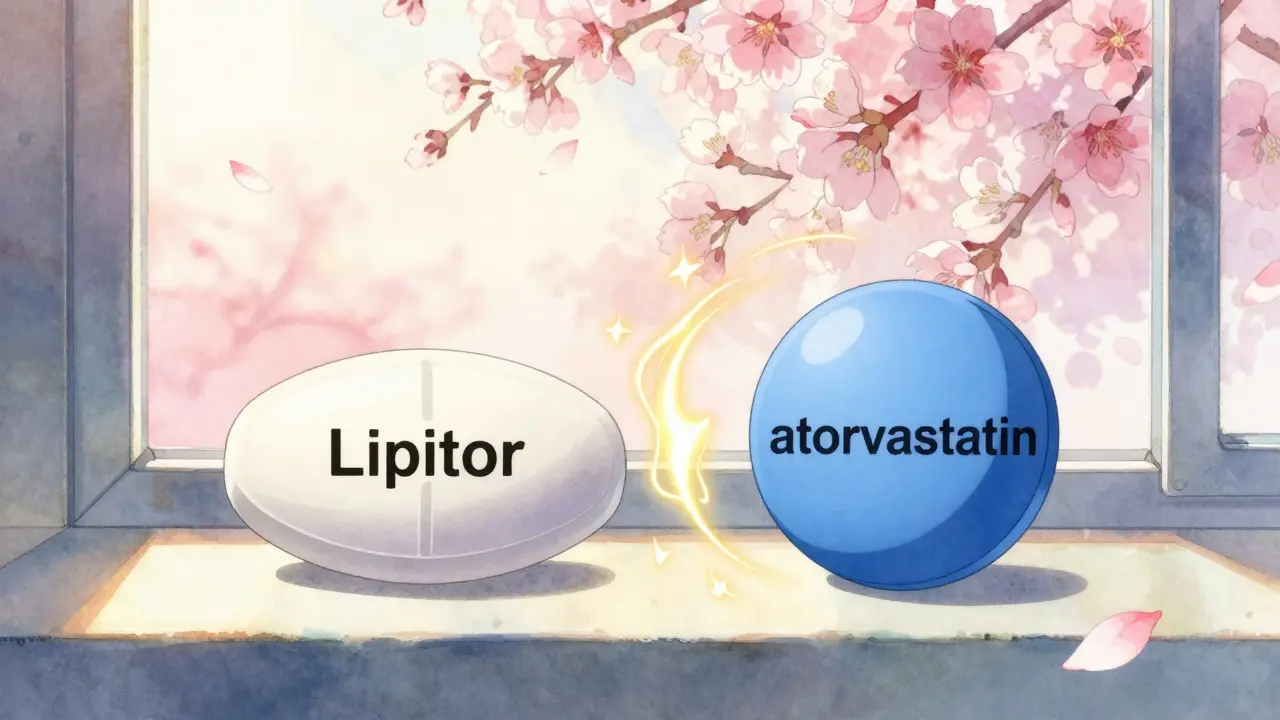
When you pick up a prescription, you might see two pills that look completely different-one white and oval, the other blue and round. One says "Lipitor," the other says "atorvastatin." You might wonder: is the cheaper one just a copy? A fake? A watered-down version? The answer isn’t what most people think.
Generic drugs aren’t copies-they’re exact matches
Generic drugs aren’t copies in the way a bootleg T-shirt is a copy of a designer brand. They’re scientifically required to be identical in how they work inside your body. The U.S. Food and Drug Administration (FDA) doesn’t approve a generic drug unless it delivers the same amount of active ingredient into your bloodstream at the same rate as the brand-name version. That’s not a suggestion-it’s a strict legal requirement.
Every generic drug must contain the same active ingredient, in the same strength, in the same form (tablet, capsule, liquid), and taken the same way (by mouth, injection, etc.) as the original. If you take 10 mg of generic lisinopril, your body gets exactly the same medicine as 10 mg of Zestril. The FDA tests this using pharmacokinetic studies that measure blood levels over time. The acceptable range? The generic’s concentration in your blood must fall within 80% to 125% of the brand-name drug’s levels. That’s not a wide gap-it’s a tight window designed to ensure identical performance.
What’s different? Only the extras
So if the medicine works the same, why do generics look different? Because the FDA allows differences in inactive ingredients. These are the fillers, dyes, flavors, and coatings that don’t affect how the drug works but make the pill look, taste, or dissolve differently. A brand-name drug might use a specific blue dye for trademark reasons. The generic can’t use that exact dye-it would be a copyright issue. So it uses a different blue, or maybe no dye at all. That’s why your generic pill looks different, even though it does the same thing.
These inactive ingredients can sometimes cause minor reactions in people with rare allergies. Someone might get a stomach upset from a new filler in a generic version, even though the active drug hasn’t changed. But that’s not a failure of equivalence-it’s an individual sensitivity, like being allergic to peanuts in one brand of granola but not another. Pharmacists often warn patients about this, especially if they’ve had issues before.
Cost difference? It’s massive
Brand-name drugs cost a fortune because the company that invented them spent years and billions developing them. They get a 20-year patent to recoup that investment. Once that patent expires, other companies can make the same drug. They don’t have to repeat expensive clinical trials. They just prove bioequivalence-which costs a fraction of the original R&D.
The result? Generic drugs cost, on average, 85% less. In 2023, the average generic prescription cost $4.27. The brand-name version? $61.85. That’s not a small savings-it’s life-changing for people on fixed incomes, especially those taking multiple medications daily. Medicare Part D beneficiaries saved over $500 a year on average just by switching to generics. Across the U.S., generics account for 90% of all prescriptions but only 23% of total drug spending.
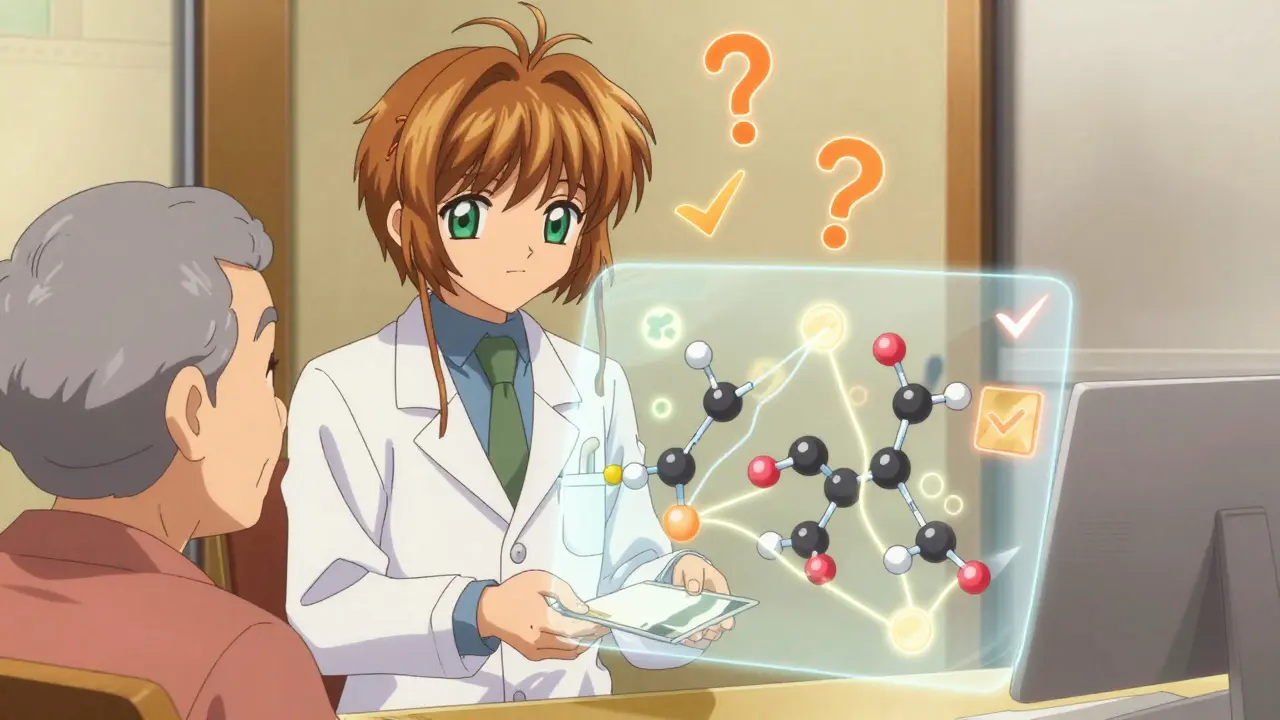
Are there exceptions? Yes-but they’re rare
Most of the time, generics work perfectly. But there’s a small group of drugs where even tiny differences in blood levels can matter. These are called narrow therapeutic index (NTI) drugs. That means the difference between a dose that works and one that’s too high-or too low-is very small.
Examples include warfarin (a blood thinner), levothyroxine (for thyroid issues), and some epilepsy drugs like phenytoin. For these, doctors and pharmacists often recommend sticking with the same brand or generic version once you’ve found one that works. Why? Because switching between different generics-even if both are FDA-approved-could theoretically cause a small fluctuation in blood levels that leads to a clot, a seizure, or a thyroid imbalance.
But here’s the key: it’s not because generics are inferior. It’s because the body is extremely sensitive to tiny changes in these specific drugs. Studies show that 96% of patients on non-NTI drugs have no issues switching to generics. For NTI drugs, the success rate is still 92%, but those patients need closer monitoring. The FDA has reviewed over 1,800 reports of possible generic-related problems between 2018 and 2022. Only 5.5 cases per year were confirmed as actual bioequivalence failures.
What do patients really experience?
On Drugs.com, over 1.2 million reviews show generics rated 7.2 out of 10, compared to 7.5 for brand names. That’s a tiny difference. Most people report no change in how they feel. Reddit’s pharmacy community found that 67% of users saw no difference after switching. About 23% noticed minor side effects-usually things like nausea or dizziness-but those often went away after a few days or were traced to a new filler, not the active drug.
One group that does report more issues is people with epilepsy. A 2021 survey by the Epilepsy Foundation found 17% of respondents had breakthrough seizures after switching generics. But follow-up FDA analysis showed most of those cases weren’t due to bioequivalence failure. Instead, they were linked to inconsistent dosing schedules, missed pills, or other lifestyle factors. Still, for this group, doctors often recommend staying on one version unless there’s a strong reason to switch.
Why do people still doubt generics?
Surveys show 43% of patients believe generics contain only 20% to 80% of the active ingredient. That’s completely false. FDA testing shows generics contain 99.2% of the labeled active ingredient-just like brand names. The myth persists because of marketing. Brand-name companies spend millions on ads that make you think their drug is “better.” Pharmacists say they spend an average of 3.2 minutes per prescription explaining that generics are not inferior.
Another reason? Placebo effect. If you believe a blue pill is “the real thing,” you might feel better taking it-even if the white pill does the same thing. That’s not the drug’s fault. It’s how the brain works.
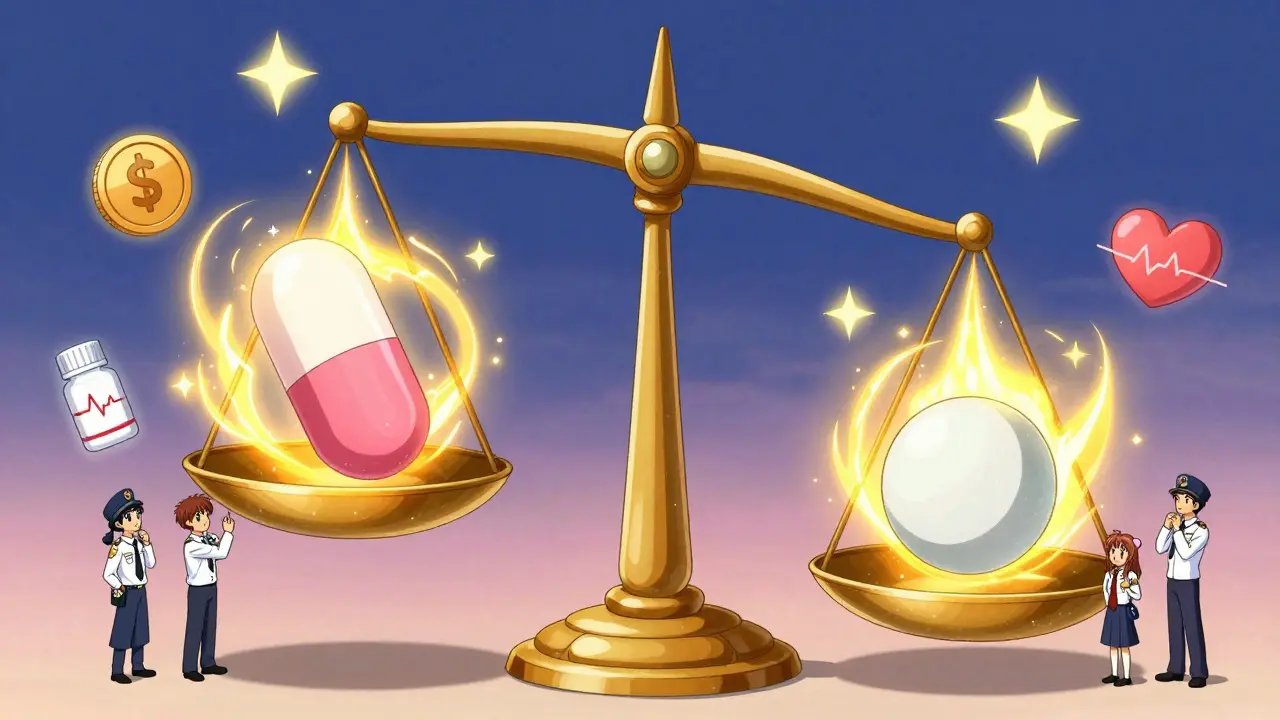
What’s changing now?
The FDA is working hard to speed up approval of complex generics-like inhalers, patches, and injectables-that are harder to copy. In 2023, there were over 1,200 pending applications for these difficult drugs. The new GDUFA IV program, running through 2027, aims to cut approval times from 38 months down to 10 months. That means more affordable options will hit the market faster.
Also, biosimilars-generic versions of complex biologic drugs like Humira and Enbrel-are starting to appear. They’re not exact copies like traditional generics, because biologics are made from living cells. But they’re proven to work the same. By 2027, they could make up 15% of the market. That’s a big deal for conditions like rheumatoid arthritis and Crohn’s disease, where brand-name drugs cost over $2,000 a month.
What should you do?
If your doctor prescribes a brand-name drug, ask: "Is there a generic?" In most cases, the answer is yes-and it will work just as well. For common conditions like high blood pressure, cholesterol, diabetes, or depression, generics are the standard of care. Pharmacies automatically substitute them unless your doctor writes "dispense as written" or you specifically ask for the brand.
If you’re on a narrow therapeutic index drug like warfarin or levothyroxine, stick with the same version unless your doctor says to switch. Keep track of how you feel. If something changes after a switch-new fatigue, dizziness, irregular heartbeat-tell your doctor and pharmacist right away.
Don’t pay more because you’re afraid. Generics aren’t cheap because they’re low quality. They’re cheap because competition works. And in medicine, that’s a good thing.
Are generic drugs as safe as brand-name drugs?
Yes. The FDA requires generic drugs to meet the same strict safety and quality standards as brand-name drugs. Every generic manufacturer must follow the same Good Manufacturing Practices (GMP), and the FDA inspects their facilities just like those of brand-name companies. Between 2018 and 2022, only 0.3% of reported issues with generics were confirmed as actual safety failures.
Why do generics look different?
U.S. trademark laws require generics to look different from brand-name drugs to avoid confusion. That means different colors, shapes, or markings. But the active ingredient, strength, and how it works in your body are identical. The differences are only in inactive ingredients like dyes or fillers, which don’t affect the drug’s effectiveness.
Can I switch between different generic versions?
For most drugs, yes. You can switch between different generic manufacturers without issue. But for narrow therapeutic index drugs like warfarin, levothyroxine, or certain seizure medications, it’s best to stick with one version unless your doctor advises otherwise. Small changes in blood levels can matter in these cases, even if both generics are FDA-approved.
Do generics take longer to work?
No. The FDA requires generics to have the same rate and extent of absorption as the brand-name drug. That means they enter your bloodstream at the same speed and reach the same peak level. If a brand-name pill starts working in 30 minutes, the generic will too. There’s no delay.
Why are some generics more expensive than others?
Price differences between generics come from competition, supply chain costs, and how many companies are making the same drug. If only one company makes a generic, it can charge more. When five or six companies make it, prices drop. Retailers like Walmart and Costco often offer generics at even lower prices-sometimes under $4 for a 30-day supply.
Are all generic drugs made in the U.S.?
No. Many generic drugs are made in countries like India and China. But the FDA inspects all manufacturing facilities-no matter where they’re located-before approving a drug. Over 50% of generic drug facilities are outside the U.S., and they’re held to the same standards as American ones. The FDA conducts thousands of inspections each year to ensure quality.
Can I ask for the brand-name drug instead?
Yes. In 28 states, you can ask your pharmacist to give you the brand-name drug even if a generic is available-and pay the generic price if they’re therapeutically equivalent. In other states, your doctor must write "do not substitute" on the prescription. Always ask your pharmacist about your options.
Final thought: Trust the science, not the label
Generic drugs aren’t copies. They’re proven, tested, and regulated versions of the same medicine. The only real difference is the price-and that’s a good thing. Millions of people rely on generics every day. They work. They’re safe. And they keep healthcare affordable. If your doctor says a generic is right for you, it’s not a compromise. It’s the standard of care.
Joann Absi
January 6, 2026 AT 08:19Ashley S
January 6, 2026 AT 22:19Katelyn Slack
January 7, 2026 AT 12:27Wesley Pereira
January 8, 2026 AT 06:51Isaac Jules
January 10, 2026 AT 03:37Pavan Vora
January 11, 2026 AT 22:48Harshit Kansal
January 12, 2026 AT 06:35Brian Anaz
January 14, 2026 AT 00:17Venkataramanan Viswanathan
January 15, 2026 AT 17:18