Imagine waking up to find that the medication you've relied on for years suddenly costs 80% less, or conversely, that your pharmacy can't find a single bottle of your brand-name prescription because a generic version just hit the market. This is the reality of the "patent cliff." When a pharmaceutical company loses its legal monopoly over a drug, the market shifts overnight. For some, it's a financial lifeline; for others, it's a logistical nightmare.
We are currently facing what experts call "Patent Cliff 2.0." Between 2025 and 2029, it's estimated that manufacturers will lose over $90 billion in net prices as patents expire. While this sounds like a corporate problem, it directly impacts how you get your medicine and how hospitals manage their budgets. Whether you are a patient managing a chronic condition or a healthcare administrator, waiting until the day of expiry to make a plan is a recipe for instability.
The Basics: What Exactly is Patent Expiry?
At its core, Patent Expiry is the point at which the legal protection granted to a pharmaceutical company for its invention ends, allowing other companies to produce generic or biosimilar versions of the drug . In the U.S., the Hatch-Waxman Act is the primary law that governs how generic drugs enter the market via an Abbreviated New Drug Application (ANDA) process .
While a patent might last 20 years on paper, by the time a drug is developed and approved, the company usually only has 7 to 10 years of actual market exclusivity. Once that clock runs out, we see a Loss of Exclusivity (LOE). For small-molecule drugs, this often leads to a price drop of 70-90% within a single year. However, it's rarely as simple as a date on a calendar. Companies often use "patent thickets"-filing dozens of secondary patents for slight variations in the drug's formula-to keep competitors at bay.
What Patients Need to Know and Do
If you take a branded medication, the transition to a generic isn't always a seamless switch. You might find yourself in the middle of a formulary change where your insurance suddenly requires a different version of the drug.
One of the biggest concerns is bioequivalence. Regulatory bodies require generics to be 80-125% bioequivalent to the brand name. While this is a safe standard, different inactive ingredients can occasionally affect how a person tolerates the drug. In fact, some surveys show that nearly 37% of patients on chronic therapies reported adverse effects when switching, even when the drugs met all standards. This doesn't mean the generic is "bad," but it means your body might react differently to the fillers or binders.
Practical steps for patients:
- Ask your doctor for the expiry date: Don't wait for the pharmacy to tell you. Ask if your medication is approaching its LOE date.
- Discuss "Therapeutic Substitution": Ask your provider if there are other drugs in the same class that might be more stable or cost-effective.
- Monitor your symptoms: If you switch to a generic and feel a difference, document it immediately. It could be a reaction to an inactive ingredient, and your doctor may need to adjust your brand choice.
- Check your formulary: Review your insurance plan's list of covered drugs every few months during a known transition period to avoid surprises at the pharmacy counter.
How Healthcare Systems Should Strategize
For hospitals and clinics, patent expiry is a double-edged sword. On one hand, the cost savings are massive; on the other, the transition can trigger temporary drug shortages. Research shows that 65% of pharmacy directors report shortages in the first few months after a drug goes generic as supply chains scramble to adjust.
Successful systems don't react; they anticipate. Data from the Healthcare Financial Management Association indicates that health systems starting their planning 24 months before expiry save about 22% more than those who wait until the 12-month mark. This is because they have time to renegotiate contracts and update clinical guidelines.
| Attribute | Small-Molecule Generics | Biosimilars (Biologics) |
|---|---|---|
| Typical Price Drop (Year 1) | 70% - 90% | 20% - 40% |
| Market Share Shift | Rapid (90%+ in 12 months) | Slower (Average 27-38% in 2 years) |
| Manufacturing Complexity | Low (Chemical synthesis) | High (Living cell cultures) |
| Switching Confidence | High (Standardized) | Moderate (Requires more clinical oversight) |
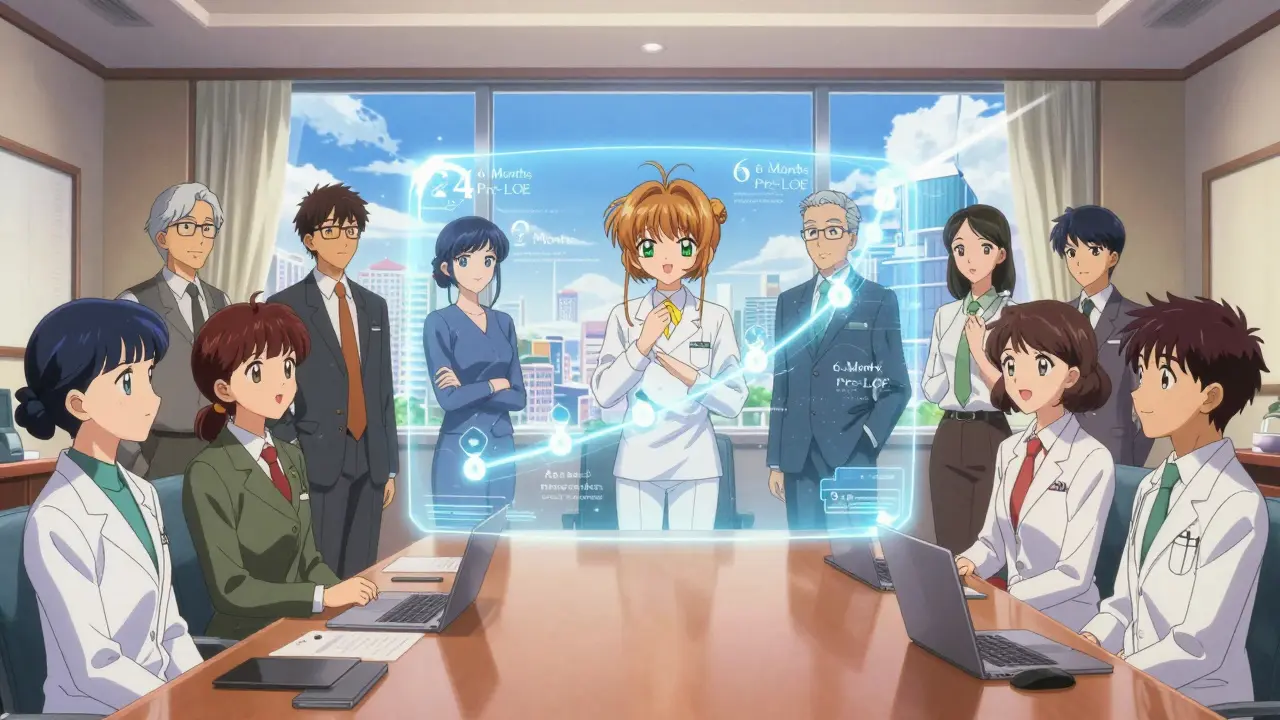
To manage this, systems should implement a structured timeline:
- 24 Months Pre-LOE: Form a task force with pharmacy, finance, and medical leads.
- 18 Months Pre-LOE: Analyze the generic pipeline. Is there only one competitor or ten? This affects how much leverage you have in pricing.
- 12 Months Pre-LOE: Finalize formulary positioning. Decide which version of the drug will be the "preferred" choice.
- 9 Months Pre-LOE: Update clinical guidelines so doctors know exactly how to handle the substitution.
- 6 Months Pre-LOE: Roll out patient education materials to prevent panic or confusion.
Navigating the Complexity of Biosimilars
It's a common mistake to treat all patent expirations the same. Biosimilars are biologic medications that are highly similar to an already approved reference biologic, but not exact copies . Because biologics are grown in living cells rather than mixed in a lab, they are far more complex to manufacture.
The "biologic cliff" is different from the generic cliff. For instance, oncology biosimilars have seen a 45% market share within a year, but autoimmune disease biosimilars are much slower, hovering around 18%. This is often due to the complexity of delivery mechanisms (like injectable pens) and a higher level of physician caution. If you are a provider, you can't expect a 90% conversion rate like you would with a heart medication; you need a slower, more patient-centric transition plan.
Dealing with Industry "Tactic" Hurdles
You might notice that just as a drug is about to expire, the manufacturer releases a "New and Improved" version. This is often a strategic move called "product hopping." They might launch an extended-release version or a slightly different isomer to move patients to a new patent-protected product before the old one becomes generic.
Another hurdle is the Supplementary Protection Certificate (SPC) a mechanism in international markets that can extend pharmaceutical protection for up to 5 years beyond the original patent date . If you're tracking dates, you have to check if an SPC has been granted, or your "expiry date" might actually be five years further away than you think.
Fortunately, regulatory bodies are fighting back. The FTC has reported a 35% drop in "pay-for-delay" schemes-where brand companies pay generic companies to stay off the market-thanks to tighter enforcement and new legislation like the CREATES Act. This means the gap between patent expiry and actual price drops is slowly shrinking.
Why doesn't the price of my medication drop immediately when the patent expires?
Several factors can cause a delay. First, some companies use "patent thickets" to extend exclusivity through secondary patents. Second, the transition depends on how many generic manufacturers enter the market; if only one or two enter, prices don't drop as sharply. Third, insurance companies and Pharmacy Benefit Managers (PBMs) have rebate contracts that may keep the brand-name drug as the "preferred" option for a while, even if a cheaper generic exists.
Is a generic drug as effective as the brand-name version?
Yes, for the vast majority of patients. Generics must prove they are bioequivalent, meaning they deliver the same active ingredient to the bloodstream at the same rate. However, they can use different inactive ingredients (binders, dyes, fillers). For most people, this makes no difference, but a small percentage of patients may be sensitive to these additives, which is why monitoring your reaction during a switch is important.
What is the difference between a generic and a biosimilar?
Generics are exact chemical copies of small-molecule drugs. Biosimilars are versions of large, complex proteins (biologics). Because biologics are made from living organisms, they cannot be copied exactly. A biosimilar is "highly similar" and provides the same clinical result, but it isn't an identical mirror image. This makes the approval process and the patient transition more complex than with traditional generics.
How can a hospital save money during a patent cliff?
The biggest savings come from proactive planning. Systems that start 24 months before expiry can achieve up to 25-30% more savings than those who react. This involves creating a cross-functional task force to monitor the pipeline, updating clinical substitution protocols 9 months in advance, and using AI-powered forecasting tools to predict the exact date and price drop of the generic entry.
What should I do if my insurance forces a switch to a generic I can't tolerate?
Your doctor can file a "medical necessity" or "formulary exception" request. They must provide evidence that the generic version caused an adverse reaction or failed to provide the same therapeutic benefit. Most insurance plans have a process to override the generic requirement if a physician can prove that the brand-name version is clinically required for that specific patient.
Next Steps and Troubleshooting
For the Individual Patient: Start a medication log. Note the brand, the dosage, and the current price. If you notice a change in your copay or the packaging of your drug, ask your pharmacist if the drug has reached its Loss of Exclusivity. If you experience new side effects after a switch, contact your provider immediately to discuss an exception request.
For the Healthcare Administrator: Audit your current formulary against known 2026-2028 expiry lists. If you don't have a dedicated LOE (Loss of Exclusivity) committee, form one now. Prioritize high-spend areas like immunology and oncology, where the "cliffs" are steepest and the transitions are the most technically challenging.
David Snyder
April 15, 2026 AT 10:35It is really heartening to see a guide that empowers patients to take control of their healthcare costs. A lot of people feel helpless when prices spike, but having a plan for when generics hit the market can make a world of difference in someone's quality of life.
Sam Dyer
April 16, 2026 AT 03:53Typical corporate shell game! 🙄 These pharma vultures just keep moving the goalposts with their "patent thickets" to bleed us dry. It is a total circus and only the most aggressive American innovators are going to survive this madness. Get your facts straight or get out of the way! 🇺🇸
Catherine Mailum
April 16, 2026 AT 12:51oh sure because the insurance companies totally care about our well-being while they play musical chairs with our formularies... just lovely
Kenzie Evans
April 18, 2026 AT 00:35The part about bioequivalence is basically a joke. Most people don't even realize that "within 80-125%" is a massive window for a drug that's supposed to be precise. I've seen people crash and burn switching to generics while the doctors just shrug their shoulders because the paperwork says it's "equivalent." Totally incompetent.
Mark Dueben
April 19, 2026 AT 04:42It might be helpful for us to remember that not everyone has the same level of health literacy to navigate these complex systems. We should try to support those who might struggle with the technical language of LOE or ANDA processes so no one gets left behind in the transition.
Randy Ryder
April 21, 2026 AT 03:39The pharmacokinetic variance in biosimilars is the real crux of the issue here. When you're dealing with tertiary protein structures and post-translational modifications, you can't just apply a standard linear generic model. The immunogenicity profile can shift drastically, leading to neutralizing antibodies that render the therapeutic useless. We need a more robust pharmacovigilance framework to track these nuances in real-time across the population.
Mary Johnson
April 21, 2026 AT 20:35Wake up people! The "patent cliff" is just a cover for the big labs to switch us over to synthetic versions they can control more easily. Why do you think they're suddenly pushing these biosimilars? It's not about cost, it's about data collection on how our bodies react to these modified proteins. They're playing God with our bloodstreams and calling it "healthcare savings." It's all a lie to keep the profit margins high while they experiment on us!
Brooke Mowat
April 22, 2026 AT 05:38Life is such a wild ride isn't it? One day you're payin a arm and a leg for a tiny pill and the next it's cheap as chips because some lawyer found a loop hole. We just gotta ride the wave and keep our spirits high!! Let's turn this chaos into a win for the little guy, just gotta be smarte than the system!
Milo Tolley
April 23, 2026 AT 20:18The volatility of the PBM rebate structures is absolutely catastrophic!!! We are seeing a complete misalignment of incentives where the "preferred" status is bought and paid for by the brand-name manufacturer regardless of the clinical utility of the generic alternative!!! It is a systemic failure of the highest order!!!
Princess Busaco
April 24, 2026 AT 08:05I find it absolutely precious that people think a simple "medication log" is going to save them from the crushing weight of a healthcare system designed to fail us, because let's be honest, the average patient is far too complacent to actually track their copays for six months, and frankly, most doctors are too overworked or disinterested to even know when a patent is expiring, meaning this entire "guide" is just a whimsical fantasy for those who believe a bit of organization can overcome institutional greed.
Billy Wood
April 25, 2026 AT 04:44GET READY!! PLAN NOW!! BE PROACTIVE!!
Olivia Lo
April 25, 2026 AT 09:47From a global perspective, the reliance on the Hatch-Waxman framework often overshadows the nuances of the Supplementary Protection Certificate in the EU. There is a delicate balance between fostering innovation through temporary monopolies and ensuring the distributive justice of affordable medicine. While the transition to biosimilars is technically demanding, the overarching goal should remain the harmonization of quality standards to mitigate the risk of adverse reactions during substitution.
Tabatha Pugh
April 26, 2026 AT 08:29Actually, if you look at the ANDA process, it's not just about the date. Many people forget that the 180-day exclusivity period for the first generic filer can keep prices high even after the main patent expires. It's a detail most "guides" ignore because they want to simplify things too much.
Rim Linda
April 27, 2026 AT 18:38Omg the thought of my meds suddenly changing colors or shapes just gives me such anxiety 😱 like how am I supposed to trust a pill that looks different?? 😭